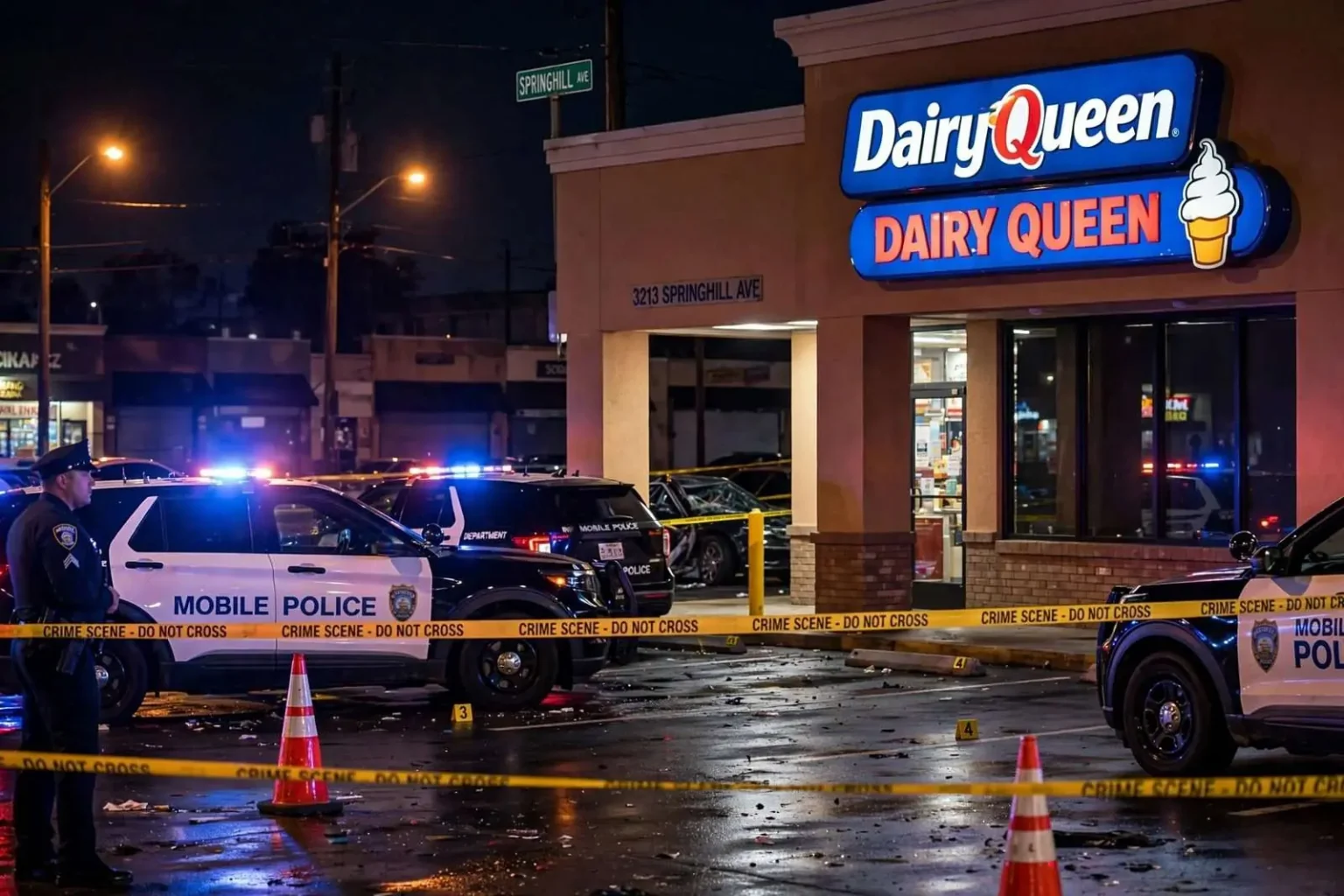
The Mobile Police Department is investigating an early-morning shooting that left two people injured outside a Dairy Queen on Springhill Avenue, according to authorities. The incident, which sent one victim from a nearby nightclub and another from the restaurant’s parking lot to the hospital, marked the kind of overnight violence that investigators in mid-sized cities treat as a priority precisely because of how easily it can escalate from an argument into gunfire that reaches people who were never part of it.
Officers responded to a report of shots fired at around 2:45 a.m. Wednesday at the restaurant, located at 3213 Springhill Avenue. The address sits along a stretch of Springhill Avenue that carries traffic between midtown neighborhoods and the city’s older commercial corridors, lined after dark with the kind of businesses that keep late hours — restaurants, convenience stores and the nightlife spots whose closing times push crowds onto the street in the hours when few witnesses and fewer patrol cars are around.
Investigators say a woman was struck by gunfire while leaving a nearby club, and a man was also struck while in the Dairy Queen parking lot. Both victims made their way to the hospital in a personal vehicle rather than waiting for emergency transport, and police said their injuries were not considered life-threatening. The decision to self-transport — common when victims or their friends panic or when the distance to a hospital is short — can complicate an investigation, because it separates the wounded from the scene where evidence, shell casings and witnesses are still being gathered.
Police also confirmed that an unoccupied vehicle in the area was struck by gunfire during the incident, adding to the evidence investigators are working through as the case continues. A shot-up car with no one inside is a valuable artifact for detectives: the trajectory of bullets through door panels and glass can help establish where shooters stood, how many weapons were involved and in what direction the gunfire traveled across the parking lot and street.
What investigators are working to establish
The Mobile Police Department said the investigation remains ongoing and did not immediately identify a suspect or a motive. Detectives handling overnight shooting scenes typically spend the first days reconciling three things that rarely match up at first: what witnesses remember, what the physical evidence shows and what nearby surveillance cameras recorded. In a corridor like Springhill Avenue, with its mix of late-night businesses, the camera coverage can come from several directions — restaurant security systems, club cameras trained on their own parking areas and residential doorbell devices on surrounding streets.
The two victims’ separate locations complicate the reconstruction. A woman leaving a nearby club and a man standing in the Dairy Queen parking lot were, by the accounts police provided, not part of the same immediate moment — which suggests gunfire traveled across a wider area than a single, contained confrontation. Investigators have not detailed the exact sequence of events, and that gap between what is known and what can be proven is where early-morning shooting cases often stall: few witnesses want to talk, and those who were present scatter before the first patrol car arrives.
Springhill Avenue is a heavily traveled corridor lined with restaurants, retail businesses and nightlife spots, and the presence of a nearby club at the time of the shooting suggests the incident may be connected to activity spilling out from that establishment in the overnight hours. That pattern — crowds emptied onto commercial corridors at closing time, alcohol in the mix, disputes that began inside carried into parking lots — is one police departments in mid-size cities across the country have grappled with as late-night altercations sometimes escalate into gunfire in nearby parking lots.
The overnight pattern behind the case
Violence in the 2 a.m. to 4 a.m. window occupies a specific place in urban policing. The bars and clubs have closed, the streets are largely empty of neutral witnesses, and the people still out — leaving late shifts, lingering after closing time or gathering in parking lots to talk — are few enough that any dispute has space to escalate without intervention. Departments across the country respond with late-night patrol concentrations, off-duty officer contracts with the venues themselves and lighting and camera improvements in the corridors where the pattern repeats.
For businesses along the corridor, the dynamics are an unwelcome but familiar backdrop. Late-night food establishments draw exactly the crowd that nightlife spills out — people looking for something to eat before heading home — and their parking lots become the informal gathering points where the night’s tensions either dissolve or turn physical. A restaurant like the Dairy Queen at 3213 Springhill Avenue becomes, through no decision of its own, part of the geography of an incident that began elsewhere, and its cameras and its staff become part of the investigation.
That two victims from what appear to be separate immediate locations — one leaving a club, another in a fast food parking lot — were both struck suggests gunfire traveled across a wider area than a single, contained confrontation, though police have not detailed the exact sequence of events. Cases with that shape — multiple victims, multiple scenes, no suspect in custody — tend to require the full toolkit: ballistic analysis of the shell casings, bullet-path work on the struck vehicle, hours of camera review and canvassing that continues days after the streets have emptied.
What police ask from the public
Anyone with information about the shooting is encouraged to contact the Mobile Police Department as the investigation continues. In overnight shooting cases, the tips that move an investigation forward usually come from people who were nearby — in the club line, in the parking lot, driving past on Springhill Avenue — and saw a moment they may not have realized mattered: a group walking to a car, an argument that stopped short of violence, a vehicle leaving quickly with its headlights off.
Departments like Mobile’s rely on that cooperation because the alternative is an unsolved case among many. Witnesses who hesitate often do so out of fear of retaliation, which is why tip channels — including anonymous options — exist and why investigators publicly stress that even partial information can be combined with camera footage and physical evidence to identify a shooter. The wounded woman and man survived, which keeps this case an aggravated assault investigation rather than a homicide, but the window for gathering usable evidence narrows with every day that passes.
No further details, including the extent of the injuries or whether charges have been filed, were available at the time of this report. What is known places the incident squarely in the pattern that residents along Springhill Avenue know too well: late hours, a crowded commercial strip, gunfire that reaches further than whoever pulled the trigger intended, and an investigation that now depends on the witnesses who saw the night unfold and are willing to say what they know.
How overnight shooting investigations unfold
In the hours after a shooting like this one, the work is fast and procedural. Patrol officers secure the scene and render aid; crime-scene technicians walk the lot and the adjacent roadway looking for casings, bullet fragments and damage patterns; detectives begin the witness canvass while memories are fresh and the bars and clubs nearby still have staff on duty who saw the crowd at closing time. The struck but unoccupied vehicle gets documented carefully, because its wounds can speak for the shooter even when no witness will.
The days that follow shift the work indoors. Detectives pull camera footage from every angle available, request hospital records through the proper channels, and trace the casings’ ballistic signatures against the department’s knowledge of weapons recovered in prior cases. They interview the victims once their conditions allow, which in self-transport cases can take longer than usual, since hospital staff, not police, control access to the patients. Every step runs on a clock that is racing the memories, the footage overwrite cycles and the willingness of reluctant witnesses to talk.
Charging decisions, when they come, depend on which of those threads hold together. A suspect identified by name in a tip still needs corroboration — a camera image, a ballistics match, a witness willing to testify — and prosecutors will weigh whether the evidence supports the charges that fit the facts: assault counts for the wounded victims, criminal mischief for the struck vehicle, or enhancements if a weapon was fired into a crowd. Until then, the department’s public posture stays where it began: investigation ongoing, no suspect named, no motive stated.
The corridor’s residents and the cost of gunfire
For the neighborhoods along Springhill Avenue, incidents like this one carry costs that outlast the police tape. Residents hear the shots and the sirens, businesses absorb the reputation damage that follows a shooting on their block, and the corridor’s mix of family restaurants, storefronts and nightlife venues absorbs another data point in the ongoing conversation about safety after dark. Community groups in midtown Mobile have repeatedly pushed for more late-night presence, better lighting and stronger relationships between venues and the police — the ingredients that most often interrupt the escalation from argument to gunfire.
The two victims’ survival is the one unambiguously good outcome available in a case like this. Both were reported in non-life-threatening condition, and both will carry the incident with them — along with the friends who drove them to the hospital and the dozens of people who were in the parking lot or the club line when the shots rang out. Their willingness to speak with detectives, and the willingness of anyone else who saw something, will largely determine whether the case produces an arrest or joins the year’s list of late-night shootings that ended with shell casings in a parking lot and no one held accountable.
Anyone with information is asked to contact the Mobile Police Department. Investigators have not announced a timeline for charges, and the department has not said whether the gunfire came from one shooter or several — details that may never become public if the case goes unsolved, but that the evidence gathered on Springhill Avenue in the coming weeks may still answer.