USS Jackson Heads Down the Mobile River for Builder’s Sea Trial
The future USS Jackson, the first littoral combat ship built by Austal as prime contractor, made its way down the Mobile River for sea trials.
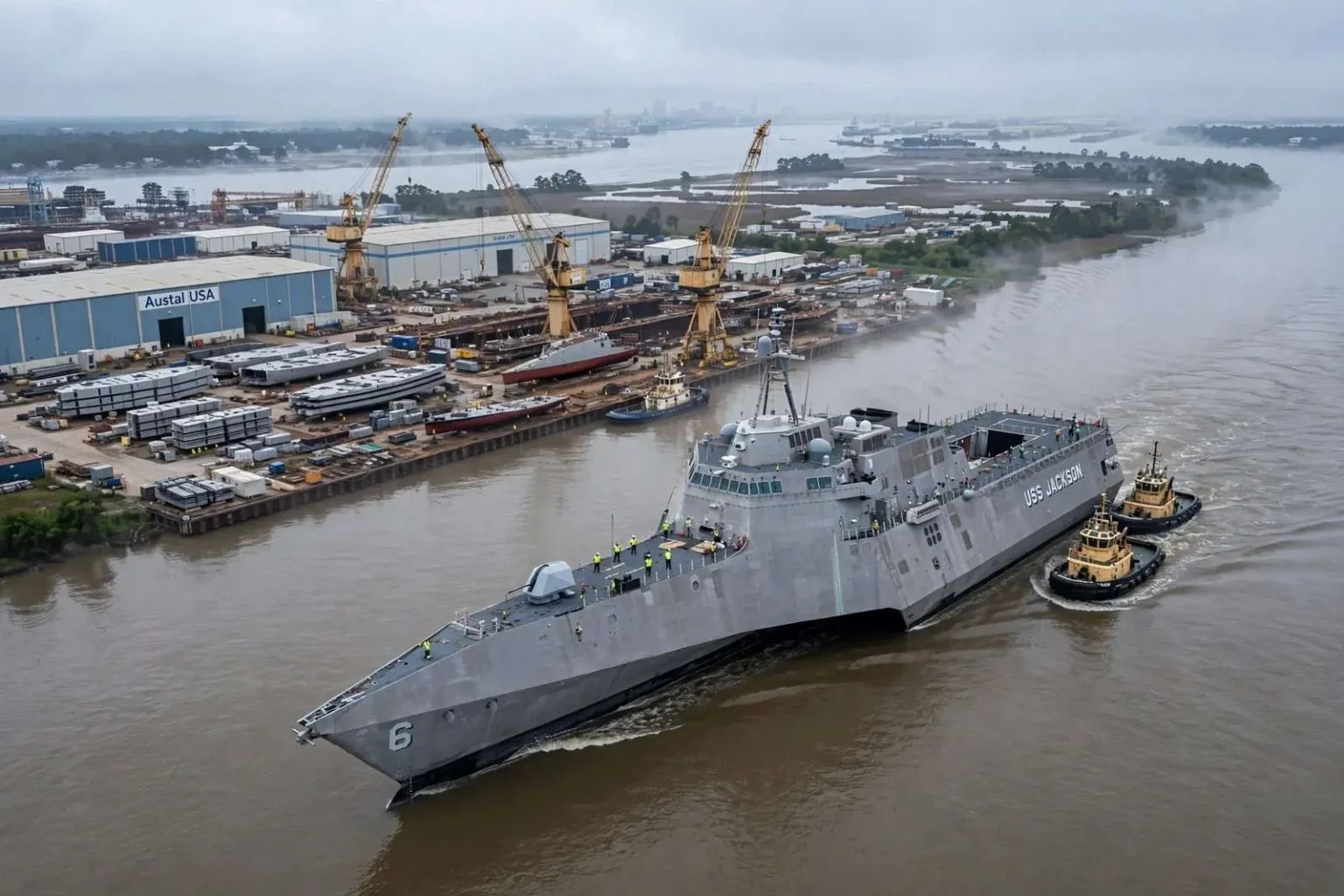
The future USS Jackson made its way down the Mobile River on a recent Tuesday morning for a builder’s sea trial, a milestone step in the ship’s path toward delivery to the U.S. Navy. The Jackson, designated LCS 6, is the third vessel in the Independence-variant class of littoral combat ships and holds a notable distinction: it is the first LCS built with Austal USA serving as the prime contractor, rather than as a subcontractor on the program.
The ship was scheduled for delivery to the Navy later in the summer.
The vessel is part of Austal’s broader $3.5 billion, ten-ship block-buy contract with the Navy to build Independence-class littoral combat ships at its Mobile shipyard, a program that has become one of the region’s most significant defense and manufacturing commitments. Around the same time the Jackson was undergoing its builder’s trial, the future USS Montgomery was also moving toward acceptance trials at the same shipyard, part of a steady pipeline of vessels moving through various stages of construction along the Mobile riverfront.
What a Builder’s Sea Trial Tests
Builder’s sea trials mark one of the final major checkpoints before a ship is formally accepted by the Navy, allowing the shipbuilder to test propulsion, navigation and other core systems on the water before the vessel undergoes acceptance trials and is ultimately delivered to the fleet.
The trials are exhaustive by design. Over several days, the ship’s crew and the builder’s engineers push the vessel through its paces — full-power runs to measure speed and handling, maneuvering tests, anchor evolutions, damage-control drills and checks of the combat and communications systems. Everything that cannot be verified at the pier gets verified offshore, and any deficiencies discovered are logged for correction before the Navy’s own inspectors arrive.
The Independence variant’s performance depends on an unusual propulsion arrangement that the trials are built to stress. The trimaran-hulled ships run on gas turbines and diesel engines driving waterjets rather than propellers, a combination that gives the class its high top speed and its shallow-water agility — qualities the Navy wanted for near-shore operations. Proving those systems work together at sea is the heart of a builder’s trial.
For Austal, the trial also serves as proof of its own evolution. The Jackson is the first littoral combat ship the company has delivered to the Navy as prime contractor, a role it inherited from the original industry team after establishing itself on the program as a subcontractor. The designation carries financial and reputational weight: the prime contractor answers for the ship, the schedule and the contract.
From Modules on the Pier to Open Water
For a ship built at Austal’s Mobile facility, the short trip down the Mobile River to open water represents the culmination of years of module construction and assembly work carried out largely by the shipyard’s South Alabama workforce. Independence-class ships begin as aluminum modules fabricated in the yard’s riverfront buildings, joined block by block on an assembly way before the hull takes shape and the ship is launched to an outfitting pier.
The journey itself is brief — down the river, past the port terminals, into Mobile Bay and out toward the Gulf — but it is the first time the ship sails as a vessel rather than a construction project. Watching a finished warship move under its own power past the same docks where its modules were welded together has become a familiar ritual on the Mobile waterfront, one that draws shipyard families and boat traffic to the banks.
The Jackson’s name connects it to the Gulf Coast’s neighbor to the east, but its building story is entirely Mobile’s. Each of the Independence-class ships takes shape through the work of welders, pipefitters, electricians and outfitters whose trades have grown up around the program, and the sea trial is the moment their work leaves the yard for the first time.
The Pipeline Behind the Program
The littoral combat ship program has been a major economic driver for the Mobile area, supporting thousands of jobs at Austal’s shipyard as the company works through its multi-ship Navy contract. Each ship that reaches the sea trial stage represents another step toward completing that pipeline, with several additional Independence-class vessels in various stages of construction at the yard at the time of the Jackson’s trial.
That pipeline is the program’s defining feature. Rather than building ships one at a time, the block-buy contract funds a fleet’s worth of vessels on a rolling schedule, with modules for one ship being fabricated while another is assembled, a third is outfitted and a fourth runs its trials. The steady rhythm smooths employment across the yard and gives suppliers — aluminum fabricators, propulsion specialists, electronics integrators — a predictable workload stretching years into the future.
The Montgomery’s movement toward acceptance trials at the same time illustrates the point. Two ships at adjacent stages of the same process mean the yard’s test teams, Navy oversight personnel and supplier networks are all running in parallel, and the bay plays host to both vessels’ sea-going milestones within weeks of each other.
Acceptance trials, which follow builder’s trials, put the Navy in the examining seat. Navy inspectors re-run the tests, evaluate the corrections made since the builder’s trial and, if the ship measures up, recommend acceptance. Delivery follows, and the ship enters the fleet’s commissioning pipeline — often with a commissioning ceremony in or near its future homeport.
The Shipyard That Changed Mobile’s Waterfront
Austal’s rise on the Mobile River is among the more consequential industrial stories of the Gulf Coast’s recent decades. The company established its U.S. beachhead on the riverfront in the mid-2000s, won a place in the littoral combat ship competition and grew from a single assembly line into a prime contractor with a vast fabrication complex on what was once a working shipyard site of an earlier era.
The yard’s aluminum fabrication capability is unusual among American shipbuilders, and it is the foundation of the Independence class: the trimaran design’s high speed and light weight depend on aluminum hulls and superstructures that few yards in the country are equipped to produce at scale. Mobile’s workforce learned those techniques on the program, and the skills base has kept the yard competitive for follow-on Navy work.
The program’s economic reach extends past the yard gates. Shipbuilding wages circulate through the region’s housing markets, schools and service economy, and the specialized trades the program has trained — welders certified for aluminum, systems technicians, marine electricians — now anchor a skilled-labor pool that Mobile’s broader maritime sector draws on.
For the Navy, the block-buy strategy was meant to capture efficiencies that one-at-a-time purchasing could not, stabilizing costs across ten ships and giving the fleet a dependable production line for the fast, shallow-draft vessels it designed for near-shore missions. For Mobile, each ship that sails past the port on its way to the Gulf is the visible dividend of that arrangement.
The Jackson’s summer delivery will close one chapter and open another: the ship trades the yard’s cranes for the fleet’s schedules, while back on the river, the next hulls in the pipeline continue the work that brought it there.
A Tuesday Morning Launch Ritual
The sea trial departure follows a choreography the Mobile riverfront has come to know well. Tugs ease the ship off its outfitting pier in the gray of early morning, the crew mans its stations, and the vessel works its way downstream past the cranes, terminals and dry docks that line the working river. By the time most of the city is awake, the warship has cleared the harbor channels and pointed toward open water in the Gulf.
For the shipyard workers who built it, the departure is a moment of accounting. Every module, every welded seam and routed cable run now has to perform in salt water under load — and the trial schedule exists precisely to find anything that does not. Engineers ride aboard with test procedures, dataloggers and the authority to halt evolutions that go wrong, and the findings they carry back to the yard become the punch list that stands between the ship and Navy acceptance.
The design burden the trials must validate is considerable. Independence-class ships were conceived for littoral missions — anti-submarine warfare, surface engagements, mine countermeasures — with swap-out mission packages that change the ship’s role between deployments. The hull form, with its trimaran stability, was chosen to give the class a wide flight deck and flexible internal volume, and the propulsion plant gives it speed that most warships of its size cannot match. None of that engineering matters until it is proven underway, which is what makes the builder’s trial the yard’s most consequential week.
What Comes After Delivery
Delivery to the Navy later in the summer would make the Jackson the newest member of a class that has drawn both praise and criticism through its development. The program’s early years included cost overruns and design debates, but the Independence variant’s supporters point to its speed, volume and mission flexibility as assets the fleet has come to rely on — and the Navy’s continued investment in a ten-ship block buy signaled its commitment to the design.
Once delivered, the ship passes into the Navy’s custody and heads toward crew training, mission package integration and eventually commissioning. The homeporting of Independence-class ships on the West Coast has meant that vessels born on the Mobile River routinely transit the globe’s longest ship canal route to reach their Pacific bases, a voyage that begins with the short hop down the bay that the Jackson just completed.
Back in Mobile, the trial calendar continues. The Montgomery’s acceptance trials and the vessels under construction behind it keep the yard’s rhythm running — fabrication, assembly, outfitting, trial, delivery — and each completed cycle adds to a workforce pipeline that has made Mobile one of the premier shipbuilding cities in the United States.
The Tuesday the Jackson sailed was, in that sense, both an ending and a middle. One ship crossed the threshold from construction to fleet service, and the program that built it turned back to the hulls still on the ways, working through the same sequence that will send them down the river in their turn.