Mobile’s L’Arche Community Celebrates 50 Years at D.C. Jubilee
Members of L'Arche Mobile traveled to Washington, D.C., to mark 50 years of the disability-support community first founded near Paris in 1964.
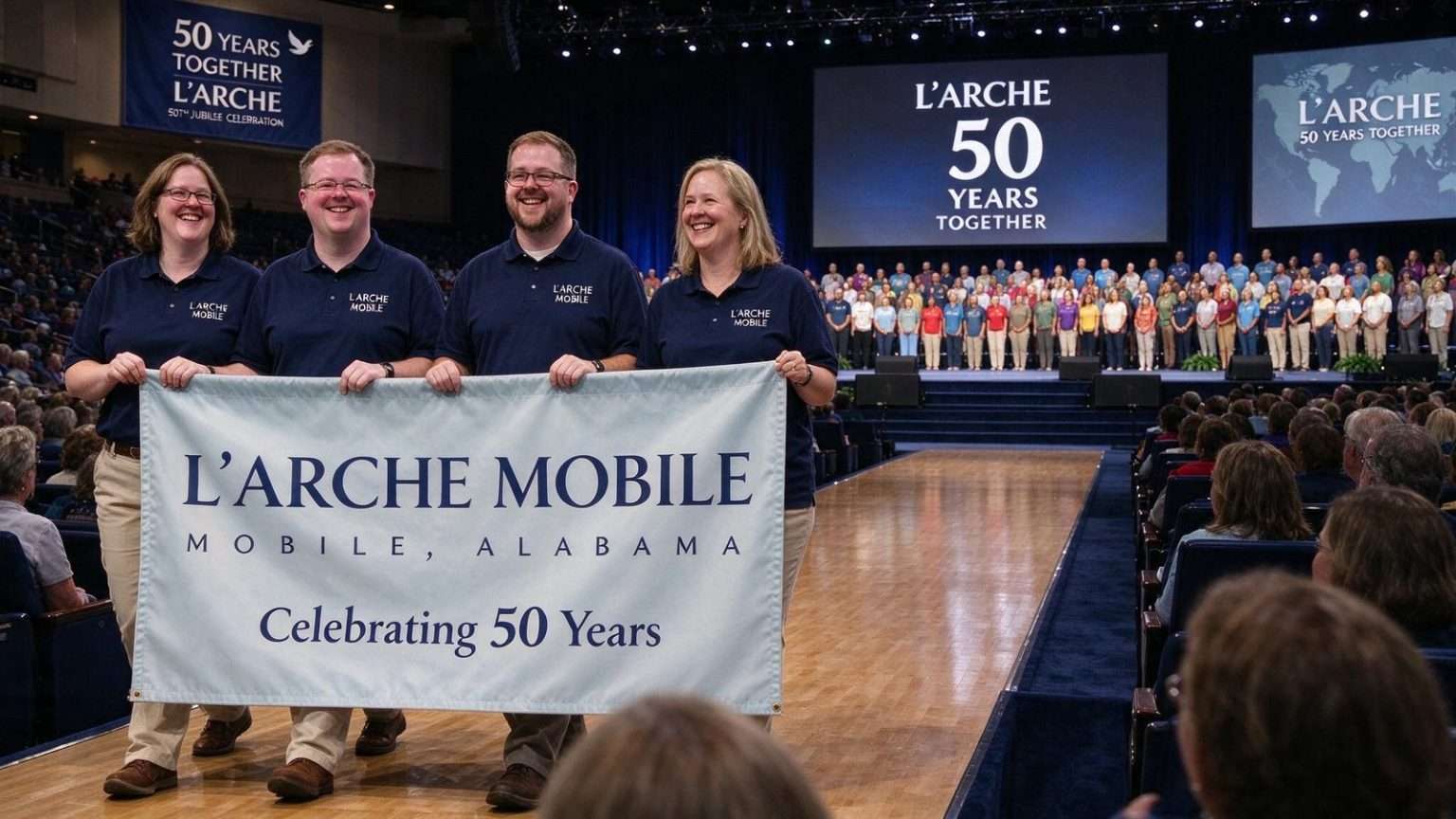
Members of L’Arche Mobile joined hundreds of others in Washington, D.C., in late May to celebrate 50 years of a worldwide movement built around shared living for people with intellectual disabilities. The anniversary gathering brought together communities from every continent for a week of ceremonies, worship and celebration — and for the small Mobile community, it was a chance to stand publicly inside a global family most of their neighbors have never heard of.
The organization traces its roots to 1964, when founder Jean Vanier bought a small home north of Paris and began sharing daily life with two men who had been living in an institution. Vanier, a Canadian philosopher and former naval officer who had become disillusioned with institutions and their failures, named the house L’Arche — “the Ark” — and its founding insight was radical in its simplicity: that people with intellectual disabilities do not need to be managed or fixed, but to be welcomed into genuine relationships where they give as much as they receive.
From that beginning, L’Arche grew into a network of roughly 140 member communities spread across 36 countries, each built on the same idea: people with intellectual disabilities living alongside team members as equals, not as residents of a facility. The communities vary enormously in size and setting — from rural villages in France to urban homes in India and Africa — but the shared table, the shared prayer and the shared chores are the constants, and the movement’s language reflects it: those with disabilities are “core members,” the heart of each house, while the assistants who live with them are “team members,” not staff.
Mobile’s delegates in the spotlight
For the Mobile chapter, the anniversary Jubilee carried extra weight because several of its core members were able to attend in person. Steven Mokrzycki and Willie McGhee, both longtime members of the Mobile community, took part in the celebration’s public assemblies, joining delegations from communities around the world in a series of gatherings that filled Washington arenas with music, testimony and prayer.
Mokrzycki helped read prayers during a service, while McGhee carried Mobile’s banner in one of the processions — a moment that put the Gulf Coast’s small chapter visibly on display before thousands of fellow members. For communities like Mobile’s, which operates a handful of homes rather than the campuses some international chapters run, the chance to appear on that stage carried a symbolic charge: it affirmed that a community’s size has nothing to do with its place in the movement.
Willie McGhee has been part of the Mobile community for roughly four decades, and organizers said that during the Jubilee they could not find anyone elsewhere in the L’Arche network with a longer tenure. That distinction made McGhee something of a celebrity among the delegates, a living link to the movement’s earliest American years, and his presence at the 50th anniversary was itself a piece of the history being celebrated.
Chris McGugin, who works with L’Arche Mobile, said the milestone became a point of pride during conversations with visitors from other chapters. Delegates compared communities the way families compare branches of a family tree, and Mobile’s claim to the longest-serving core member anywhere in the network traveled quickly through the crowd.
Highlights beyond the ceremonies
Beyond the formal ceremonies, the trip included lighter moments. Mokrzycki said meeting core members from other communities and a visit to the zoo stood out to him, while McGhee pointed to a Friday afternoon of games and activities as a highlight. Both said they enjoyed a dance held on the final evening of the gathering — the kind of unhurried celebration that L’Arche gatherings are known for, where the pace is set by the core members themselves and the line between performers and audience, like the line between caregivers and cared-for, deliberately dissolves.
The Jubilee program blended celebration with the movement’s spiritual identity. L’Arche communities are grounded in faith — rooted in Roman Catholic tradition but deliberately interfaith in membership — and the Washington gatherings wove prayer services and moments of quiet reflection through the public festivities. For many attendees, the week’s emotional center came in testimonies from core members themselves, delivered from stages that few people with disabilities are ever invited to occupy.
An advocacy detour on Capitol Hill
The visit wasn’t purely celebratory. Adrian Anderson, a team member with the Mobile community, said she used part of the trip to speak with staff from Senator Jeff Sessions’ office about the potential impact of benefit cuts on core members like those she works alongside every day. The concern is immediate for L’Arche homes, whose budgets lean heavily on Medicaid and supplemental programs that cover the daily support — meals, medications, transportation, personal care — that shared living requires.
Anderson, who grew up watching her mother work with L’Arche, said the conversations underscored how much day-to-day support depends on programs that can be vulnerable to funding changes. Her advocacy reflected a habit the movement has cultivated as it has matured: core members and those who live with them are increasingly visible in statehouses and congressional offices, arguing in person that disability services are not line items but lifelines.
L’Arche Mobile continues to operate as part of the larger international network, with team members and core members sharing homes and daily routines rather than a traditional caregiver arrangement. Organizers said the Washington trip reinforced the sense of connection between the small Mobile community and a much larger global family marking a half-century of shared life — a family, as McGhee’s record-setting tenure demonstrates, that has been putting down Alabama roots almost as long as L’Arche has existed anywhere.
What shared living looks like day to day
To understand what made the Jubilee meaningful for the Mobile delegation, it helps to understand what L’Arche is when there are no ceremonies. In a L’Arche home, there is no shift change in the traditional sense: the team members who assist core members with meals, bathing, medications and appointments are also the people who eat dinner with them, celebrate their birthdays and argue with them about whose turn it is to wash dishes. The model rejects the professional distance that defines most residential care, betting instead that mutual relationships are themselves therapeutic.
That approach has drawn attention well beyond the disability community. The movement gained international prominence through the writings of Jean Vanier, whose books on weakness, belonging and community became bestsellers translated into dozens of languages, and through Henri Nouwen, the renowned theologian who spent the final decade of his life as a team member in a Toronto L’Arche community and wrote about the experience in some of his most beloved work. Vanier died in 2019, but the communities he founded continue the pattern he set — small, deliberately unglamorous households where the measure of success is belonging.
In Mobile, the community’s homes operate within the daily rhythms of the city: core members hold jobs and volunteer placements, attend day programs and churches, and participate in the same civic life as their neighbors. The Jubilee gave them the experience of being part of something far larger — an organization whose very name, the Ark, evokes a vessel carrying an unlikely assortment of people through the world together.
The policy stakes behind the trip
Anderson’s Capitol Hill conversations pointed to the movement’s practical vulnerability. Federal programs, Medicaid chief among them, fund the bulk of formal disability services in the United States, including the paid support that supplements family and community caregiving. When those programs are restructured or cut, the effects land first on exactly the people L’Arche exists to serve — adults with intellectual disabilities who can live in the community with support but cannot live without it.
Disability advocates spent that same season pressing Congress on precisely those questions, and the L’Arche delegation’s timing put its members in Washington at a moment of live policy debate. That core members themselves made the trip — not just professional advocates — reflects the movement’s conviction that its most persuasive messengers are the people whose lives the programs sustain.
Half a century on, what endures
The 50th anniversary celebrations will continue in communities around the world through the year, but for Mobile the Jubilee served as both a milestone and a recruitment moment. Communities like L’Arche Mobile depend on a steady stream of team members — usually young adults who commit to a year or more of shared living — and the visibility of a global celebration tends to ripple into applications and donations.
For McGhee, Mokrzycki and the Mobile delegation, the week in Washington offered something simpler and harder to quantify: the experience of being celebrated, on a national stage, for exactly who they are. Four decades into a movement that insists every person carries gifts the community needs, that may be the most accurate summary of what L’Arche has built — and why its members crossed the country to celebrate it.