Retired Baldwin County Judge Robert Wilters Launches Bid for District Attorney
Robert Wilters, who stepped down from the Baldwin County bench in June, is now running for district attorney and says the office needs new leadership.
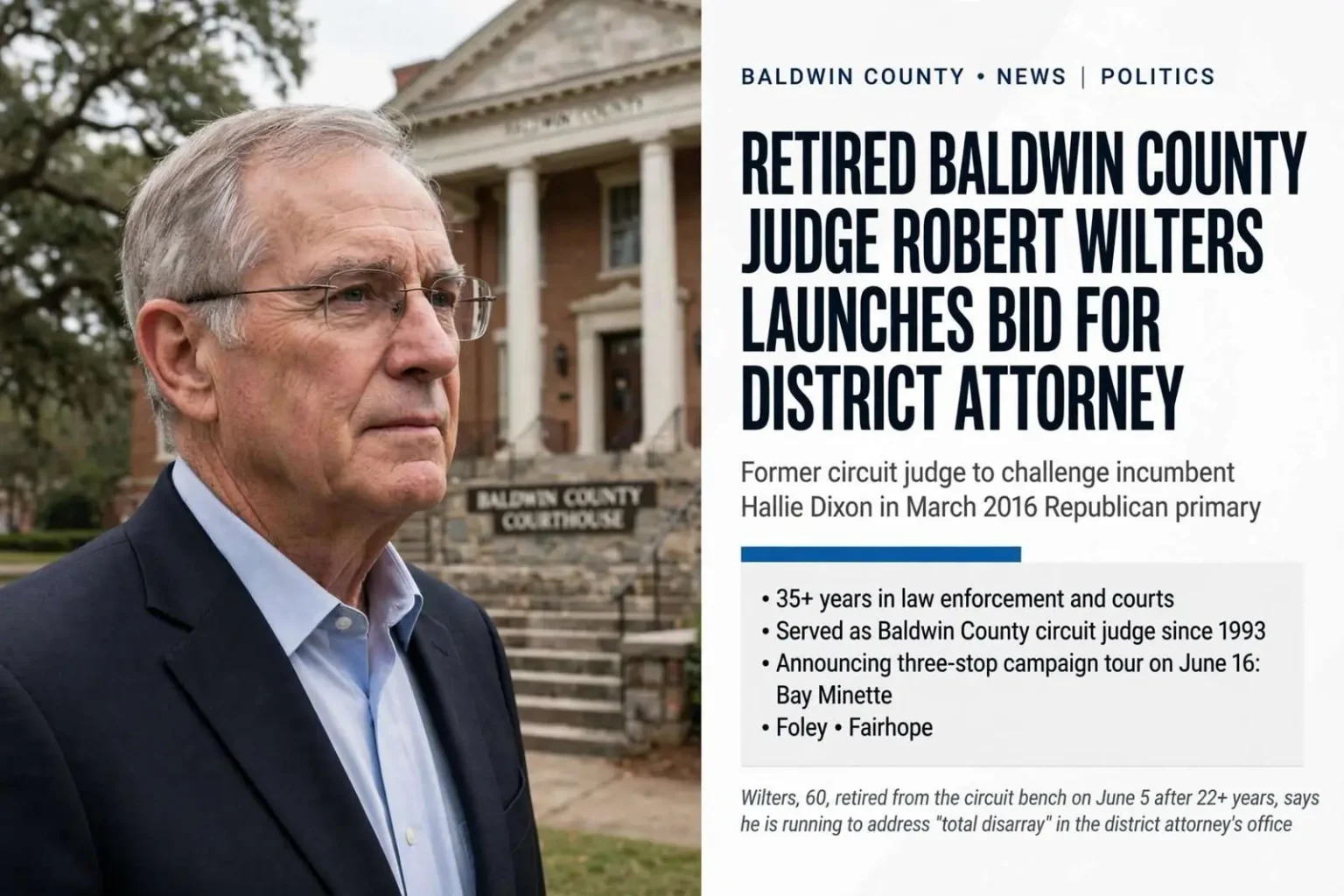
Robert Wilters, who spent more than two decades as a Baldwin County circuit judge before stepping down from the bench in early June, announced this week that he is running for Baldwin County District Attorney, setting up a challenge to incumbent Hallie Dixon. The announcement instantly reshaped the local political calendar, pairing one of the county’s best-known judicial figures against the incumbent prosecutor in a race that will headline the March 2016 Republican primary.
Wilters, 60, is a Bay Minette native with more than 35 years in law enforcement and the courts. Few candidates in Baldwin County can claim a resume that stretches as deeply into the local justice system, and his decision to leave the bench mid-career for an elective prosecutor’s race makes the contest one of the more closely watched contests on the Baldwin County ballot heading into next year’s primary.
A Three-Stop Launch Across the County
Wilters said he plans to make his candidacy official during a three-stop tour of the county on June 16. The itinerary is a study in Baldwin County’s geography: a morning breakfast at Street’s in Bay Minette, the county seat in the northern end of the county; a midday stop at Wolf Bay Lodge in Foley, in the heart of the fast-growing southern corridor; and an evening event at The Venue in Fairhope, along the eastern shore of Mobile Bay.
Stumping in all three population centers on a single day is a deliberate strategy in a county that stretches roughly 40 miles from the Tennessee Street courthouse in Bay Minette to the Gulf-front communities in the south. Baldwin County is Alabama’s largest county by land area, and candidates for countywide office traditionally build their campaigns around appearances in each of its distinct regions, the judicial center in the north, the rapidly expanding U.S. 98 and Alabama 59 corridors in the south, and the Fairhope-Daphne eastern shore, which has become one of the state’s fastest-growing areas.
He will face Dixon, the county’s top prosecutor since 2011, in the Republican primary set for March 1, 2016. Because Baldwin County is overwhelmingly Republican in statewide and local races, the March primary has long functioned as the decisive contest for county office, with the general election in November largely a formality. That dynamic raises the stakes of the primary campaign for both candidates.
Wilters’s Case Against the Current Office
Wilters was blunt about his reasons for entering the race, describing the district attorney’s office under Dixon as being in what he called “total disarray.” He said assistant prosecutors are not receiving adequate training, phone calls from the public are going unreturned, and local law enforcement agencies have lost confidence in the office’s leadership. Each of those criticisms targets the day-to-day machinery of prosecution rather than any single case, a framing that allows him to argue the office needs a management overhaul rather than a change in legal philosophy.
His experience gives those arguments a particular edge. As a circuit judge since January 1993, Wilters spent more than two decades watching prosecutors appear before him in the Baldwin County courthouse, giving him an insider’s vantage point on how the office operates. He said he decided to act rather than simply criticize from the sidelines, a line likely to become the centerpiece of his campaign messaging as the race develops.
He retired from the circuit bench on June 5, closing out a judicial tenure that began more than 22 years earlier. Wilters said launching a drug court in 2007 stood out as the achievement he was proudest of during his time on the bench. Drug courts, which emphasize supervised treatment and accountability over incarceration for eligible offenders, spread across Alabama in the 2000s as a way to break cycles of repeat offending, and Baldwin County’s program has handled hundreds of participants since its launch.
Wilters acknowledged it is unusual for a judge to leave the bench to seek a prosecutor’s job rather than the other way around. The traditional career path in Alabama law runs in the opposite direction: prosecutors use the office as a stepping stone to a judgeship, not the reverse. His move signals, in effect, that he views the district attorney’s office as the place where he can do the most good, an argument his campaign will likely press against an incumbent with far less courtroom experience on the bench.
Dixon’s Rocky Year
Dixon has faced a rocky stretch in office over the past year, and Wilters’s entry gives those troubles renewed political relevance. Among the episodes that drew scrutiny: a federal review of how her office handled certain personnel matters, a municipal citation in Daphne over barking dogs, and an incident in which marijuana-laced brownies turned up in her office.
The brownies incident in particular attracted widespread attention well beyond Baldwin County, becoming the subject of late-night jokes and viral headlines, while the federal review raised more serious questions about management of the office. Together, the episodes handed any prospective challenger a ready-made list of talking points, and Wilters’s “total disarray” characterization shows he intends to use them.
Dixon also drew public attention after turning her adult daughter over to authorities on a theft matter, a move she addressed publicly to push back on speculation about her personal life. At the time, Dixon framed the decision as an act of principle, saying that no one, including her own family, stood above the law. Supporters viewed the episode as evidence of her integrity; critics noted the unusual publicity that surrounded it.
Dixon has said she has never lost a case she has personally prosecuted and maintains that crime victims she has represented in court have been satisfied with the outcomes. That record of personal courtroom success is the foundation of her defense of the office, and her campaign is expected to argue that conviction results, not office gossip, should decide the race. Dixon was not immediately available for comment on Wilters’ announcement.
What the Race Means for Baldwin County
The district attorney’s office is one of the most consequential posts in county government. The elected DA sets charging policy, decides which cases are pursued and which are dismissed, manages a staff of assistant prosecutors across the county’s courts, and serves as the primary liaison with every police department and sheriff’s deputy in Baldwin County. Decisions made in the Bay Minette office ripple through court dockets in Foley, Fairhope, Daphne, Gulf Shores and the county’s other municipalities.
The race will be one of the more closely watched contests on the Baldwin County ballot heading into next year’s primary. For Wilters, the campaign is a chance to extend a public-service career that has spanned law enforcement, the judiciary, and now elective office. For Dixon, it is a referendum on four years in an office that has spent much of the past year under public scrutiny. With more than eight months between the June announcement and the March 1 primary, both candidates will have an extended runway to make their case across the county’s courthouses, civic clubs, and communities.
The race also carries weight for the county’s courts well beyond the courtroom. The district attorney’s office staffs the grand jury that hears felony presentations in Bay Minette, handles appeals from convictions obtained in county circuit court, and coordinates with the Baldwin County Sheriff’s Office and municipal police departments on everything from routine case filings to major violent crimes. When assistant prosecutors turn over frequently or feel unprepared, cases slow down, victims wait longer for resolution, and law enforcement officers spend more hours in court on matters that could be resolved sooner. Those practical consequences are the substance behind Wilters’s complaints about training and communication.
Wilters’s 35 years in law enforcement and the courts span nearly the entire modern history of the Baldwin County justice system. He worked in law enforcement before his judicial career, was elected to the circuit bench in the early 1990s, and presided over the county’s docket through a period of explosive growth, when Baldwin County’s population more than doubled and its court caseloads grew with it. Candidates with that length of institutional memory are rare in local races, and the contrast between a 22-year judge and an incumbent with a single term as prosecutor will be the central storyline of the campaign.
The drug court he founded offers a preview of how he may frame his approach to the DA’s office. Drug courts operate on a simple premise: nonviolent offenders whose crimes are driven by addiction are more effectively handled through supervised treatment, frequent testing, and immediate sanctions than through the standard cycle of incarceration and release. The model has been adopted by courts across Alabama and credited with reducing recidivism among graduates. A prosecutor who champions such programs can argue that a modern district attorney’s office should be about more than winning convictions, it should be about reducing the repeat offending that fills the county’s dockets in the first place.
For her part, Dixon’s claim of never having lost a case she personally prosecuted speaks to her strengths as a trial lawyer, and her campaign will almost certainly emphasize courtroom results and her daily presence in the county’s courtrooms. Incumbent prosecutors typically run on their conviction records, their relationships with victims’ families, and their management of high-profile cases, and Dixon’s team has a full nine months to make that argument to primary voters.
Between now and March 1, the contest will play out in front of the civic clubs, Republican party gatherings, and community forums where Baldwin County candidates have traditionally made their case. With a veteran judge challenging an incumbent prosecutor in Alabama’s second-fastest-growing county, the race is positioned to draw more attention than any other countywide contest on the 2016 ballot.