Volunteer Boaters Keep Up Search Efforts Nearly Two Weeks After Dauphin Island Regatta Tragedy
Nearly two weeks after a deadly storm capsized boats during the Dauphin Island Regatta, volunteer search teams kept scouring local waters for closure.
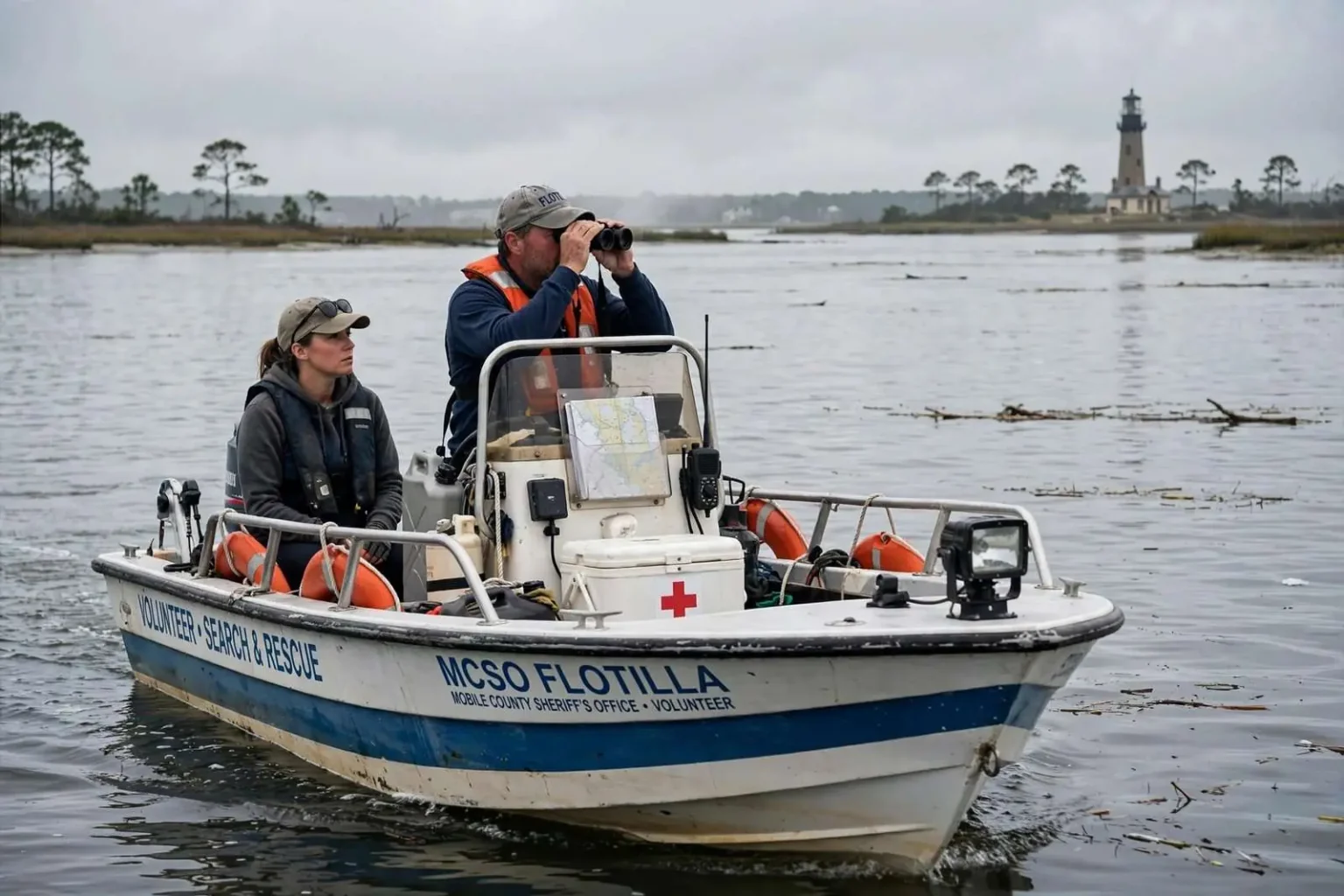
Nearly two weeks after a sudden, violent storm swept over Mobile Bay during the Dauphin Island Regatta, an all-volunteer search and rescue team was still combing local waters, determined to bring closure to the community even as official search operations wound down.
The storm struck without warning in late April, capsizing boats and throwing sailors into the bay during what is normally one of the region’s most popular sailing events. The regatta draws sailors from across the central Gulf Coast for a spring race out to Dauphin Island, the barrier island that guards the mouth of Mobile Bay, and the fleet on the water that day included boats and crews of every description, from veteran racers to family weekend sailors.
What began as a routine race became, in minutes, the worst maritime disaster in recent memory along the Alabama coast. Several participants died in the tragedy, and in the weeks that followed, searchers recovered the bodies of most of those who went missing. Sudden squalls are a known hazard of Gulf sailing, but the speed and violence of this one — catching a scattered fleet under full sail in open water — left little time for crews to drop sails, radio for help or reach shelter.
The volunteers who stayed on the water
As of mid-May, volunteers with the Mobile County Sheriff’s Office Flotilla were still searching for one remaining boater. Two-man teams in small boats scoured the waters around Dauphin Island day after day, a routine that by that point had stretched on for nearly two weeks — launching at dawn, working the channels and shorelines through the heat of the day, and returning to the dock to plan the next morning’s grid.
The Flotilla is a volunteer marine unit that works alongside the sheriff’s office, its members trained in search patterns, boat handling and recovery operations, and equipped with vessels the county could not otherwise keep crewed. In coastal Mobile County, where fishing boats, sailboats and commercial traffic share waters that can turn hostile quickly, the unit fills a gap that no single government agency can cover alone.
Flotilla members said they do not give up a search unless they believe there is genuinely no chance of finding someone, and described the ongoing effort as both a duty and a deeply personal mission for the volunteers involved. Many of them know the regatta community from years of covering races, regattas and fishing tournaments on the bay, and several knew the sailors who never made it home.
The search was not confined to the water. In the days before, Flotilla members had even taken to the air, flying personal aircraft from Dauphin Island out over the waters stretching into Mississippi and Louisiana in hopes of spotting any sign of the missing boater, without success. The flights extended the search across state lines and hundreds of square miles of Gulf and sound waters, looking for debris, capsized hulls or anything else that might narrow the grid for the boat crews below.
How the official response stood down
The Alabama Law Enforcement Agency had led the search and recovery effort in the days immediately following the storm before returning to normal patrol duties, leaving the volunteer Flotilla as one of the only teams still actively searching. That handoff followed the familiar arc of maritime emergencies: a massive multi-agency mobilization at the outset — with marine patrols, rescue boats, helicopters and dive teams converging on the bay — followed by a gradual demobilization as the likelihood of live recoveries faded and routine public safety demands resumed.
The stand-down was not a judgment on the mission but an acknowledgment of its arithmetic. Government search operations are built around survivability windows, and once those pass, the remaining work — locating a missing sailor for the sake of the family — becomes a patient, grinding effort better suited to smaller crews working day after day. On the Alabama coast, that work fell to the volunteers.
Local, state and federal agencies assisted in the initial response, alongside private boaters who joined the search in the first hours, when every extra hull on the water mattered. The outpouring was a measure of how deeply the regatta is woven into the coastal community: marinas, yacht clubs and waterfront businesses that had prepared to welcome the fleet instead became staging points for the response.
The regatta itself is a fixture of the spring sailing calendar, drawing boats from Mobile, Fairhope, New Orleans and the smaller clubs along the Mississippi Sound for a race whose course and after-party have made it as much a social occasion as a competition. That mix — serious racers, casual cruisers, families riding along — is part of what made the storm’s toll cut so widely across the sailing community.
The cost of staying on the water
Flotilla leaders said the emotional toll of the search weighs heavily on both the victims’ families and the volunteers themselves, many of whom have spent years responding to water emergencies around Dauphin Island and Mobile Bay. Recovery work is a different discipline from rescue, and a different burden: the volunteers know from the outset that the outcome they are searching for is closure rather than survival.
The team, which receives only a modest annual stipend from Mobile County to fund its operations, said the cost of maintaining its boats, including one damaged during the search, typically far exceeds what the county provides. Fuel, maintenance, insurance and equipment come largely from the volunteers’ own pockets and from donations, a financial reality that surprises many residents who assume marine rescue is fully budgeted government work.
The damage to one of the Flotilla’s boats during the search added both expense and strain, since the unit had to keep enough vessels operational to sustain daily patrols even while repairing a hull battered during recovery operations. Volunteers kept the missions going regardless, shifting crews and equipment to cover the grid with what remained afloat.
Lessons from a sudden storm
The regatta disaster prompted painful questions along the coast about warnings, race management and the Gulf’s weather. Spring storms on the northern Gulf Coast can build and strike with little lead time, and sailors who raced that day described conditions that transformed from a pleasant breeze to life-threatening seas faster than the forecast suggested. The regatta community has long accepted that the bay and the waters around Dauphin Island demand respect; the April storm proved how narrow the margin can be.
For Dauphin Island itself — a town of a few thousand residents on a barrier island whose economy rises and falls with fishing, tourism and the water — the disaster was deeply personal. Islanders had watched the rescue effort stage from their docks, welcomed the families of the missing, and lived with the search on their horizon for weeks. The volunteer crews working off the island’s boat ramps became part of the town’s daily landscape.
The final recovery, whenever it comes, will bring the regatta community a measure of peace and a chance to mourn together. Sailing clubs along the Gulf Coast have planned memorials and tributes, and the race itself — a tradition that predates the storm by decades — will carry the memory of those lost every time the fleet assembles at the start line.
Why the volunteers keep going
What the Flotilla’s two-week effort demonstrated, above all, is the particular character of the Gulf Coast’s volunteer tradition. From the volunteer fire companies that organized Mobile’s earliest parades to the sea-going rescue units of today, the coast has always relied on neighbors willing to train, equip themselves and answer the call without pay.
The families of the missing have thanked the searchers publicly, and the Flotilla has said it will remain on the water as long as there is a realistic prospect of recovering the last of the regatta’s victims. Every day on the bay is a further expense borne by a handful of volunteers and donors, and every empty grid square is one more answer to the question the families have carried since late April.
When the search finally ends, the unit will return to its ordinary mission — rescuing swimmers and boaters, assisting sheriff’s deputies on the water, and standing ready for the next storm — with one more chapter in the long, costly, unpaid work that keeps the waters of Mobile Bay from being as dangerous as they can suddenly become.
Members of the public who want to help the unit’s work can support it through the channels the sheriff’s office has highlighted, and the Flotilla has noted that the best tribute to the regatta’s victims is the preparedness of every boater who ventures onto the bay: life jackets worn, weather watched and float plans left ashore.