

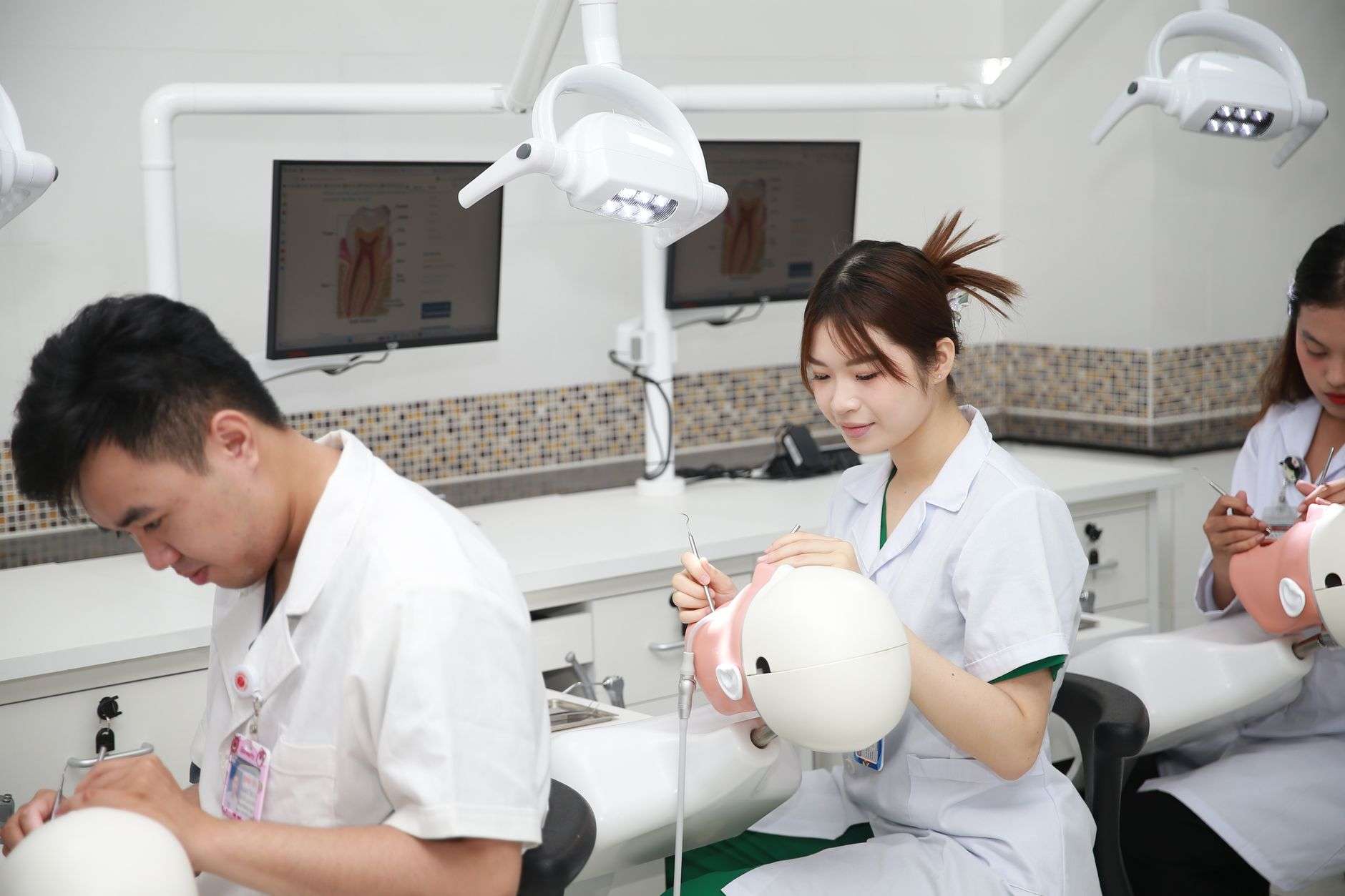
MOBILE, Ala. — The Whiddon College of Medicine Class of 2030 has elected its officers and class representatives, choosing students who describe their goal in terms of class culture rather than class business.
Cindy Nguyen was elected president, with Kylie Blue serving as vice president.
Why Nguyen Ran
“We are going to experience some of the most exciting and challenging years of our lives together,” Nguyen said, “and I wanted to have a role in making those years feel a little more connected, positive and supportive for the people around me.”
Her stated priority is representation within a class of 75 students bringing different experiences and perspectives.
“My biggest priority is making sure every person in our class has a voice, not just those who are most comfortable speaking up,” she said. “Being heard should not depend on being the loudest person in the room.”
That is a more pointed observation than it first appears. Medical school selects heavily for people who perform well in competitive, articulate environments, and the students whose concerns get raised in a class meeting are frequently the ones most comfortable raising them. A class president who names that dynamic has identified a real structural problem rather than a generic one.
Nguyen also pushed back on a framing that medical education sometimes encourages.
“Excellence and kindness are not competing values; I think the best physicians embody both,” she said.
Why Blue Ran
Blue said she sought office to be an approachable advocate for her classmates.
“I wanted to play an active role in building a class environment where we can communicate openly and work together throughout medical school,” she said.
As vice president, Blue plans to focus on strengthening communication between students and faculty, developing intentional avenues for students to provide feedback and ensuring concerns are addressed constructively.
Blue chose Whiddon for its close-knit learning environment and its focus on serving communities throughout Alabama, and valued the opportunity to join a smaller class where she could build relationships with classmates and faculty.
“I’m grateful that my classmates trusted me to represent them,” Blue said. “I’m excited to help make our time at Whiddon as positive and collaborative as possible.”
Why the Community Emphasis
The sense of community is part of why Nguyen chose Whiddon as well.
“There is a genuine sense that people are invested in one another, from faculty who want to see you succeed to students who celebrate and support each other along the way,” she said. “Success here has never felt like something you have to pursue alone.”
Class size is the mechanism behind that. A cohort of 75 is small by medical school standards, and it means faculty know students by name and students know each other across the full class rather than within sections of it.
Making Room for Joy
Nguyen returned to a theme that medical students hear less often than they might.
“There will always be another exam to prepare for or another thing we could be doing, but I don’t want us to become so focused on getting to the next milestone that we forget to appreciate the people and moments that make the journey meaningful,” she said.
Small acts of encouragement, she said, make a difference — celebrating a classmate’s success, offering affirmation before an exam, or reminding someone that they are doing better than they think.
“We have an incredible four years ahead of us,” she said, “and I hope we make the most of them, not only by becoming great physicians, but by becoming the kind of people who bring out the best in those around us.”
A Long Committee List
The full slate reflects how much of a medical school class’s operation is handled by students themselves.
President: Cindy Nguyen
Vice President: Kylie Blue
Secretary: Daniel Norred
Treasurer: Natalie Hadad
SGA Liaison: Grace McDavid
IT Officer: Ikq Dechanuwong
Honor Council: Sara Bridges, Katherine Ennis, Ava Morelli, Caden McGarity
Wellness Council: Robyn Beeman, Hamptom DeMent, Maura Hawkins, Jessie Holsombeck
Merchandise Chairs: Emma Hwang, Zachary Sanders
Community Service Chairs: Arjun Ram, Eryn Stockdale
Social Chairs: Carly Hornby, Hannah Lee, Preston Reed
Intramural Chairs: Savannah Creel, Julian Gilstrap, William Robertson
Assessment and Evaluation: Jaya Evans, Hayden Haddock, Andy Hart, Ava Morelli
Continuous Quality Improvement: Sara Bridges
Organization of Student Representatives: Khadija Malik
What Those Roles Actually Do
Several of the positions carry real institutional weight.
The Honor Council handles matters of academic and professional integrity — a student body’s self-governance over conduct standards that the profession takes seriously.
The Wellness Council addresses student mental health and wellbeing, an area that medical education has come to treat as a structural responsibility rather than an individual one, given well-documented rates of burnout and distress among trainees.
Assessment and Evaluation and Continuous Quality Improvement connect students to curriculum review. Accreditation standards require medical schools to gather and act on student feedback, and these representatives are the formal channel through which that happens.
The Organization of Student Representatives is the national body through which medical students participate in the Association of American Medical Colleges — a role that extends beyond the campus.
Whiddon and Alabama
The Frederick P. Whiddon College of Medicine at the University of South Alabama is one of the state’s medical schools, with an explicit focus on serving communities throughout Alabama.
That mission matters in a state facing significant physician shortages, particularly in rural counties. Where medical students train, and where they form professional relationships, substantially influences where they ultimately practice — which is why a school oriented toward its own state’s communities is a workforce strategy as much as an educational one.
The Class of 2030 will graduate four years from now, into that landscape.