Woman charged with child abuse at Crestview youth crisis center
A Crestview woman was charged with child abuse after an incident captured on video at the Hope House youth crisis center, deputies said.
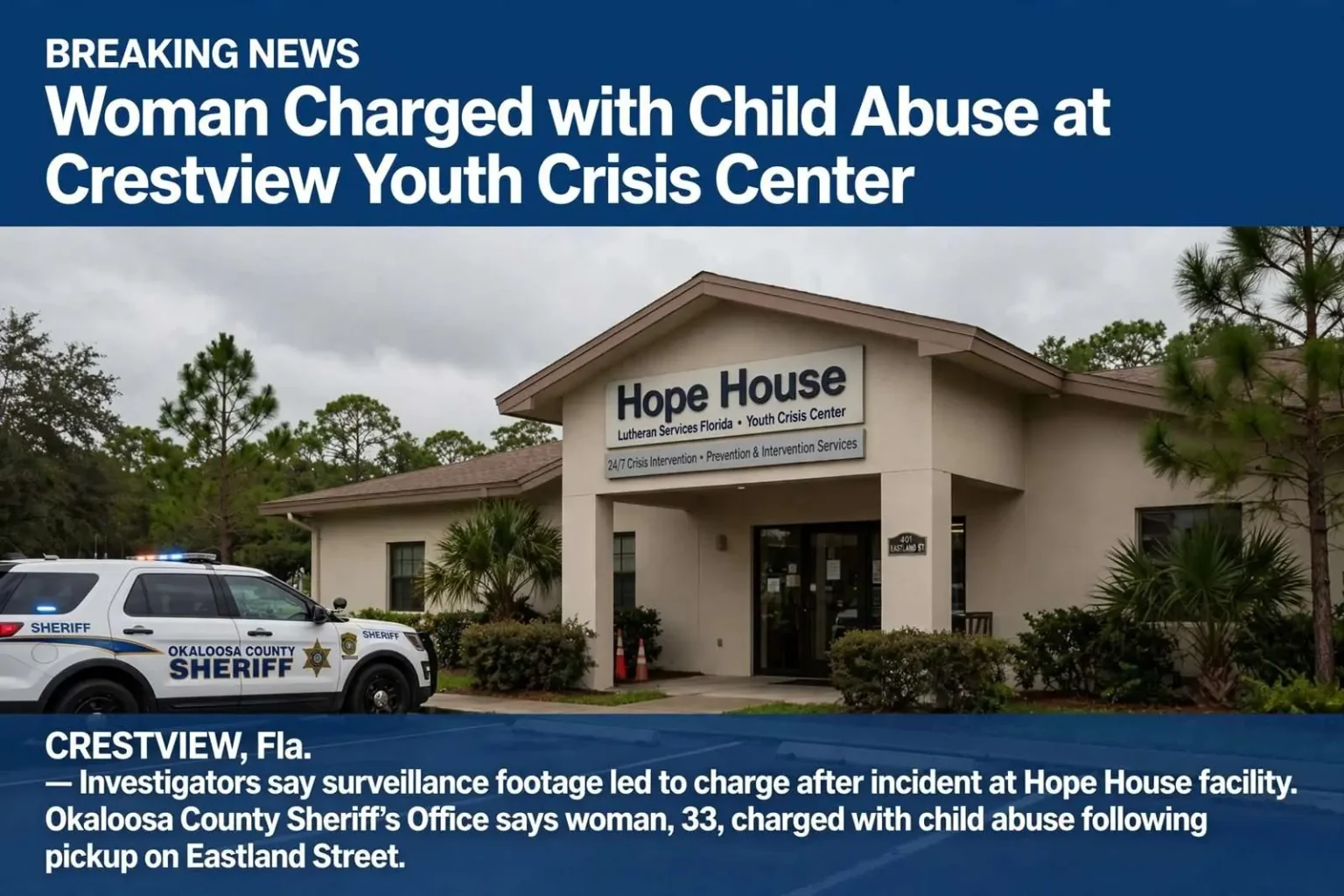
CRESTVIEW, Fla. — A woman has been charged with child abuse after an incident at a youth crisis center in Crestview, according to the Okaloosa County Sheriff’s Office. The charge followed an investigation into what investigators described as physical mistreatment of a child at the facility, captured in part by the center’s own surveillance system. The case unfolded at one of the panhandle’s specialized youth facilities — a place designed precisely for children in crisis — and it has raised familiar questions about oversight, accountability and the treatment of young people navigating the juvenile justice system.
Elyssa Alves, 33, arrived at Hope House on Eastland Street to pick up a boy who had been involved in a battery. The circumstances of the pickup — a child who had himself been involved in an altercation, being retrieved from a crisis facility — illustrate the environment in which the incident occurred. Youth crisis centers like Hope House serve children at moments of acute instability, and the arrival of a guardian to take a child home is a routine part of their operation. According to sheriff’s investigators, what happened during that routine pickup is what turned it into a criminal case.
What the Surveillance Video Showed
Sheriff’s investigators said surveillance video showed Alves putting the child in a headlock, grabbing his hair and forcing his head into the door of the facility. The surveillance system that documented the alleged treatment is standard equipment at youth care facilities, installed both for security and for the protection of the children and staff inside. In this case, investigators said, that same footage became the core evidence supporting the charge — a graphic, time-stamped account of physical contact that investigators could review frame by frame and compare against the accounts of the adults and the child involved.
The boy was later seen with a bruise on his head. The injury, noted after the pickup, gave investigators a physical marker to weigh alongside the video and the statements gathered in the days that followed. In Florida, child abuse charges turn on evidence of intentional physical harm to a child, and the combination of recorded conduct and a visible injury formed the basis for the charge the Sheriff’s Office filed. The boy’s age and the exact nature of his relationship to Alves were not detailed in the public account.
The Interviews
When interviewed, the boy denied Alves had struck him, while Alves acknowledged holding his head but said she was unsure what else happened. The conflicting accounts are a familiar feature of child abuse investigations, where the child’s fear or loyalty, the adult’s self-perception and the objective record often diverge. The child’s denial did not erase the surveillance evidence; nor did the adult’s partial admission settle the question of intent. Investigators weighed all three elements — the video, the injury and the statements — in building the case, and the charge reflects their judgment that the conduct crossed the legal line from discipline or restraint into abuse.
The criminal charge now moves the case into the courts, where it will be adjudicated on the evidence and not on the initial accounts. An arrest and a charge are formal accusations, not findings of guilt, and the presumption of innocence applies to Alves as it does to every defendant. The Okaloosa County court system will determine what the surveillance video and the rest of the evidence support — whether a conviction, a plea, or an acquittal.
What Hope House Does
Hope House, run by Lutheran Services Florida, helps adolescents stay out of the juvenile justice system through prevention and intervention programs. The facility is part of a statewide network of youth crisis services that Florida built over decades to give troubled teenagers an alternative to jail cells and courtroom dockets. Its mission — keeping kids out of the system entirely — is the working philosophy behind Florida’s network of children’s crisis services: intervene early, de-escalate conflicts, counsel families and give young people a structured place to stabilize before their troubles harden into criminal records.
Lutheran Services Florida, the nonprofit that operates the Crestview facility, is one of the state’s larger social service organizations, with programs spanning refugee services, housing assistance, youth shelters and crisis intervention across multiple counties. Facilities like Hope House occupy a deliberate middle ground: not detention, not therapy clinics, but short-term intervention centers where adolescents in conflict — at home, at school or with the law — can be housed, counseled and connected to services before their situations escalate. The staff members who work in such facilities handle some of the most volatile moments in young people’s lives, and the centers operate under state licensing requirements and oversight designed to protect the children in their care.
Crestview and the Okaloosa Context
Crestview, the county seat of Okaloosa County, sits inland from the beaches of Fort Walton Beach and Destin along the U.S. 90 corridor that runs across the Florida panhandle. It is a growing military-linked community — the influence of Eglin Air Force Base and the region’s defense installations runs through its economy — and its social service infrastructure, including facilities like Hope House, serves families across the northern part of the county. The Okaloosa County Sheriff’s Office, which investigated the case, is the primary law enforcement agency for the county’s unincorporated areas and works the kind of child welfare cases that cross the line between family matters and criminal law.
Child abuse cases in Florida follow a defined path when they arise at licensed facilities. Investigators coordinate with the Department of Children and Families, which maintains the state’s child protection hotline and abuse reporting systems; the facility reports the incident; and the licensing agency may conduct its own review independent of the criminal case. A criminal charge arising from an incident at a youth facility thus typically triggers parallel processes — the criminal prosecution, the state’s licensing oversight and the facility’s internal review — each asking a different question about the same event.
The Broader Question of Discipline and Restraint
Where discipline ends and abuse begins is the line at the center of cases like this one, and it is a line the law draws carefully. Florida law permits parents and guardians to use reasonable discipline, but the statute draws a hard boundary at harm: acts that knowingly or willfully cause physical injury to a child fall outside any defense of parental authority. Surveillance footage showing a child’s head forced into a door frame, if proven, sits far on the wrong side of that boundary — which is why the charge was filed despite the child’s denial and the adult’s partial account.
The case also underscores why the video evidence mattered. Abuse most often occurs in private, and children’s accounts — especially children already entangled in crises — are frequently discounted. A facility’s surveillance system removes some of that ambiguity, giving investigators and, eventually, a jury the chance to see the conduct for themselves rather than reconstruct it from recollection and injury reports alone.
What Happens Next
The charge will now work its way through Okaloosa County’s courts. Prosecutors will review the file the Sheriff’s Office assembled — the surveillance footage, the injury documentation and the interviews — and determine the charges to be formally pursued. Alves will answer the charge in court, where the presumption of innocence applies and the state bears the burden of proof. The boy, whose identity is protected in any juvenile-related proceeding, may be connected to child welfare services as the case proceeds, and the adults responsible for his care face the harder task of sorting out the circumstances that led a crisis pickup to end in a criminal case.
The outcome of the criminal case will be a matter of public record in time, but the immediate aftermath for the institutions involved moves faster. A facility named in a child abuse case faces immediate scrutiny — from its licensing agency, from the nonprofit that operates it and from the families who entrust children to it. Hope House’s role in the incident was that of the setting and the reporter, not the subject: the abuse charge concerns the conduct of a private adult during a pickup, not the operations of the center or its staff. Still, any such incident at a youth facility becomes part of its institutional history, weighed by regulators and administrators alike.
Why the Facility’s Mission Matters to This Story
There is a bitter irony in the setting that investigators say they documented. Hope House exists because the community decided that children on the edge of the juvenile justice system deserve intervention rather than incarceration — a philosophy that took Florida decades and significant public investment to build out. A child who had been involved in a battery was at the center precisely because of that mission: he was there for help steering away from the system, not deeper into it. An incident of alleged abuse at the hands of the adult collecting him underscores how fragile that intervention work can be, and how much depends on the conduct of the adults around a child in crisis.
Child welfare researchers have long documented the pattern this case reflects: children already in trouble are at elevated risk of mistreatment, precisely because their situations — distraught guardians, crisis facilities, involvement with authorities — place them in volatile circumstances with adults under strain. The systems built to protect them, from surveillance requirements to mandatory reporting laws to licensing oversight, exist because that risk is real. When those systems work as designed, they produce evidence like the footage investigators cited; whether the justice system handles the rest of the case as well remains to be seen.
The Bottom Line
The charge filed in Crestview is, at this stage, an accusation backed by significant evidence — but only a court can convert an accusation into a judgment. What the record shows today is this: a boy picked up from a crisis center after a fight, a surveillance system that recorded what investigators describe as abusive treatment, a bruise noted afterward, conflicting accounts from the two people closest to the incident, and a charge filed by the Okaloosa County Sheriff’s Office under Florida’s child abuse statutes. The courts will take it from there, and the outcome will be reported when the record supports it.