

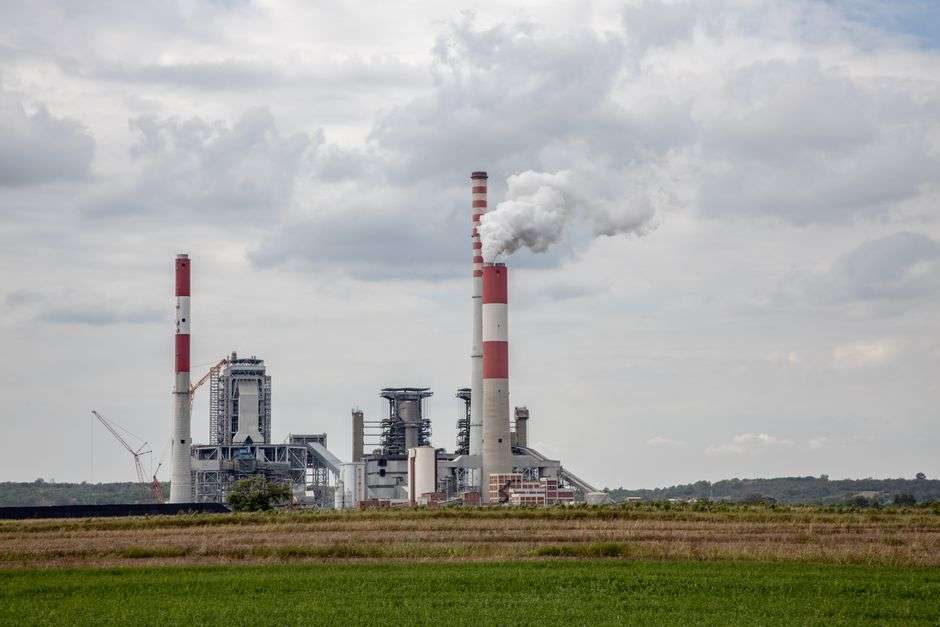
The director of the Alabama Department of Environmental Management said this week that state law gives utility companies the option to permanently cap coal ash ponds in place rather than fully excavate them, and that Alabama’s oversight of the closure process meets or exceeds federal standards.
Lance LeFleur, who leads the state agency responsible for regulating the closure of Alabama’s dozen coal ash ponds, addressed the issue publicly as scrutiny continues over Alabama Power’s plans for its ash storage facilities, including the largest at Plant Barry in north Mobile County. He said the Alabama Environmental Management Act, first enacted in 1982, contains no requirement that utilities pursue “clean closure,” the process of excavating ash and moving it to a lined landfill, and that state lawmakers have shown no interest in changing that.
LeFleur contrasted Alabama’s approach with Virginia and North Carolina, where legislatures passed laws effectively mandating excavation of coal ash from most ponds. He said that nationally, only about 31 percent of coal ash impoundments are expected to be closed through clean closure or excavation, and argued that figure is often overstated given how it is calculated in some states.
As an example, he pointed to Georgia, where utilities plan to consolidate ash from two ponds into a third rather than removing the material from the site altogether. “So in effect two ponds will be clean-closed, and they still have the one that will be capped in place,” he said, calling it misleading to describe that process as a wholesale reduction in environmental risk since the ash itself never leaves the site.
Coal ash ponds have drawn increased attention across the country in recent years because the waste they hold, primarily the residue left over from burning coal to generate electricity, contains heavy metals and other contaminants that can leach into groundwater over time. Advocates of clean closure argue that capping ponds in place does nothing to stop existing contamination from spreading, particularly in unlined ponds built years before more rigorous environmental standards were adopted.
That risk is not merely theoretical in Alabama. Alabama Power, which owns 11 of the state’s coal ash ponds, agreed earlier this year to pay $1.25 million in fines after ADEM identified groundwater violations at five of its facilities, including one pond that had already been capped. LeFleur acknowledged the significance of those violations but defended the size of the penalty, saying research shows steep fines are not the most effective way to drive compliance.
“There are many people who feel that bigger penalties result in better compliance with permit conditions, but that way of thinking is not borne out by reality, research and what happens on the ground,” LeFleur said. Under the Alabama Environmental Management Act, the maximum fine ADEM can levy administratively is $250,000 per violation, though the state can pursue larger penalties through litigation.
“In the case of Alabama Power, we determined the maximum penalty was appropriate, and in order to begin the process of closing these facilities and cleaning up the groundwater, rather than spending years in court, we wanted to get the process done immediately,” he said. “We took action very quickly after we became aware of the groundwater contamination, and we are well along the path of getting it cleaned up.”
LeFleur also noted that the fine amounts to a small fraction of what Alabama Power is expected to spend complying with the closure requirements altogether. He said the utility, which reported $5.5 billion in retail revenue in 2017, will likely spend more than $1 billion statewide on pond closures and associated groundwater remediation.
“The penalty will be an exceptionally small amount compared to the closure and groundwater remediation, that total will be more than a billion dollars,” he said. “So whether it was $250,000 or $2 million, it’s very small compared to the cost that must be incurred to close and clean up these sites, and we want that process to move along as quickly as possible.”
Rather than relying primarily on fines, LeFleur said ADEM’s enforcement strategy leans heavily on inspections and informal corrective action. “In Alabama and throughout the nation, the biggest contributor to compliance is inspections,” he said. “The second biggest contributor is technical assistance and informal enforcement, and a distant third is penalties.” He said the agency can conduct five to ten informal enforcement actions, largely educational in nature, for the same cost as a single formal enforcement proceeding, and argued that approach has helped Alabama maintain one of the lowest violation rates in the country.
LeFleur maintained that Alabama’s regulatory framework for coal ash is at least as strict as the federal rules set by the Environmental Protection Agency, which itself permits cap-in-place closures under certain conditions similar to those used for hazardous waste sites. “If a proposal that ultimately comes to us after back and forth with the power companies meets the requirements of the regulations, we are obligated to approve that method of closing the ash ponds,” he said. “If we do not allow that method to be utilized and it meets the requirements and regulations, we will be sued, and they will win.”
He emphasized that regardless of which closure method is used, utilities remain on the hook for cleaning up any contaminated groundwater tied to their ash ponds, a requirement he said sometimes gets overlooked in public debate over capping versus excavation. “That will be part of the permit, so groundwater remediation will take place and any proposal will have an obligation for performance,” LeFleur said. “If, for example, they start a remediation plan and it’s not showing the results necessary to meet groundwater standards, then they have to redo their plan and undertake advanced procedures to make sure the groundwater will be remediated, regardless of what manner of closure may be used.”
Alabama Power’s own monitoring has already flagged problems at Plant Barry. During the utility’s first semi-annual assessment monitoring event in August, the company reported that arsenic and cobalt levels in groundwater near the plant’s coal ash pond exceeded state protection standards. Alabama Power has pledged to continue groundwater monitoring and reporting as required under state and federal law.
The debate over LeFleur’s leadership at ADEM has itself become a point of contention. The Alabama Environmental Management Commission approved a one-year contract extension for LeFleur as director on Oct. 18, despite a large volume of public comments calling for his removal, many of them tied to frustration over the agency’s handling of coal ash regulation and enforcement across the state.
The Alabama Department of Environmental Management, commonly known as ADEM, is the state agency responsible for issuing environmental permits and enforcing state and federal environmental regulations. The department has been at the center of several high-profile disputes over industrial pollution in recent years, particularly around coal ash disposal at power plants.
Alabama Power, a subsidiary of Atlanta-based Southern Company, operates several coal-fired power plants across the state. Coal ash, a byproduct of coal combustion, has been the subject of federal regulation since 2015, when the U.S. Environmental Protection Agency finalized the Coal Combustion Residuals rule. Alabama has taken a largely state-led approach to managing coal ash under its own approved permitting program.
Cap-in-place, the disposal approach defended by the ADEM director, involves leaving coal ash in place at the generating site and covering it with an engineered cap, rather than removing the ash to a lined landfill. Environmental groups have argued that cap-in-place approaches risk long-term groundwater contamination, particularly in areas where groundwater is used for drinking water or irrigation.
Local governments and community partners are working through the implications of the situation, and several follow-up meetings have been scheduled for the coming weeks. Members of the public who want to weigh in on the matter can find the meeting dates on city and county websites, and written comments can be submitted through the standard channels used by the relevant agencies. Local news outlets will continue to cover the story as it develops.
Across south Alabama, similar issues are being addressed in other communities, and the lessons learned here are likely to inform how those communities approach their own challenges. Local officials have indicated they are in regular contact with counterparts in neighboring cities and counties, and they expect to share best practices as the situation continues to evolve.
The agencies involved in the matter have committed to keeping the public informed as the work progresses, and residents who want to receive updates directly can sign up for email or text alerts through the relevant city or county websites. Local community organizations have also agreed to share information as it becomes available, and several have scheduled public forums in the coming weeks to give residents a chance to ask questions of the officials involved.
For background, readers can consult the official websites of the relevant agencies, the local newspapers that have covered the story, and the public-meeting archives that document the prior deliberations on related topics. The combination of those resources should give residents a thorough understanding of how the current situation developed and how the agencies and elected officials are approaching the decisions that remain.