After 75 Years, Korean War MIA From Alabama Is Identified and Coming Home to Daphne
Pfc. Joseph Chancery, missing since the Korean War, has been identified by the DPAA after 75 years. The Purple Heart ceremony is Aug.
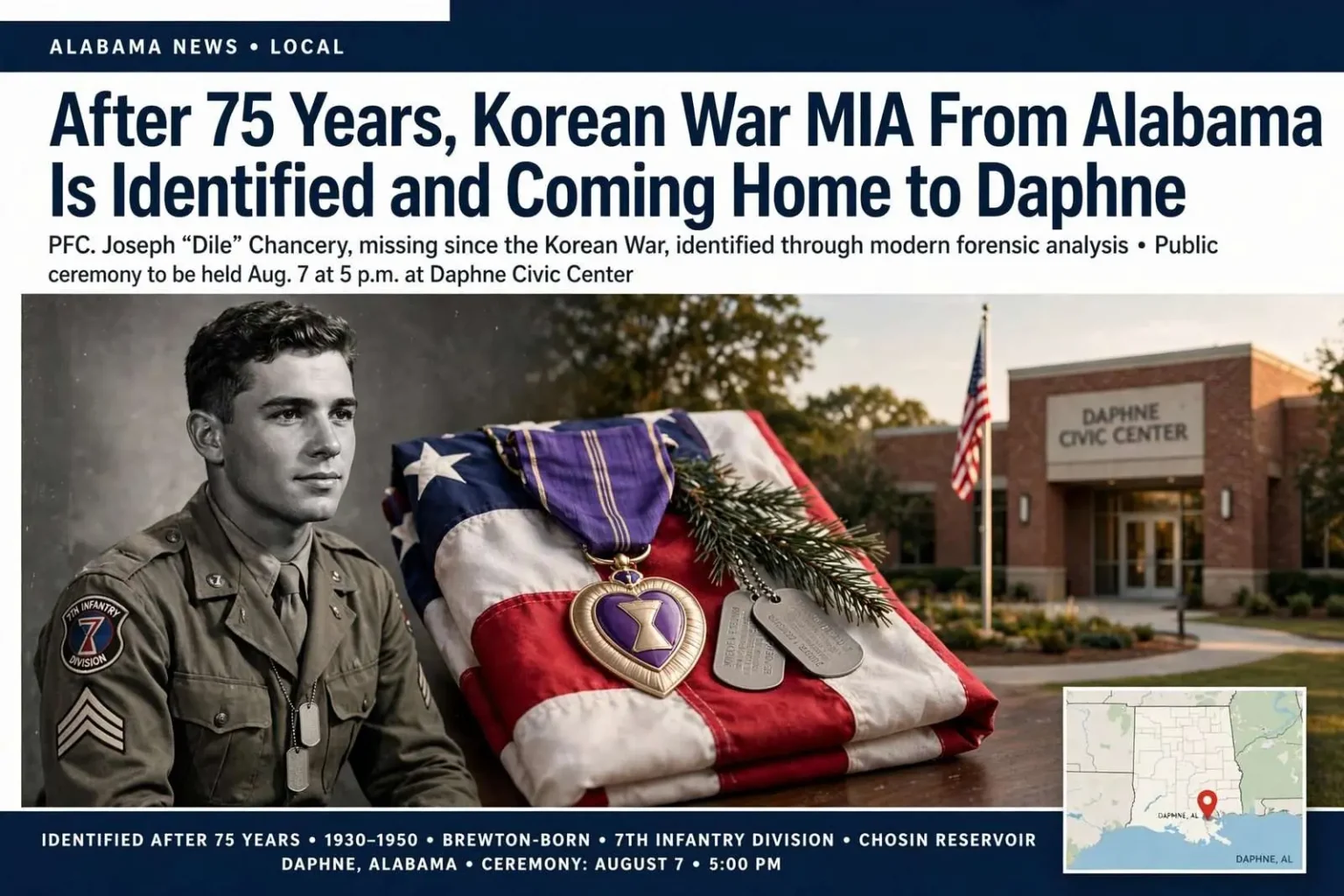
After 75 years as a name on a missing list, U.S. Army Pfc. Joseph “Dile” Chancery is coming home to Alabama.
The Defense POW/MIA Accounting Agency has identified the Brewton-born soldier, missing since the Korean War, through advances in forensic science, and his family will gather at the Daphne Civic Center on Aug. 7 at 5 p.m. to receive the Purple Heart awarded in recognition of his sacrifice. The ceremony is open to the public, and organizers are encouraging attendees — especially young people — to come and witness a piece of living history.
A Soldier From a Family of Twelve
Chancery was born June 26, 1930, in Brewton, one of 12 siblings. His brother Albert also served in the U.S. Army. There are no living members of his immediate family today, but his memory never left the family — carried principally by his niece, Christine Cumbie, through her grandfather Marvin Chancery, Dile’s older brother.
Cumbie said in a statement that her grandfather, Marvin Chancery, whom she called Paw Paw, was her best friend. Growing up, he made sure Dile’s memory never faded, often sharing stories about his younger brother, describing him as kind, easygoing, and the type of person everyone enjoyed being around. To Paw Paw, Dile was never just a soldier missing from the Korean War; he was his little brother, whose absence left a void the family carried for generations.
Frozen Chosin
Chancery served with Battery A, 57th Field Artillery Battalion, 7th Infantry Division — the unit strength at the heart of one of the Korean War’s most brutal chapters. In the winter of 1950, the division came under overwhelming attack by Chinese People’s Volunteer Forces at the Chosin Reservoir, where American and allied units fought in temperatures that plunged far below zero amid relentless assaults. Many of the fallen were never recovered from the frozen ground.
When the war’s dead began returning years later through Operation GLORY, the large-scale exchange of remains between the United Nations Command and communist forces, the United States received many unidentified soldiers’ remains. The forensic technology needed to identify them simply did not exist, so the unidentified dead were interred at the National Memorial Cemetery of the Pacific in Honolulu, Hawaii, in 1956 — the volcanic crater known to generations of families as the Punchbowl.
The Punchbowl holds 848 sets of unidentified remains from the Korean War. The Defense POW/MIA Accounting Agency reports that nearly 7,500 American soldiers from that conflict remain unaccounted for. Each identification made through modern DNA analysis and forensic anthropology is a case file decades in the closing, and each one begins with a family like the Chancerys, who never stopped marking the empty chair.
Cumbie said for more than 75 years Dile was listed as missing in action; to the Army he was a soldier, to history one of thousands, but to the Chancery family he was their uncle, their brother, and their family’s missing piece.
Another Family Still Waiting
Among the thousands of families still waiting is one that knows exactly what the Chancerys are about to feel. Air Force Colonel Steve Carey, president of the local Veterans Commission — the organization that helps stage honorary events for veterans like next month’s ceremony — counts his own family among the war’s unaccounted.
Carey’s uncle, 1LT James Desmond Carey, was young when he deployed, leaving behind his wife and an unborn son. His father served in World War II and Korea as well, giving the family three generations touched by the wars of the 20th century. According to transcripts of radio calls from the battle, 1LT Carey was in the air when a dogfight erupted, and his last radio call marked the moment his family’s waiting began.
Carey’s presence at the Chancery ceremony bridges the two stories: one family receiving answers after 75 years, another still holding its breath.
Why the Ceremony Is Open to the Public
Organizers have deliberately kept the Aug. 7 event open to everyone, and they have made a particular point of urging families to bring children. A Korean War veteran coming home is, for most Alabamians under 80, an event that will happen once in a lifetime — a chance to see the full weight of a name moved from the missing column to the home column.
The Daphne Civic Center ceremony will include the presentation of the Purple Heart, the medal awarded to those wounded or killed in action against an enemy of the United States. For the Chancery family, it is the closing of a loop opened in the winter of 1950 on a frozen reservoir half a world away.
Seventy-five years is a long time to wait for a homecoming. On Aug. 7, the wait ends.
Related coverage from South AL News
- Purple Heart Recipients Honored at Daphne Ceremony, Including Korean War Soldier Laid to Rest After 75 Years
- 75 Years After Chosin Reservoir, Brewton-Born Soldier Pfc. Joseph 'Dile' Chancery Is Coming Home
- Remains of Korean War Soldier PFC Joseph 'Dile' Chancery Return Home to Escambia County After 75 Years
- Missing Since 1950: Brewton-Born Soldier Finally Coming Home for Burial Near Atmore