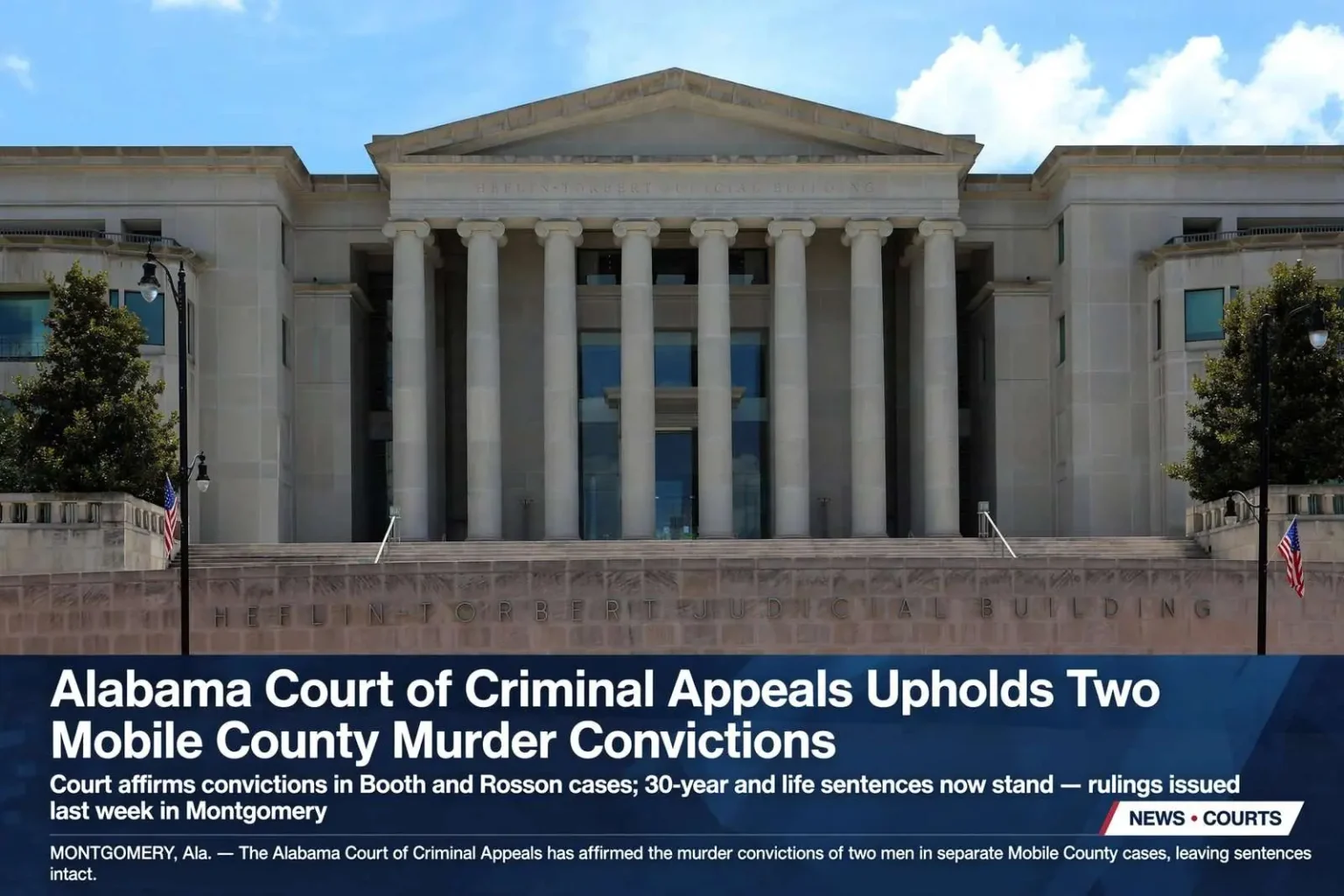
The Alabama Court of Criminal Appeals has affirmed the murder convictions of two men whose cases originated in Mobile County, rejecting appeals in both matters in an order issued last week.
The Booth case
The appellate court upheld the conviction of Joseph Hunt Booth, who was found guilty in 2018 of killing 23-year-old Antonio Crawford. Crawford was shot three times with a shotgun on a Sunday afternoon in April 2014 at a house on Houston Street that belonged to Booth.
Houston Street runs through a residential section of Mobile west of downtown, and the April 2014 shooting was among the homicides that marked a violent stretch for the city that year. Prosecutors presented evidence that the killing unfolded in daylight at Booth’s own residence, with witnesses and forensic work tying Booth to the shooting in the years that followed.
Prosecutors said at trial that the shooting stemmed from a dispute over money Crawford believed he was owed from a drug transaction, and that Crawford had pressed Booth to get the funds from his elderly parents, who were visiting at the time of the shooting. According to the state’s theory, that pressure escalated into the confrontation that ended with Crawford’s death.
A jury convicted Booth, and he was sentenced to 30 years in prison. He challenged the conviction on appeal, but the Court of Criminal Appeals ruled against him, leaving the sentence intact.
The Rosson case
In a separate case, the same appellate panel upheld the conviction of Aubrey Allen Rosson, 61, who was found guilty of murdering Duane Massingale and assaulting Massingale’s wife, Veronica Massingale, in the first degree.
According to evidence presented at trial, Rosson had been drinking at the Massingale residence on June 27, 2016, when he announced that he intended to kill the couple. He then shot Duane Massingale multiple times, killing him.
Veronica Massingale was also shot and struggled with Rosson before attempting to flee, at which point she was shot again. Prosecutors told jurors she survived the attack by pretending to be dead until Rosson left the scene. Her testimony and survival became central to the state’s presentation, providing jurors a firsthand account of the attack inside the couple’s home.
Rosson was sentenced to life in prison for the murder conviction and an additional 10 years for the assault conviction. The appellate court’s ruling leaves that sentence undisturbed, closing off the normal avenue of review for the 2016 attack.
The court that ruled
Both rulings came from the same round of appellate review handed down by the court in Montgomery, which hears challenges to criminal convictions from across the state, including cases originating in Mobile County circuit courts. The Court of Criminal Appeals is one of Alabama’s two intermediate appellate courts, sitting in downtown Montgomery and staffed by five elected judges who review the trial record in each case that reaches them.
The court’s docket is among the heaviest in the state judiciary. Every felony conviction in Alabama carries an automatic right of appeal, and the five-judge court handles roughly a thousand appeals a year — ranging from direct challenges to the sufficiency of evidence to claims that trial judges made legal errors in admitting evidence, instructing juries or sentencing defendants.
In most criminal appeals, the court reviews the written trial record rather than hearing new evidence. Attorneys file briefs outlining the alleged errors, and the court typically issues written opinions or memorandum rulings without oral argument. When the court affirms, as it did in both Mobile County cases, a defendant’s next step is to seek review from the Alabama Supreme Court, which grants certiorari in only a fraction of criminal cases, or to file post-conviction petitions in the trial court raising claims that were not part of the direct appeal.
What appellate review covers
Appeals to the Court of Criminal Appeals typically argue that errors at trial — improper evidence, flawed jury instructions, insufficient proof, or constitutional violations — require reversal. The court reviews those claims against a demanding standard: when a defendant challenges the sufficiency of the evidence, the court views the record in the light most favorable to the prosecution and asks whether any rational jury could have found guilt beyond a reasonable doubt.
That standard means appellate success is rare in cases where the trial evidence was substantial. Juries are the constitutionally designated finders of fact, and appellate courts generally do not second-guess their credibility judgments — including, as in the Rosson case, a jury’s decision to credit a surviving victim’s account of the attack.
The court’s review of the Booth and Rosson appeals followed that framework, with the panel finding the trial proceedings sufficient to sustain both convictions. The written orders leave the two Mobile County cases resolved at the appellate level unless the Alabama Supreme Court agrees to further review.
Mobile County’s criminal pipeline
Both cases traveled the standard route through Alabama’s justice system: a Mobile County grand jury indictment, proceedings before the Mobile County Circuit Court’s criminal division, a jury trial, sentencing, and then the years-long appellate process that followed. For the families involved, each stage brings its own wait — the gap between the 2014 Houston Street shooting and Booth’s 2018 conviction alone spanned more than four years of investigation and trial preparation.
Mobile County’s circuit court is one of the busiest trial courts in Alabama, serving the state’s second-largest county. Its criminal division handles hundreds of felony cases a year, from drug trafficking to homicide, and its judges manage dockets that stretch across multiple courtrooms in Government Plaza downtown. Murder cases, with their higher evidentiary stakes and mandatory trial procedures, typically take longer than the average felony to reach trial.
The appellate stage adds years more. Briefing schedules alone often take several months on each side, and the court’s review of the full trial record — transcripts of every hearing, every witness examination and every ruling — takes additional time. Cases that end in affirmance at the intermediate court can consume most of a decade from crime to final judgment, as these two did.
Victims and the appellate process
For surviving victims and victims’ families, appellate review is a period with no closure. The conviction stands, but the sentence is on hold against the possibility of reversal, and each round of briefing revives the case’s details. Alabama’s victim notification laws require prosecutors’ offices to keep victims informed of hearings and rulings, and victims’ advocates in Mobile County assist families in tracking cases through the appellate maze.
Veronica Massingale’s survival of the 2016 attack — her testimony about pretending to be dead until Rosson left — stands as one of the case’s defining elements, and her continued standing as the state’s principal witness made the appeal’s outcome directly personal to her. Surviving victims of violent attacks often appear at sentencing and again at any post-conviction proceedings, a burden advocates say is rarely understood outside the families who endure it.
The families of murder victims face the same extended timeline. In Crawford’s case, the April 2014 shooting and the 2018 trial bookended four years in which the case moved through grand jury, motion practice and trial scheduling before a jury finally weighed the evidence.
After the affirmance
With both convictions affirmed, the sentences — 30 years for Booth, life plus 10 years for Rosson — are now fully in effect, subject only to the discretionary and post-conviction avenues that remain. Defendants in Alabama may petition the Alabama Supreme Court for a writ of certiorari within a set window after an intermediate court’s ruling, and later may file Rule 32 petitions in the trial court claiming constitutional violations outside the trial record, such as ineffective assistance of counsel based on facts not appearing in the transcript.
Those later stages succeed only rarely, and the overwhelming majority of affirmances by the Court of Criminal Appeals become final judgments. For the Alabama Department of Corrections, the rulings finalize the prison terms that began when each man was sentenced — Booth to the 30-year term, Rosson to the life sentence with the additional 10-year term attached.
The twin rulings from Montgomery also mark the end of the line for the Mobile County District Attorney’s office in both prosecutions, which defended the convictions on appeal after securing them at trial. Prosecutors’ appellate divisions handle the briefing in affirmance-stage cases statewide, and both matters now close with the original verdicts intact.
Appeals of this kind also serve a systemic function beyond the individual defendants. Each affirmance confirms the trial court’s handling of the evidence and instructions, and the court’s written reasoning becomes guidance for future trials across the state — particularly in Mobile County’s busy criminal courts, where many of the issues that recur on appeal, from witness identification to shotgun evidence, arise case after case.
The court issued its orders in the regular course of its docket, and neither case involved a published opinion reversing or modifying the lower court’s judgment — the outcomes Mobile County prosecutors sought in both prosecutions.