Alabama’s Beaches Hit $739 Million in Lodging Revenue Through July, Tourism Chief Tells Chamber
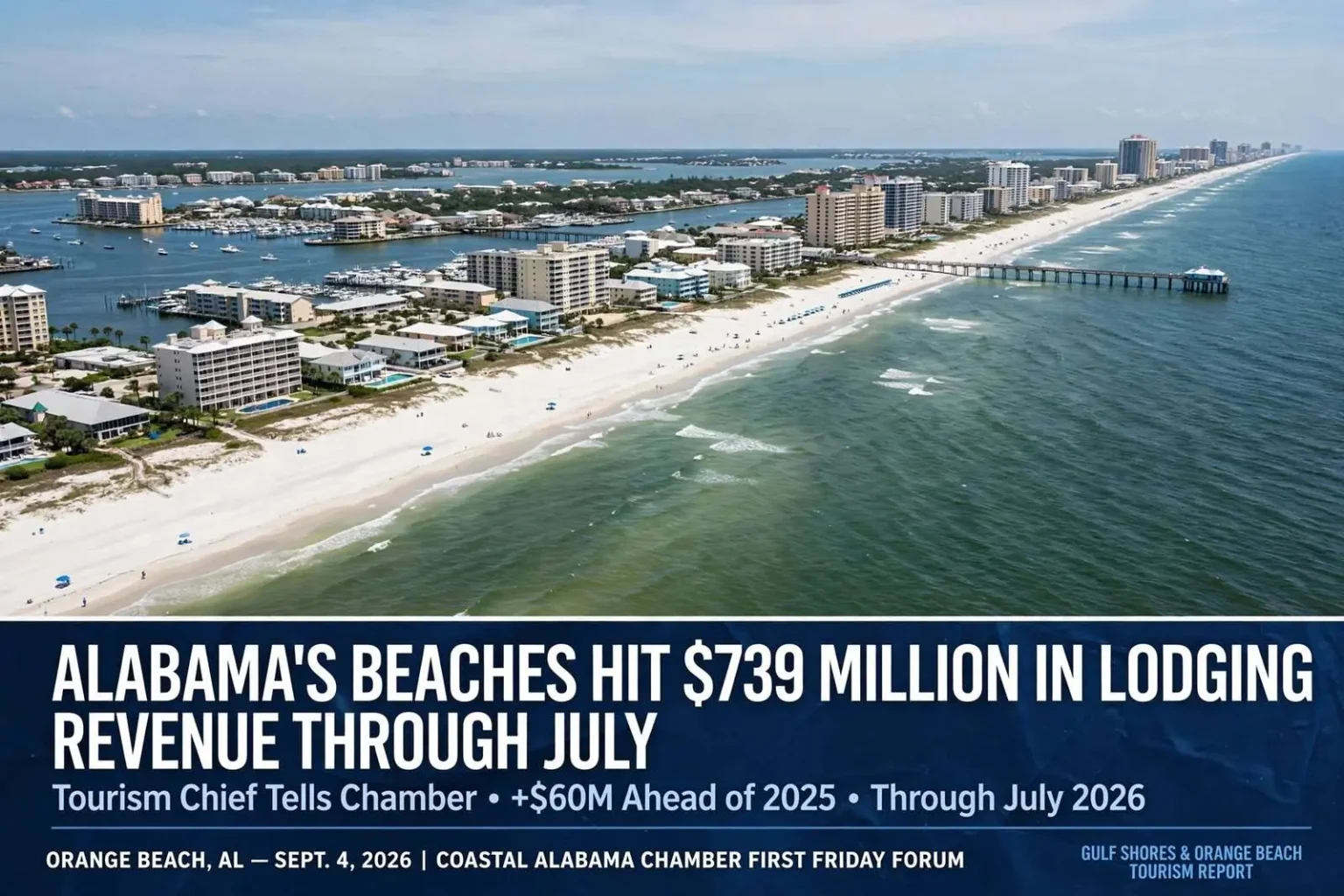
Gulf Shores & Orange Beach Tourism CEO Beth Gendler told a Chamber breakfast that taxable lodging rentals reached $739 million through July, $60 million ahead of last year, with 950 new lodging units planned over the next two years.
The number that mattered most at breakfast Friday morning was $739 million.
That is what taxable lodging rentals across Alabama’s Beaches had generated through July of this year — $60 million more than the destination had booked at the same point a year earlier. Business and industry leaders from across south Baldwin County gathered at the Orange Beach Event Center on Friday, Sept. 4, to get their first look at the year-to-date figures, and the message from the podium was that the run is not over yet.
Gulf Shores & Orange Beach Tourism sponsored the Coastal Alabama Chamber’s First Friday Forum breakfast, and GSOBT President & CEO Beth Gendler used the hour to walk the room through what visitors did to the local economy in 2025 and what they have done so far through the 2026 summer season.
“The number one question we get at the tourism office from elected officials and our local businesspeople is always ‘How are we doing this year?’” Gendler said as she started her presentation. “I am happy to report that as we move into fall, projections look very good for another strong year.”
Why Lodging Revenue Is the First Number Out of the Gate
“One of our primary key indicators of the health of our tourism industry is taxable lodging rentals,” explained Gendler. “Through July of this year, our area was already at $739 million in lodging revenue, which is $60 million AHEAD of where we were at this point last year.”
Destination marketing organizations lean on lodging revenue for a practical reason: it is one of the few tourism metrics that arrives quickly, arrives regularly, and is not built out of survey estimates. Lodging revenue is derived from what accommodations actually collected and remitted — hotel rooms, condominium rentals, vacation homes, campgrounds and other short-term stays that fall under the lodging tax. It is a receipt, not a projection.
Visitation counts require modeling. Employment figures lag. Full economic impact studies take the better part of a year to compile. Lodging collections, by contrast, land on a schedule, and they capture the single largest category of visitor spending in a destination where most guests stay multiple nights.
What lodging revenue does not do is separate its own ingredients. A total can rise because more people came, because they stayed longer, because nightly rates went up, or because there were simply more units available to rent. That is why tourism officials pair the revenue figure with occupancy, average nightly rate and inventory counts rather than treating any one of them as the whole story.
It also leaves a great deal out. Day-trippers who drive down from Mobile, Pensacola or south Mississippi and go home the same night never touch a lodging ledger. Neither does the money guests spend at restaurants, charter docks, golf courses, outfitters, grocery stores and gas stations once they have checked in. Those dollars show up in a different measure.
Half a Billion Dollars in New Visitor Spending
That broader measure moved too. Gendler said visitor spending increased by $500 million in 2025 compared with 2024, quipping that it was “enough for 17 million seafood dinners!”
Visitor spending is the wider net. It attempts to account for the full cost of a trip — lodging plus food and beverage, retail, recreation, transportation and everything else a household buys while it is away from home. For a coastal destination, that spread tends to run heavily toward restaurants and groceries, because families renting condos with kitchens do both, and toward recreation, because the reason for the trip is the water.
The distinction between lodging revenue and total visitor spending matters for local businesses that never rent a room. A boat captain, a bike shop, an ice cream counter or a beach chair service does not appear anywhere in the $739 million figure, but each one lives or dies on the same visitor volume that produced it. When tourism officials talk about the health of the industry, the lodging number is the indicator and the spending number is the outcome.
What 57,000 Jobs Looks Like in a Town of 27,000
While tourism numbers show economic growth, Gendler framed the real impact as what the industry does for the 57,000 workers whose livelihoods depend on both residents and guests along Alabama’s Beaches.
“In just one year, salaries and wages generated by tourism grew by $200 million,” stressed Gendler. “We had a strong spring and summer, and fall is looking impressive — which means steady hours for more months of the year for your employees from housekeepers to dishwashers, front desk staff to servers, boat captains to maintenance workers. Gone are the days where summer was our only season.”
The phrase to underline there is “steady hours for more months of the year.” Seasonality is the structural problem of every beach economy, and it is a labor problem before it is a revenue problem. A destination that does most of its business in ten weeks needs a workforce that materializes in May and disappears in September, which means part-year employment, high turnover, heavy reliance on seasonal and student labor, and constant retraining. A destination that fills rooms in March, June, October and December can offer something closer to a year-round job.
The scale of the workforce relative to the resident population explains why that matters so much here. According to the Alabama Tourism Department’s 2025 report, tourism helped employ 57,000 people in Gulf Shores, Orange Beach and the Fort Morgan area — where the resident population is just under 27,000. The industry employs roughly two workers for every full-time resident, which means the labor force is drawn from a commuting shed that reaches well up into Baldwin County and beyond it. Housing costs, road capacity and drive times are therefore not side issues for the tourism industry. They are inputs.
Where the Money Goes After Checkout
Gendler made a point of following the dollars past the businesses that collect them.
“As the destination marketing organization for this area, we know that tourism’s impact extends far beyond hotels, vacation rentals, restaurants, and attractions,” she said. “The money that comes into our cities helps fund the things that make this a special and incredible place to live — city parks and recreation facilities, new schools, and our impressive beach safety divisions, to name a few.”
This is the argument that keeps lodging taxes politically durable in resort communities. A lodging tax is a levy on the room rate, paid by the guest at the time of the stay and remitted by the property. Most of the people paying it do not live in the jurisdiction collecting it, and most of them are gone within a week. In practice that lets a small coastal city fund public facilities at a scale its own property tax base could never support, because the cost is spread across millions of short-term visitors rather than a few thousand households.
The offsetting reality is that those same visitors are the reason the facilities have to be that large in the first place. A city sized for 27,000 residents that hosts several million guests a year has to build and staff for the peak, not the baseline — more lifeguards, more police and fire coverage, more sanitation, more parking, more water and sewer capacity, more road maintenance. Lodging revenue is what closes that gap. When collections run $60 million ahead, it is not only hoteliers who notice.
950 New Units, and What They Add Up To
Growth is also arriving in the form of concrete. Gendler said increased lodging inventory is following demand, with 950 units planned over the next two years.
Those 950 new lodging units, as she illustrated, equal 346,750 additional available room nights — the arithmetic of 950 units multiplied by 365 nights in a year. The projects behind that figure include Margaritaville Orange Beach, Abaco, Caribe Seaside and Phoenix Key, along with hotels including Hotel Rain, AC by Marriott and TownPlace Suites.
“Room nights available” is the supply side of the tourism ledger, and it is the number that governs how much business a destination can physically absorb. On a sold-out summer Saturday, a destination cannot serve one more visitor than it has beds. Adding inventory raises that ceiling. It also changes the arithmetic of every ratio built on top of it.
Why Occupancy Got Harder to Read
“Occupancy has always been one of our key measurements,” Gendler explained. “It is challenging to compare year-over-year occupancy now with the continued growth in our available lodging segment. But we know this increase in inventory reflects the popularity of our area as a vacation destination.”
The problem she is describing is a denominator problem. Occupancy is occupied room nights divided by available room nights. Add hundreds of new units and the denominator grows immediately, while the demand to fill them builds over time. The result is that a destination can sell more room nights than it ever has and still post a flat or lower occupancy percentage, simply because it now has more rooms to sell.
That is why officials in growing markets tend to move their emphasis toward absolute measures — total room nights sold, total lodging revenue, revenue per available room — when supply is expanding quickly. Occupancy remains useful for comparing one week to the next, or one property type to another. It becomes a blunt instrument for judging whether a year was good.
The Season Keeps Getting Longer
The shape of the coastal Alabama calendar has changed considerably over the past two decades, and Gendler’s line about summer no longer being the only season reflects a deliberate, long-running strategy.
The traditional beach year here still peaks between Memorial Day and early August, when family vacation travel and school schedules concentrate demand into a narrow window and rates run at their highest. But the surrounding months have been steadily filled in:
- Winter and early spring bring long-stay visitors from the Midwest and Canada, who book by the month rather than the night and keep condominium inventory occupied in January, February and March.
- March and April carry spring break traffic from schools and universities across the Southeast and Midwest.
- September through November has become a genuine second season, with warm Gulf water lingering well past Labor Day, lower rates, thinner crowds, strong inshore and offshore fishing, and a festival calendar that anchors October.
- The holidays and the early-winter weeks pick up shorter regional trips and events.
Each of those blocks does something different for the workforce. Filling the shoulder seasons is what converts summer jobs into year-round jobs, and it is why destination marketing organizations spend a disproportionate share of their promotional budgets on the months that are not June and July.
A Program Aimed at the People Who Live Here
The other announcement of the morning was not a number. Gendler used the presentation to reveal GSOBT’s new “By Locals for Locals” program, which provides community resource information, locals’ discounts and high check-in/check-out days.
Each of those three pieces is aimed at a different friction point between a resident population and the visitor economy built on top of it. Community resource information gathers in one place the practical details residents ask about a destination they share with millions of guests. Locals’ discounts turn businesses that depend on peak-season visitors into year-round neighbors, which matters most in the off months when the same restaurants and attractions are counting on local traffic to stay open.
The third piece is the most specifically coastal. In a market dominated by weekly vacation rentals, arrivals and departures do not spread evenly across the week — they concentrate on the changeover days, when one set of families is checking out in the morning and another is checking in that afternoon. Publishing which days those are is a small piece of information with a large practical payoff for anyone trying to run errands, get to work, or schedule an appointment without sitting in turnover traffic.
Gendler closed on that relationship rather than on the revenue figures.
“We are a tourism economy here. It is the number one industry in our county. This community relies and thrives on our guests. But it isn’t just about filling rooms; it’s about strengthening the community we all call home.”
The Full Picture Arrives Next Spring
Final 2026 economic impact numbers will not be compiled until next spring, so Friday’s presentation was a progress report rather than a verdict. The most recent complete accounting comes from the Alabama Tourism Department’s 2025 report, and it puts the scale of the coastal visitor economy in plain terms.
An estimated 8.9 million visitors came to Baldwin County, with a strong majority of those — 7.1 million — coming to Alabama’s beaches. Those beach visitors spent almost $6.8 billion in the coastal communities and helped employ 57,000 people in tourism-related jobs in Gulf Shores, Orange Beach and the Fort Morgan area.
Set against a resident population just under 27,000, that works out to more than 260 visitors for every person who lives there year-round. Few economies in Alabama are so completely defined by people who do not live in them, which is precisely why a room-revenue figure released at a chamber breakfast draws a full house of business owners on a Friday morning in September.