Amazon Confirms First Alabama Facility: Sortation Center Coming to Theodore
Amazon has confirmed its first Alabama facility, a sortation center in the Theodore area, that officials say could create as many as 500 jobs.
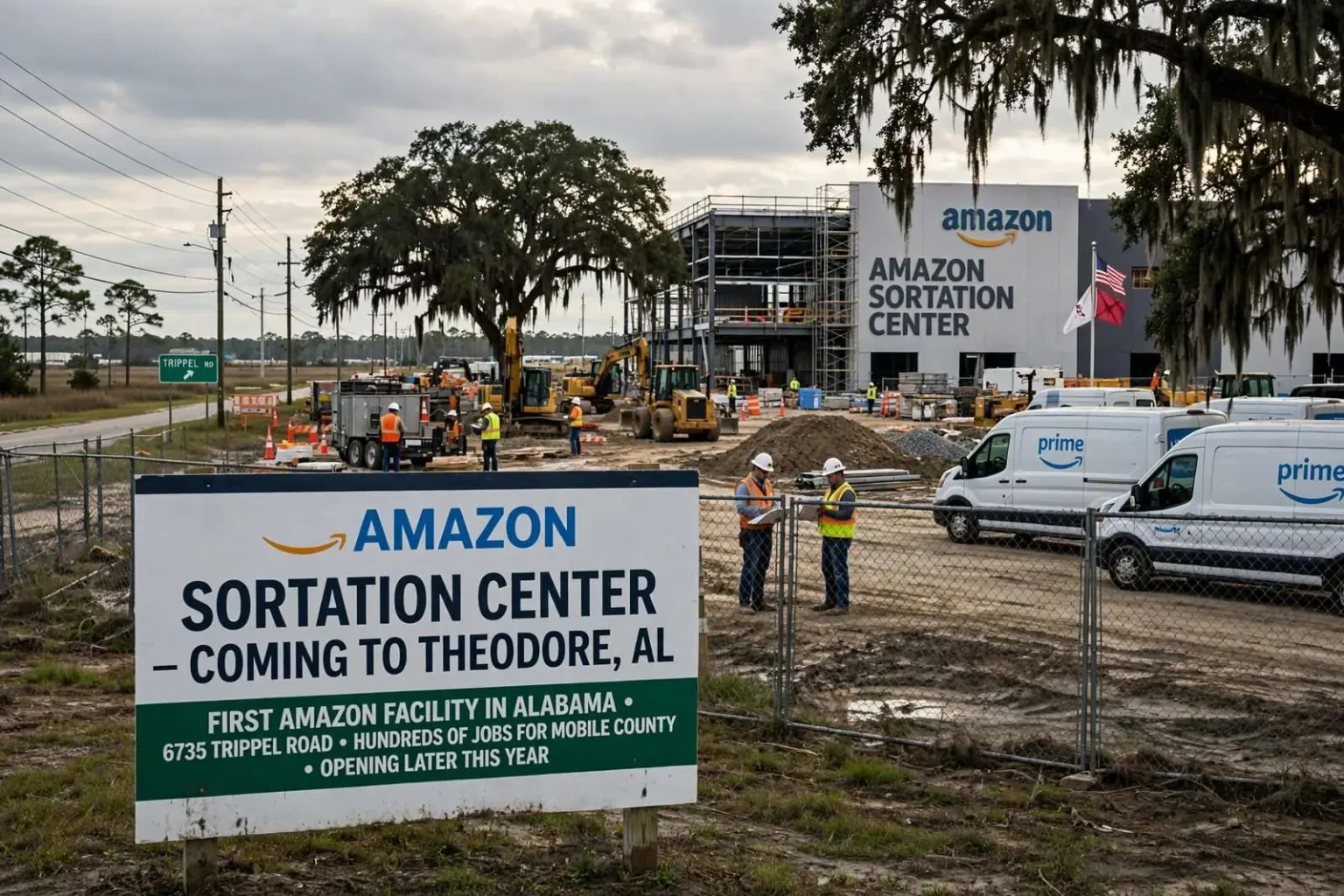
Online retail giant Amazon has confirmed plans to open a sortation center in the Theodore area later this year, marking the company’s first customer fulfillment facility in Alabama and bringing what officials describe as “hundreds of jobs” to Mobile County. The facility will be located at 6735 Trippel Road, where construction crews are already at work preparing the site.
A First for Alabama
Amazon spokeswoman Ashley Robinson said the company chose the Theodore location to help expand delivery capacity across the region. “This will be our first customer fulfillment facility in Alabama, and we look forward to creating hundreds of jobs to help us better serve customers in Mobile County and throughout Alabama,” Robinson said.
The arrival gave Alabama a place in Amazon’s fulfillment network that neighboring states had held for years, and it put Mobile County on the map of the company’s expanding Gulf Coast logistics footprint. For local economic development officials, landing the company’s first Alabama operation represented a signature recruitment win in a competitive field where communities across the Southeast had spent a decade courting the retailer’s warehouses.
Sortation centers differ from Amazon’s larger fulfillment centers, where customer orders are picked, packed and shipped out to buyers. Instead, sortation centers receive packages that have already been packed at other Amazon facilities and sort them by delivery route, allowing packages to move more efficiently through the company’s shipping network.
What a Sortation Center Does
The sortation model is the middle link in Amazon’s delivery chain. A customer’s order might be packed at a fulfillment center hundreds of miles away, arrive at Theodore by the truckload, and then be routed by ZIP code and neighborhood so that the final miles happen on local delivery routes rather than from regional hubs. The Theodore facility’s work begins where the picking and packing ends, scanning each package and directing it onto the truck that serves its route.
Robinson said the added capacity supports “faster and expanded delivery options, such as Sunday delivery and later cut-off times” for online orders. Sunday delivery and late-evening order deadlines have become competitive weapons in online retail, and both depend on having sortation facilities close enough to customers that a package can make its final trip the same day it is needed.
For shoppers in Mobile, Baldwin County and across south Mississippi and the Florida Panhandle, the Theodore site means packages ordered late in the day are more likely to arrive the next day, and the delivery network gains local capacity that previously routed through facilities in other states.
The Jobs
While Amazon has not released an exact hiring figure, people involved in recruiting the company to the area have previously said the sortation center could employ as many as 500 workers once it reaches full capacity. The jobs are expected to be less physically demanding than positions at some other distribution facilities because sortation work relies heavily on automated technology and scanning systems.
That technology-driven approach, Robinson said, makes the positions “a great option for people looking for part-time jobs,” including college students and retirees seeking flexible schedules. Sortation work follows the rhythm of the delivery day — packages arrive, are processed and are loaded for routes — which creates shift patterns that differ from around-the-clock fulfillment center schedules and can accommodate workers balancing school, retirement or family obligations.
The hiring wave arrives as Mobile County’s logistics sector continues to grow around the Port of Mobile, the interstate corridors and the industrial sites along Highway 45 and the Theodore industrial areas, adding another major employer to a labor market already anchored by aerospace, shipbuilding and maritime trade.
Behind the Deal
The announcement follows a closed executive session held last month by the Mobile County Commission to discuss what was described only as an economic development opportunity. Commissioners could not name the company at the time, a standard practice when recruitment involves confidential negotiations and incentives, but the pieces were visible to anyone watching: site preparation at the Trippel Road property, surveyors and heavy equipment on the ground, and the kind of industrial recruitment activity that precedes a major warehouse announcement.
The Trippel Road location sits in the Theodore area, south of Mobile along the Highway 45 corridor, within reasonable trucking distance of Interstate 10 and the Port of Mobile. That positioning matters for a sortation operation, which lives or dies on truck access — packages arrive by the trailerload and leave the same way, bound for local routes across the central Gulf Coast.
Economic development officials had spent years courting distribution and logistics projects for south Mobile County, where flat land, rail access and proximity to the port create a natural draw for warehouse users. Amazon’s decision validated the strategy, and the county’s recruitment of the project joined a portfolio that has steadily diversified the area’s industrial base beyond its traditional petrochemical and maritime employers.
How Sortation Fits the Regional Network
The Theodore center joins a Gulf Coast network in which Amazon has invested heavily along the I-10 corridor from Florida to Texas. Each sortation center serves a radius of delivery routes, and the Theodore site’s position near the western edge of the Florida Panhandle and the Mississippi line lets the company cover territory that previously required longer hauls from facilities in Louisiana, Florida or Tennessee.
When the facility reaches full operation, packages bound for Mobile addresses will no longer make a long round trip through a distant hub. Instead, they flow through Theodore, onto local delivery routes, and to doorsteps across the county — with the Sunday deliveries and later order cut-offs that the company ties directly to local sortation capacity. The effect compounds during peak season, when holiday volumes stress every link in the chain and local capacity determines whether next-day delivery holds.
The Labor Market Picture
As many as 500 jobs at full capacity would place the sortation center among the larger single-site employers in south Mobile County, though the hiring will build gradually toward that figure. The positions emphasize flexibility — part-time schedules, shift options and technology-assisted work — which Amazon pitches toward students at the University of South Alabama and Bishop State Community College, retirees re-entering the workforce and parents fitting work around school hours.
The company’s benefits package and wage scales in the region will be watched as hiring ramps up, particularly as the sortation center competes with the port, the shipyards and other warehouses for many of the same workers. Amazon’s entry into an Alabama labor market of this size tends to put upward pressure on warehouse wages across the area, a ripple effect local officials quietly count among the benefits of recruitment.
Construction activity at 6735 Trippel Road is the first visible phase; the hiring and the delivery-route expansion follow once the building is fitted out with the conveyors, scanners and sorting systems that define the operation. By the end of the year, the county will have its first Amazon facility — and online shoppers across the central Gulf Coast will be a step closer to their orders.
Theodore’s Place in Mobile County’s Growth
Theodore has long been one of the working anchors of Mobile County — an unincorporated community south of the city where industry, freight corridors and residential neighborhoods share the landscape. The community sits near the industrial complexes that have defined south Mobile County for decades, and its access to Highway 45, U.S. 90 and the interstate system has made it a recurring candidate for logistics and distribution projects as e-commerce reshapes the region’s economy.
For local residents, the facility’s arrival brings both opportunity and traffic. Delivery routes radiating from Trippel Road will put Amazon vans on residential streets across the area, while the trucks serving the center will add to the freight moving along the corridor. County officials weighed those realities in the recruitment, as they do with every major warehouse project, balancing the job creation against the infrastructure demands of a 24-hour freight operation.
E-Commerce and the Changing Shape of Work
The sortation center is a case study in how e-commerce has redrawn the map of American employment. A generation ago, retail jobs clustered in shopping centers; today, they increasingly sit in buildings like the one rising on Trippel Road, where the work is moving packages rather than selling them. The shift has been a boon for communities with land and logistics advantages, and Mobile County has positioned itself squarely in that category.
The technology emphasis Robinson described — automation and scanning systems that make the work less physically demanding — also signals where such operations are heading. Sortation centers run on conveyor networks and barcode infrastructure, with workers handling exceptions rather than brute force. That design keeps the work accessible to a broader range of employees, including older workers and those seeking lighter physical demands.
What Officials Are Watching
County commissioners and economic development staff will track the project through its milestones: the build-out, the hiring ramp, the delivery-route launches and the eventual headcount against the 500-worker ceiling projected by those involved in the recruitment. The company’s first Alabama facility carries symbolic weight beyond its payroll — it makes the state part of Amazon’s expansion map and gives state recruiters a reference point for pursuing the larger fulfillment centers that have so far landed elsewhere.
For Mobile County, the Theodore sortation center adds a modern logistics operation to an industrial base long defined by chemical plants, shipyards and the port. It also connects the area directly to the consumer economy of the digital age: every order placed by a customer in Mobile, Pascagoula or Pensacola may now pass through the Trippel Road building on its way to a doorstep.
The construction crews already at work on the site are preparing for that role, moving dirt and laying foundations for a facility designed to receive, sort and dispatch thousands of packages a day. Later this year, when the trucks start rolling and the hiring begins, Alabama will formally join the states that host Amazon’s fulfillment network — and Theodore will have a new answer to the question of what a south Mobile County community can grow into.