

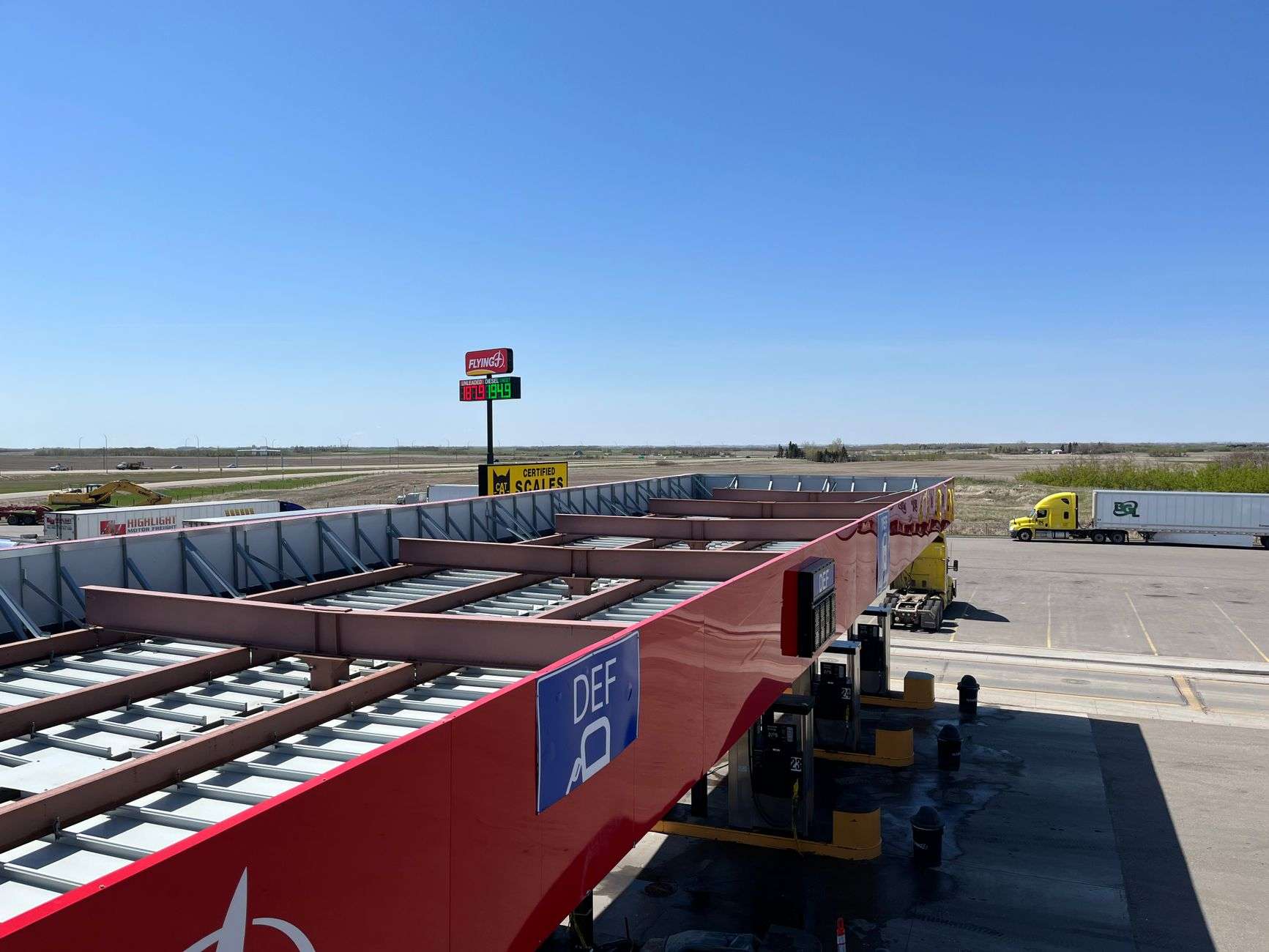
ATMORE, Ala. — Woody Daw fills one truck. It costs him more than $3,000 a week before he earns a dollar.
“And it’s just hurting us,” Daw said. “And it’s really, really, really bad.”
Daw is an independent truck driver with Majestic Manor Trucking in Atmore. He spends nearly every day of the week on the road across the Southeast — Florida, Alabama, Mississippi and Georgia — hauling stone, dirt and sometimes crops.
“I mean, we’re barely breaking even right now,” Daw said. “So it’s really tough.”
Asked whether he had faced prices this high before, he said no.
“I mean, we’re used to four or five years ago, it was getting around $2, $3 a gallon,” he said.
Now, Daw says, he pays nearly $6 a gallon wherever he goes.
The Math of an Independent Operator
Daw’s $3,000-a-week fuel bill is the number that explains why independent trucking is under pressure, and it helps to break down what sits behind it.
A heavy truck hauling aggregate typically returns fuel economy in the range of five to seven miles per gallon, and loaded weight and terrain push that number down rather than up. At $6 a gallon, fuel alone runs roughly $1 per mile.
Fuel is only one line. An independent operator also carries a truck payment or maintenance on an owned vehicle, commercial insurance, tires, permits and licensing, regulatory compliance costs, and whatever the driver takes home. Tires on a heavy truck run into the thousands per set. A major engine repair can exceed a month’s gross revenue.
The structural problem is that freight rates do not move in step with fuel prices. Fuel surcharges exist in much of the industry precisely to address this, but they are negotiated, they lag, and small operators hauling on the spot market frequently have the least leverage to obtain them. A driver whose rate was set before fuel spiked absorbs the difference.
That is the position Daw describes: the same work, the same miles, a fuel bill that has roughly doubled from a few years ago, and rates that have not.
Why It Reaches Everyone
Patrick De Haan of GasBuddy made the case that diesel prices do not stay in the trucking industry.
“Well, everything you see behind me, everything consumers generally consume gets through the supply chain with diesel,” De Haan said. “Food gets out of the table with the farmer, with the tractor, with the semi truck that consumes diesel. Everything at the grocery store gets there with diesel. Diesel is the fuel that drives the US economy through construction, trains, tractors and trucks. All of it runs on diesel. And so the price of diesel being record-setting is likely to reignite inflation.”
The point is worth taking seriously, because diesel occupies a different economic position than gasoline.
Gasoline is largely a consumer expense. When it rises, households feel it directly and adjust their own spending.
Diesel is an input cost. It moves through the price of nearly every physical good before a consumer sees it. Agriculture runs on diesel — tractors, combines, irrigation pumps, grain trucks. Construction runs on diesel. Rail freight runs on diesel. Marine shipping runs on distillate fuels closely related to it.
Because it enters at multiple points in a supply chain, a sustained diesel increase compounds rather than passing through once. The same load of produce may absorb diesel costs at the farm, at the processor, at the distribution center and on the final delivery.
What Is Driving Prices, According to the Analysis Cited
De Haan attributed the price levels to conditions in global energy markets and identified what he said would need to change.
“Either we’d have to see the Strait of Hormuz reopen in the Iran war end, or we would have to see Ukraine slow down or stop their attacks on Russian oil refineries,” De Haan said.
Both factors he names bear specifically on distillate supply rather than crude oil generally.
The Strait of Hormuz is the waterway through which a substantial share of the world’s seaborne oil trade passes. It is a chokepoint with no practical alternative for much of the volume that moves through it, which is why disruptions there affect global prices rather than only regional ones.
Attacks on refining capacity affect the market differently than disruptions to crude supply. Crude oil must be refined into usable products, and refining capacity for middle distillates — diesel, heating oil, jet fuel — is finite. When refineries are damaged or taken offline, the resulting shortage is in refined product specifically. That is why diesel can move sharply even when crude prices are comparatively stable: the constraint is in the conversion step.
Diesel markets are also structurally tighter than gasoline markets. Distillate inventories tend to run lean, demand is relatively inelastic because it is driven by economic activity rather than discretionary travel, and seasonal heating oil demand competes for the same production in colder months.
South Alabama News reports these attributions as they were given. The characterizations of the conflicts referenced are those of the analyst quoted.
Waiting It Out
For Daw, the analysis is beside the point. What matters is whether he can keep operating until something changes.
“I mean, we heard today Trump said fuel prices are going to fall at the end of the midterm,” Daw said. “So we’ll see what happens there. We’re just going to try to hold on until then.”
President Donald Trump has said he expects the war with Iran will be over in a matter of months.
“Hold on until then” describes the position of a great many small operators. Independent trucking has thin margins in ordinary conditions, and the businesses that fail during a fuel spike are rarely the ones that fail immediately. They deplete reserves, defer maintenance, delay equipment replacement, and reach a point where a single major repair ends the operation.
The Consolidation Risk
Analysts cited in the reporting say rising prices are putting some transportation companies out of business.
When independent operators exit, capacity does not disappear — it consolidates. Larger carriers absorb the freight, and they are better positioned to weather fuel volatility. They buy fuel at negotiated rates through fleet programs, operate newer and more efficient equipment, hedge fuel costs financially, and hold contract freight with fuel surcharge provisions built in.
The consequence over time is a freight market with fewer, larger participants. For shippers, that means less competition on rates once conditions normalize. For drivers, it means fewer opportunities to operate independently rather than as an employee.
That dynamic has recurred through previous fuel spikes. The operators who exit generally do not return, because re-entering requires capital that was consumed on the way out.
Atmore and the Regional Freight Economy
Atmore sits along Interstate 65 in Escambia County, between Mobile and Montgomery, in a corridor where trucking is a significant employer.
The commodities Daw hauls — stone, dirt and crops — reflect the regional economy: construction aggregate for the development underway across the Gulf Coast, and agricultural freight from the farms of south Alabama and the Florida Panhandle.
Those are also among the freight categories least able to absorb higher transportation costs. Aggregate and agricultural products are low-value-per-ton commodities, which means transportation is a large fraction of delivered cost. A load of electronics can absorb a fuel increase within its margin. A load of dirt cannot.
South Alabama News will continue reporting on fuel costs and their effects on regional businesses.