Armstrong Announced Closure of Mobile Plant in 2009
Armstrong World Industries announced in 2009 that it would end production at its Mobile plant, affecting 172 jobs amid the recession.
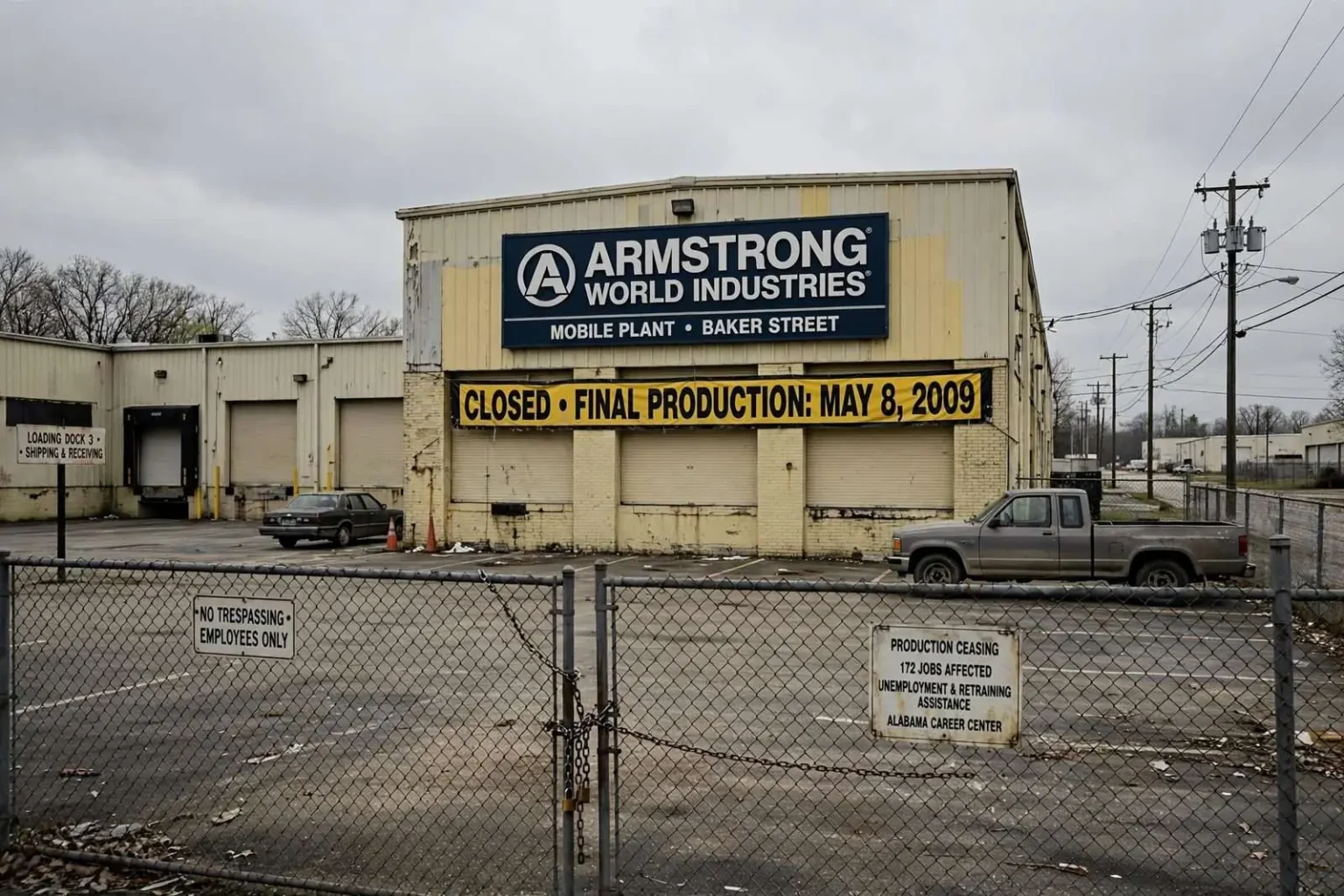
Armstrong World Industries announced in March 2009 that it would end production at its Mobile plant, putting 172 jobs at risk during the depths of the recession. The Baker Street facility made flooring, ceiling and cabinet products, and its shutdown marked one of the most significant single-employer losses to hit Mobile’s manufacturing workforce that year.
The company cited economic conditions and said its final day of production was scheduled for May 8 — a timeline that gave workers less than two months to absorb the news and begin planning for life after the plant. For a workforce of 172, the announcement landed with particular force: the country was shedding hundreds of thousands of jobs a month, and the housing-driven recession had hollowed out the very construction markets that sustained a plant making flooring and ceilings.
Workers Faced an Uncertain Transition
Employees said slowing work had led some to expect bad news, while others were caught off guard. Production lines had been running below capacity as demand for the plant’s products fell with the collapse of residential and commercial construction, and the atmosphere on the shop floor in the weeks before the announcement reflected that unease.
Workers interviewed after the announcement said they were preparing to search for other jobs as the plant wound down. Some had spent decades at the Baker Street facility, and the prospect of starting over — at whatever age, in whatever job market the spring of 2009 offered — weighed heavily in the conversations along the production line.
Company officials said severance packages were offered to salaried employees, while terms for hourly employees were still being negotiated. That distinction left the plant’s largest group of workers — the hourly production workforce — waiting for answers about what, if anything, would cushion their transition.
The closure also concerned nearby businesses that had relied on plant workers as customers. Restaurants, shops and service businesses around the Baker Street corridor counted shift workers among their regulars, and the loss of 172 steady paychecks rippled outward through the surrounding neighborhood economy.
A Recession-Era Local Impact
The announcement reflected the pressure facing manufacturing communities during the 2009 downturn. Across Alabama and the Gulf South, plants tied to construction materials, furniture and home goods were cutting shifts, laying off workers or closing outright as the housing bust erased demand downstream. Armstrong’s Mobile operation, producing finished flooring and ceiling products for builders and remodelers, sat squarely in the path of that contraction.
Nationally, the recession had begun in December 2007 and would not end until mid-2009, and manufacturing employment was among the hardest-hit categories. Companies across the building-products industry responded with plant consolidations, seeking to concentrate production in fewer, larger facilities and shut the rest. The Mobile plant’s closure fit that pattern — a capacity decision made in a market with far too little of it.
Armstrong World Industries was, at the time, one of the best-known names in American interiors — a Pennsylvania-based manufacturer whose flooring, ceilings and cabinets appeared in homes and commercial buildings across the country. The company had operated plants across the United States for more than a century, and its decisions about where to keep production running were watched closely in the towns that hosted them.
For Mobile, the loss of 172 jobs came on top of the broader erosion the recession was inflicting on the local economy. The Port City’s job market in 2009 was a mixed picture: the shipbuilding and aerospace presence at places like Austal and the growing industrial corridor around Mobile Bay offered some offset, but retail, construction and manufacturing employment across the metro area was contracting. Workers leaving Armstrong would be searching in that market — alongside hundreds of thousands of other Alabamians doing the same.
Local retraining and unemployment resources became part of the story as the May 8 date approached. Dislocated workers in Alabama could turn to the state’s career center system for unemployment claims, job search assistance and — where funding allowed — retraining programs aimed at helping manufacturing workers translate their skills to growing sectors. For older workers, the calculus was different: some would retire early rather than search, and others would take lower-paying jobs to bridge the gap.
The End of Production
The final day of production on May 8 closed a chapter for a facility that had been part of Mobile’s industrial landscape for years. Plant closings of that scale change a community’s daily rhythms — the shift-change traffic that neighborhood businesses timed their days around simply stops, and the payroll that circulated through local shops, churches and schools disappears.
For the affected workers, the plant shutdown meant not only a loss of employment but also the need to find new work in a difficult job market. National unemployment would climb past 9 percent within weeks of the closure, and in Alabama the rate was running even higher. Economists warned at the time that recession-era job losses — particularly in manufacturing — tended to leave lasting scars, with many displaced workers never returning to the wages they had earned before.
The Baker Street closure also illustrated how tightly linked construction and manufacturing had become in the economy of the 2000s. The same collapse that idled builders, realtors and subcontractors across the Gulf Coast echoed upstream to the factories that supplied them, and Mobile’s Armstrong plant stood as a local instance of that national chain reaction.
What the announcement could not capture was the human ledger: 172 households recalculating budgets in the spring of 2009, coworkers saying goodbye on a production floor for the last time, and a neighborhood adjusting to the absence of a plant that had been part of its landscape for decades. The May 8 date made it official; the recession made it harder; and for the workers of the Baker Street facility, the search for what came next began immediately.
Severance negotiations between the company and representatives of the hourly workforce became the immediate concern in the weeks after the announcement. Salaried employees knew their terms; hourly workers did not, and uncertainty over severance shaped family decisions about savings, mortgages and the timing of a job search. Plant-closing announcements of that era routinely involved unions, employee committees and company human resources offices working out final packages as the shutdown date approached.
The broader industrial context in Mobile added a bittersweet note. Even as the Baker Street plant was winding down, the region was courting new industrial investment — the steel facility under construction in north Mobile County and the aerospace work taking root at Brookley were the foundations of a manufacturing future that would eventually offset some of the recession’s losses. But those jobs were years away from hiring at scale, and they could not arrive in time for many of the workers leaving Armstrong.
Employees leaving the plant carried with them skills — machine operation, quality control, materials handling, industrial maintenance — that remained in demand wherever production continued. Workforce professionals advising dislocated manufacturing workers in that era emphasized transferable skills, resume translation and the value of certifications, even as they acknowledged that the sheer depth of the downturn meant competition for every opening.
Nearby business owners, meanwhile, braced for the change. A plant with 172 employees supports an ecosystem of lunch counters, convenience stores, auto shops and childcare providers, and the arithmetic of lost regular customers is as real to those operators as any headline about national unemployment. The weeks after the announcement were filled with the same conversations playing out in manufacturing towns across America: how long could the neighborhood absorb the loss, and what would replace the payroll.
The March 2009 announcement and the May 8 shutdown stand today as a case study of the recession’s reach — from national housing markets through building-products manufacturers to a single plant on Baker Street in Mobile, and from there into the paychecks and plans of 172 families who had done nothing wrong except be present when the economy gave way beneath them.
The story of the Baker Street plant reflects a pattern Mobile had seen before and would see again. Industrial employers rise with national demand and fall with it, and the Port City’s manufacturing workforce has long absorbed such cycles — from paper mills to chemical plants to the building-products facility that Armstrong closed. Each cycle leaves veterans of the last shutdown advising the workers of the next.
In the spring of 2009, the national mood made the closure feel part of something larger. Headlines across Alabama that season told similar stories: textile plants idled, furniture factories dark, auto suppliers slowing lines as car sales collapsed. The Armstrong announcement in Mobile arrived in that context — one more entry in a season of bad news, and for its 172 workers, the entry that mattered most.
The company’s statement pointed to economic conditions alone; officials did not tie the closure to the Mobile facility’s productivity or workforce. That distinction mattered to the employees who left the plant with their heads high — the decision was about markets, not their work, a point coworkers and neighbors repeated in the weeks after the news broke.
By summer, the Baker Street facility had gone quiet, and the story of the Armstrong closure passed from the front pages into the longer memory of Mobile’s industrial history — remembered by the workers who walked out for the last time on May 8, 2009, and by the businesses along Baker Street that felt their absence every day after.