Baldwin County Landfills to Take 500,000 Cubic Yards of Escambia County Isaias Debris After 3-1 Vote
The Baldwin County Commission voted 3-1 to accept about 500,000 cubic yards of Hurricane Isaias construction debris from Escambia County, Florida, whose landfill has about four years of life left. Commissioner Matt McKenzie voted no, citing future local needs.
BALDWIN COUNTY, Ala. — Baldwin County landfills will take in roughly 500,000 cubic yards of Hurricane Isaias debris from neighboring Escambia County, Florida, after the Baldwin County Commission voted 3-1 on Tuesday, Oct. 20, to accept the material from across the state line.
County waste officials told commissioners that burying that much storm debris in Escambia County’s own landfill would be “detrimental” to a facility that is already nearing the end of its useful life. Baldwin County, they said, has the room to spare.
The decision was not unanimous. District 2 Commissioner Matt McKenzie, who will leave office in November, cast the lone “no” vote, saying he worried about using up landfill space Baldwin County may need after its own future disasters.
Why Escambia County needs help
Terri Graham, chief executive officer of the Solid Waste Disposal Authority of Baldwin County, laid out the case for accepting the debris. She said the Escambia County landfill does not have much time left.
“Their landfill has about four years of life left,” Graham said. “I think the 500,000 cubic yards of construction and demolition debris for their landfill would probably be detrimental.”
Graham said Baldwin County’s landfills have ample room to handle the load, while Escambia County’s do not.
“I don’t think they are ready as Escambia County to take on that volume,” she said.
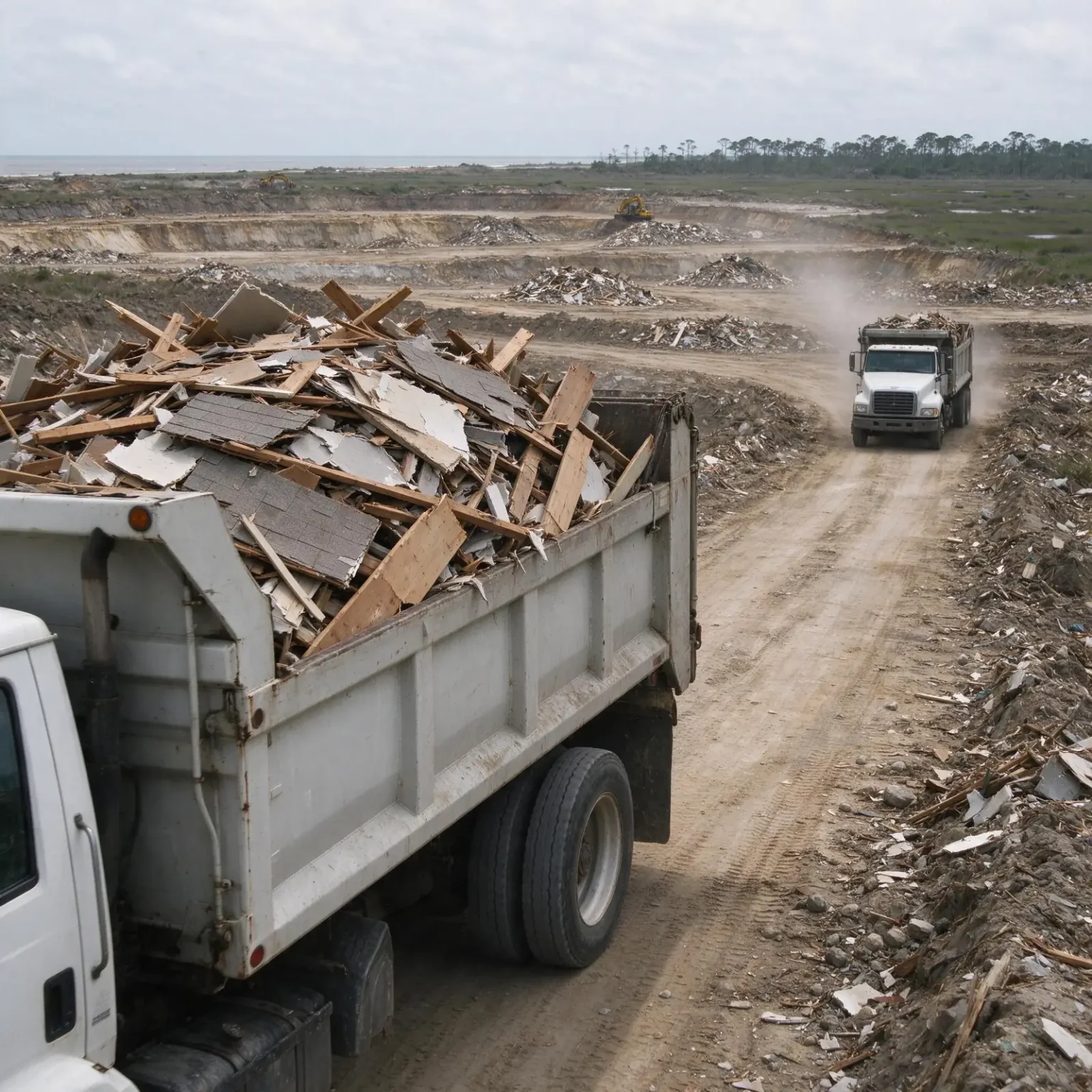
The material is construction and demolition debris, the category that typically includes broken lumber, roofing, drywall, fencing, siding and other building materials torn loose or damaged by a storm. After a hurricane, this kind of debris piles up quickly along streets as homeowners and contractors tear out damaged roofs and walls. Unlike household garbage, it is bulky and takes up a large amount of landfill space for its weight.
How the debris will be handled
According to Graham, the Escambia County material will be spread across debris fields at three different Baldwin County landfills rather than concentrated at a single site. The project is expected to continue through December.
The Solid Waste Disposal Authority will also set a rate for Escambia County to pay to offset the cost of transporting the debris to Baldwin County sites. The specific rate had not been announced at the time of the vote.
Key details of the arrangement, as described by county officials:
- Volume: About 500,000 cubic yards of construction and demolition debris
- Source: Escambia County, Florida, from Hurricane Isaias
- Destination: Debris fields at three Baldwin County landfills
- Cost: The Solid Waste Disposal Authority will set a rate for Escambia County to offset transportation costs
- Timeline: Through December
- Vote: 3-1, with Commissioner Matt McKenzie opposed
McKenzie: ‘I care about taking up space for the future’
McKenzie said before the vote that he was hesitant to approve bringing another government’s storm debris into Baldwin County landfills when that space could be needed for local disasters down the road.
“I’m not against helping our partners,” he said. “I care about taking up space for the future of Baldwin County.”
His concern reflects a basic reality of landfill planning. Landfill capacity is finite, and opening new disposal sites can take years of planning, permitting and construction. Every cubic yard of space used today is space that is not available later, whether for routine waste from a growing population or for the surge of debris that follows a major storm.
The other three commissioners, however, voted to accept the material, siding with waste officials who said the county’s landfills could absorb the load.
Lessons from Hurricane Sally
Baldwin County knows firsthand how much debris a hurricane can leave behind. After Hurricane Sally made landfall near Gulf Shores on Sept. 16, 2020, roughly 4.5 million cubic yards of construction and demolition debris was placed in landfills and waste sites across the county, Graham said. That is about nine times the volume Baldwin County has now agreed to take from Escambia County.
The county has also grown considerably since then. District 1 Commissioner Jeb Ball and other county officials said during a meeting in early October to discuss preparations for Hurricane Isaias that Baldwin County has added around 40,000 residents since Sally. More homes and businesses mean more potential debris when the next major storm hits, which is part of the reason McKenzie urged caution.
Sally’s slow crawl across the coast, with heavy rain and hurricane-force winds, left damaged roofs, fallen trees and wrecked structures from the Eastern Shore to Orange Beach and into the Florida Panhandle. The cleanup took months, and the debris hauled away during that recovery remains one of the county’s main reference points when officials discuss storm preparedness.
Isaias spared Baldwin, hit the Panhandle
Hurricane Isaias appeared headed for the Baldwin County area as a potential Category 3 storm as it raced toward the northern Gulf Coast earlier this month. Instead, the storm shifted east and made landfall near Destin, Florida, east of Pensacola, on Friday, Oct. 9, as a Category 2 hurricane.
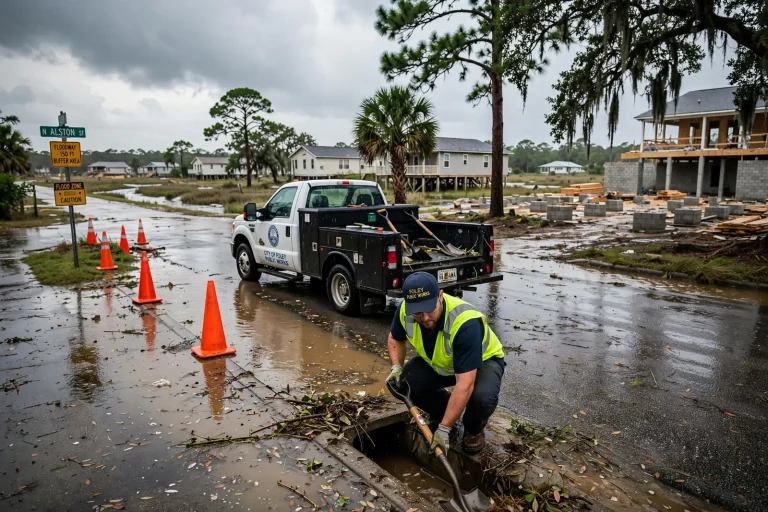
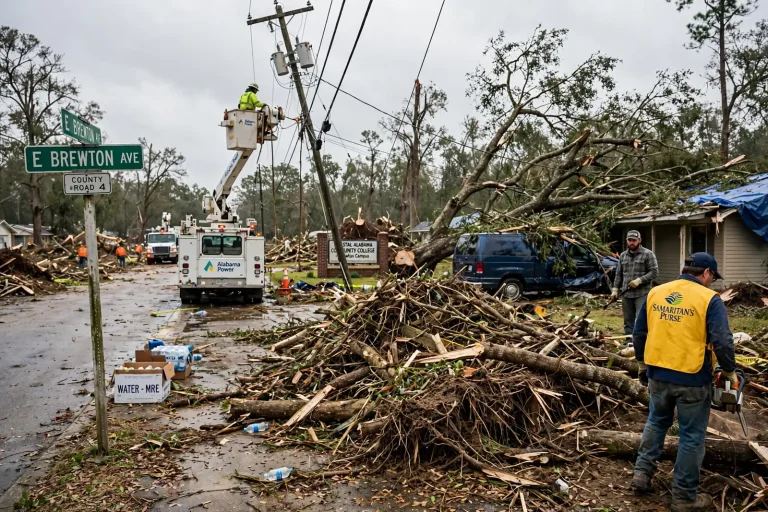
That late turn spared coastal Alabama the worst of the storm. Baldwin County dealt with fallen trees, scattered damage and power outages, but county officials reported no injuries. The heavier structural damage came on the Florida side of the line, where communities in Escambia, Santa Rosa and Okaloosa counties saw roofs torn off, trees toppled and widespread power outages. Florida officials attributed two deaths in the Panhandle to the storm, including one in Escambia County, Florida, where a tree fell on a home.
Several Alabama counties experienced tropical storm conditions as Isaias moved inland. Possible assistance from the Federal Emergency Management Agency for affected areas was still pending as of Wednesday, Oct. 21.
How storm debris cleanup works
Debris removal is usually one of the largest and longest parts of hurricane recovery. In the days after a storm, residents typically sort damaged materials and pile them at the curb, often in separate piles for vegetation, construction and demolition debris, appliances and household hazardous waste. Local governments or their contractors then make repeated passes through neighborhoods to collect it.
Vegetative debris, such as limbs and downed trees, can often be ground into mulch or otherwise reduced in volume. Construction and demolition debris is harder to shrink. Much of it must be buried, which is why a large storm can consume years’ worth of landfill capacity in a matter of months.
When a disaster is federally declared and a community qualifies, FEMA’s Public Assistance program can reimburse eligible local governments for a share of debris removal costs. Whether such help will be available for this storm remains to be seen, as federal decisions on Isaias assistance were still pending this week.
For communities with limited disposal space, sending debris elsewhere can help preserve their own landfills for everyday waste. For the receiving community, the trade-off is the space that the incoming material fills, the question at the center of Tuesday’s debate in Baldwin County.
A regional approach to recovery
Baldwin County and Escambia County, Florida, are separated only by the Perdido River and Perdido Bay, and the two communities are closely tied. Thousands of people cross the state line each day for work, shopping, medical care and recreation, and the Pensacola and Baldwin County areas share beaches, waterways and, often, the same storms.
Cooperation between neighboring governments is common after hurricanes. Utility crews, emergency responders and public works employees routinely cross county and state lines through mutual aid arrangements to help communities recover faster. Sharing disposal capacity is another form of that cooperation, particularly when one community has room and the other does not.
Commissioners who supported the agreement framed it as helping a neighbor in need while being paid to offset the costs. McKenzie, while voting against it, also stressed that he was not opposed to helping partners in principle, but wanted the county to weigh its own long-term needs first.
What happens next
With the commission’s approval in place, debris from Escambia County is expected to begin moving to Baldwin County landfills, where it will be spread across debris fields at three sites. The work is scheduled to continue through December, and the Solid Waste Disposal Authority will set the rate Escambia County pays to cover transportation costs.
For Baldwin County residents, officials have not indicated that the arrangement will affect local garbage collection or access to county waste facilities. Residents with questions about debris disposal, landfill hours or local solid waste services can contact the Solid Waste Disposal Authority of Baldwin County.
The vote also adds to a broader conversation about how Baldwin County plans for growth. As the county continues to add residents, decisions about landfill space, drainage, roads and other infrastructure will shape how well it handles both everyday demand and the next major hurricane. Baldwin County Commission meetings are open to the public, and agendas are posted in advance on the county’s website for residents who want to follow those decisions.