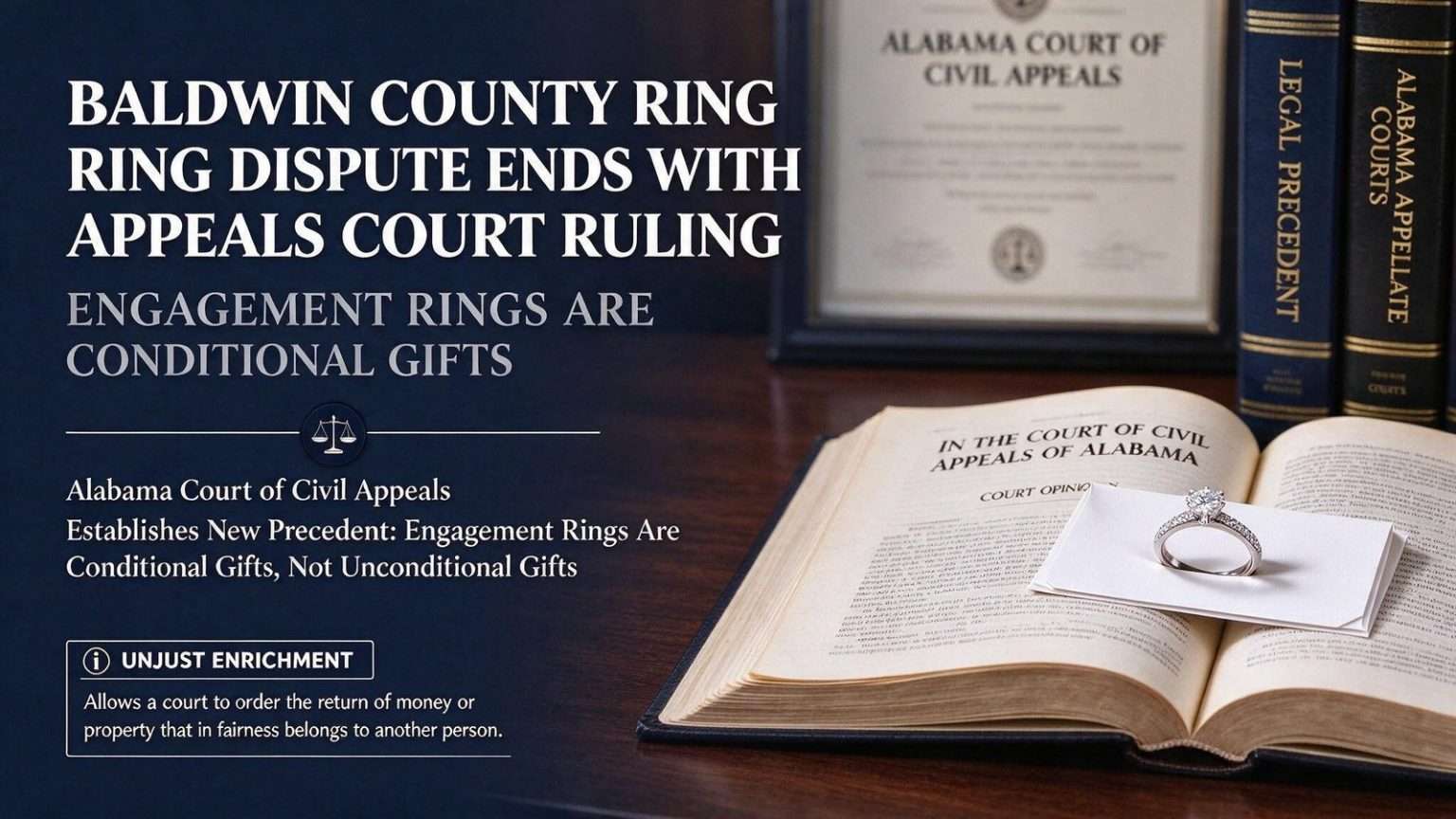
Close-up of a diamond engagement ringA diamond engagement ring, the type of gift at the center of a Baldwin County court case.

The Alabama Court of Civil Appeals has issued a precedent-setting ruling in a Baldwin County dispute over a $32,000 diamond engagement ring, declaring for the first time under state law that such rings are conditional gifts that must be returned if a marriage never happens.

The 23-page opinion, handed down Friday, resolved a years-long legal fight between Terrell Hattaway and Valerie Kathy Coulter, a Baldwin County couple who were living together and in a romantic relationship around Christmas 2018. According to court records, Hattaway gave Coulter a gift bag that Christmas containing an ornament and a 2.5-carat diamond ring. Hattaway testified that he dropped to one knee and proposed as Coulter opened the bag. Coulter disputed that account, testifying that Hattaway never formally proposed or told others the couple was engaged, though she said she assumed the ring was meant as an engagement ring.

Court records show Hattaway had given Coulter other expensive gifts during their relationship, including a $10,000 diamond tennis bracelet, and had not expected those items to be returned. The ring, he argued, was different because it was tied to a marriage that never took place.

Over the following months, the two disagreed on whether they had made a genuine effort to set a wedding date. Hattaway testified he tried repeatedly to settle on a date and that the couple attended counseling to work through relationship issues. Coulter testified that Hattaway was the one who refused to discuss setting a date. The relationship ended in September 2019 when Coulter moved out of the home the couple shared.

By November 2019, Hattaway had an attorney send Coulter a letter demanding the ring back. Coulter initially told Hattaway she had thrown the ring into the Intracoastal Waterway, but she later admitted at trial that she had sold it for $10,000 sometime in 2020, saying she needed money after losing her job during the COVID-19 pandemic.

Hattaway sued Coulter on claims of conversion, infliction of emotional distress and unjust enrichment. A Baldwin County judge dismissed the conversion and emotional distress claims before trial. Following a bench trial earlier this year, Presiding Circuit Judge Clark Stankoski ruled against Hattaway on the remaining unjust enrichment claim, finding the ring had been given as an unconditional gift rather than one tied to any specific condition or promise.

In his written ruling, Stankoski did not hide his discomfort with the outcome, writing that Coulter had “an outright moral obligation to return the engagement ring” and that her justification for selling it “is telling to the Court as to her moral compass.” But Stankoski said he was bound by existing Alabama precedent, which at the time did not clearly classify engagement rings as conditional gifts.

See also  Third-Party Talk and Courthouse Upsets: More Super Tuesday Winners and Losers

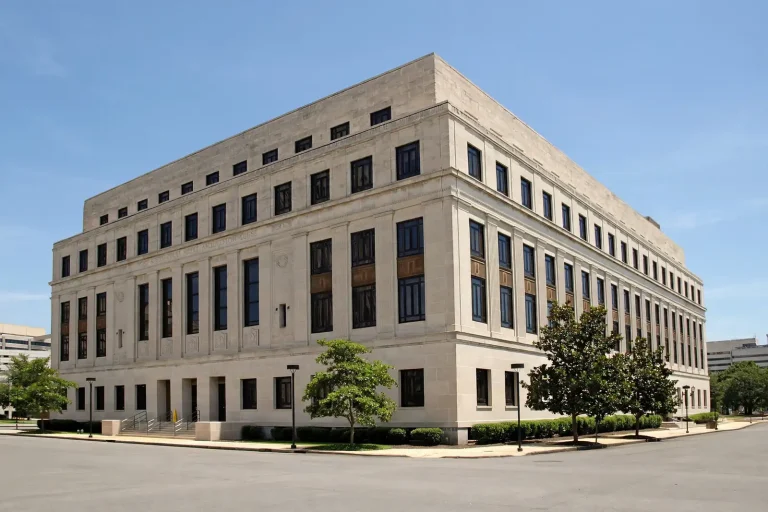
On appeal, the Alabama Court of Civil Appeals took a different view of how the law should apply. Presiding Judge William C. Thompson, writing for the court, found that an engagement ring is by its nature “a gift conditioned upon the fulfillment of marriage.” Because the marriage never happened, the court ruled, Hattaway was entitled to have the ring, or its value, returned to him.

“The evidence unequivocally establishes that, after the engagement ended, Coulter refused to return the ring or its value, which in equity and good conscience belonged to Hattaway,” Thompson wrote in the opinion.

The ruling is considered significant because Alabama previously had not directly addressed whether engagement rings should be treated as conditional or unconditional gifts under state law, an issue courts in most other states had already settled.

Hattaway was represented at trial by attorney Meggan Huggins and on appeal by attorney Tina Moon. In a joint statement issued after the ruling, the two said they were “extremely pleased with the recent ruling recognizing engagement rings as a conditional gift,” adding that Alabama is now in line with the majority of other states on the issue and that their client was relieved to see the matter resolved.

Coulter was represented by attorney Abner Powell IV. As of the ruling, no date had been set for a possible rehearing.

This story unfolds across the distinctive landscape of South Alabama, a region defined by its pine forests, winding rivers, and Gulf Coastal Plain geography. The area’s communities—from the port city of Mobile to the agricultural heartlands of the Black Belt—share interconnected economies and histories shaped by timber, agriculture, shipping, and more recently, aerospace and advanced manufacturing. Local governance across county lines often coordinates on regional planning, workforce development, and infrastructure projects that affect residents throughout the southern tier of the state. The geography itself shapes daily life: low-lying coastal plains face hurricane exposure, while inland counties contend with river flooding and rural transportation challenges. Understanding the setting helps explain why local decisions carry weight far beyond municipal boundaries.

Economic activity in South Alabama reflects both deep-rooted industries and emerging sectors. The region’s forest products industry remains a cornerstone, while the Port of Mobile anchors global trade connections. Aerospace manufacturing has grown significantly around the Mobile Aeroplex at Brookley, and automotive suppliers feed assembly plants across the Southeast. Workforce development initiatives through community colleges and the Alabama Industrial Development Training program aim to align skills with employer needs. Broadband expansion and highway improvements—including the I-10 Mobile River Bridge project and I-65 corridor enhancements—address longstanding connectivity gaps that affect business recruitment and quality of life. Small businesses, agriculture, tourism, and the service sector round out a diverse regional economy that has weathered national downturns through a mix of resilience and adaptation.

See also  Eddie Tyler Agrees to Take Baldwin County Schools Superintendent Job

The environmental context of South Alabama is inseparable from its waterways and Gulf coastline. The Mobile-Tensaw Delta, one of the nation’s most biodiverse river systems, filters freshwater into Mobile Bay while supporting fisheries, recreation, and flood mitigation. Coastal communities face recurring hurricane exposure and long-term sea-level considerations, shaping building codes, insurance markets, and emergency planning. Conservation efforts by organizations like the Alabama Coastal Foundation, The Nature Conservancy, and state agencies work to preserve critical habitat while balancing development pressures. Water quality monitoring, oyster reef restoration, and living shoreline projects represent collaborative approaches to sustaining the natural resources underpinning both ecology and economy. Inland, working forests and farmland form the backbone of a rural landscape where land use decisions carry generational significance.

Healthcare delivery in the region contends with the dynamics of a largely rural service area anchored by regional medical centers. USA Health’s University Hospital and Children’s & Women’s Hospital in Mobile provide tertiary care, while community hospitals in Baldwin, Escambia, Monroe, Clarke, and other counties serve as critical access points. The expansion of telehealth, federally qualified health centers, and rural health clinics addresses provider shortages that have long challenged underserved areas. Public health departments coordinate on immunization, disease surveillance, maternal health, and emergency preparedness, often in partnership with the Alabama Department of Public Health and federal HRSA-supported programs. Access to care remains a defining issue for the region, influencing everything from economic development pitches to quality-of-life rankings that prospective residents weigh when deciding where to live and work.

Public safety across South Alabama depends on layered coordination among municipal police, county sheriffs, state troopers, and federal partners. Sheriffs’ offices in rural counties often serve as the primary law enforcement presence, while city departments handle municipal policing and community outreach. Emergency management agencies at the county and state level plan for hurricanes, flooding, and other hazards, coordinating shelters, evacuations, and recovery aid. Fire districts, volunteer rescue squads, and emergency medical services bridge gaps in coverage where paid staffing is thin. The Alabama Law Enforcement Agency and programs like AMBER Alert and the state fusion center extend resources regionally. How these agencies communicate and cooperate—through joint task forces, mutual aid compacts, and shared dispatch systems—directly affects response times and community trust in the places where people live and work.

Sport occupies a central place in South Alabama’s community life, from Friday-night high school football that draws whole towns to the sidelines, to college athletics at the University of South Alabama and across the state. Mobile’s longstanding role as a cradle of football talent—producing legends who went on to the professional ranks—is a point of regional pride, reinforced by events like the Senior Bowl, which has showcased NFL hopefuls in the city for decades. Youth leagues, recreation departments, and booster clubs sustain participation at the grassroots level, while the area’s coastal setting supports fishing tournaments, regattas, and beach athletics that reflect the local environment. The economic and social lift from sporting events—hotel stays, restaurant traffic, and civic visibility—makes athletics a quiet but steady contributor to the regional identity and to the small-business economy that surrounds game days.

See also  Woman Airlifted to ICU After High-Speed Motorcycle Crash on I-10 in Baldwin County

Animal welfare organizations across South Alabama operate with limited resources and a steady stream of need. Municipal animal shelters in Mobile, Baldwin, and neighboring counties manage intake, adoption, and reunification efforts, often partnering with nonprofit rescues that provide foster networks, spay-neuter assistance, and transport to out-of-region adopters. Volunteer-driven groups fill gaps that public funding cannot, relying on donations, fundraisers, and grant support to keep operations running. The Gulf Coast’s position as both a tourist destination and a growing residential region has increased demand for pet services, while rural areas contend with stray and feral populations that strain capacity. Community education on responsible ownership, microchipping, and low-cost veterinary care has emerged as a practical lever for reducing shelter overcrowding. Efforts like local giving campaigns demonstrate how resident participation can translate directly into care for animals that might otherwise go without.

As this situation continues to develop, stakeholders across the affected communities will monitor outcomes and adjust responses accordingly. The interconnected nature of South Alabama’s counties means that decisions in one jurisdiction often ripple outward, affecting neighbors in ways that underscore the value of regional communication and coordinated planning. Residents seeking to stay informed can engage with local government meetings, school board sessions, and community forums where these matters are discussed in public. The ongoing dialogue between officials, experts, and citizens reflects the democratic processes through which the region navigates change while preserving the character and resilience that define its communities. Continued attention from local news outlets helps ensure that decisions remain transparent and that the people most affected have the information they need to participate in shaping what happens next.