Baldwin County Forum Examined Proposed School Sales Tax in 2010
Baldwin County residents and school leaders discussed a proposed one-cent sales-tax referendum at a Bay Minette forum in March 2010, focusing on jobs, spending priorities and accountability.
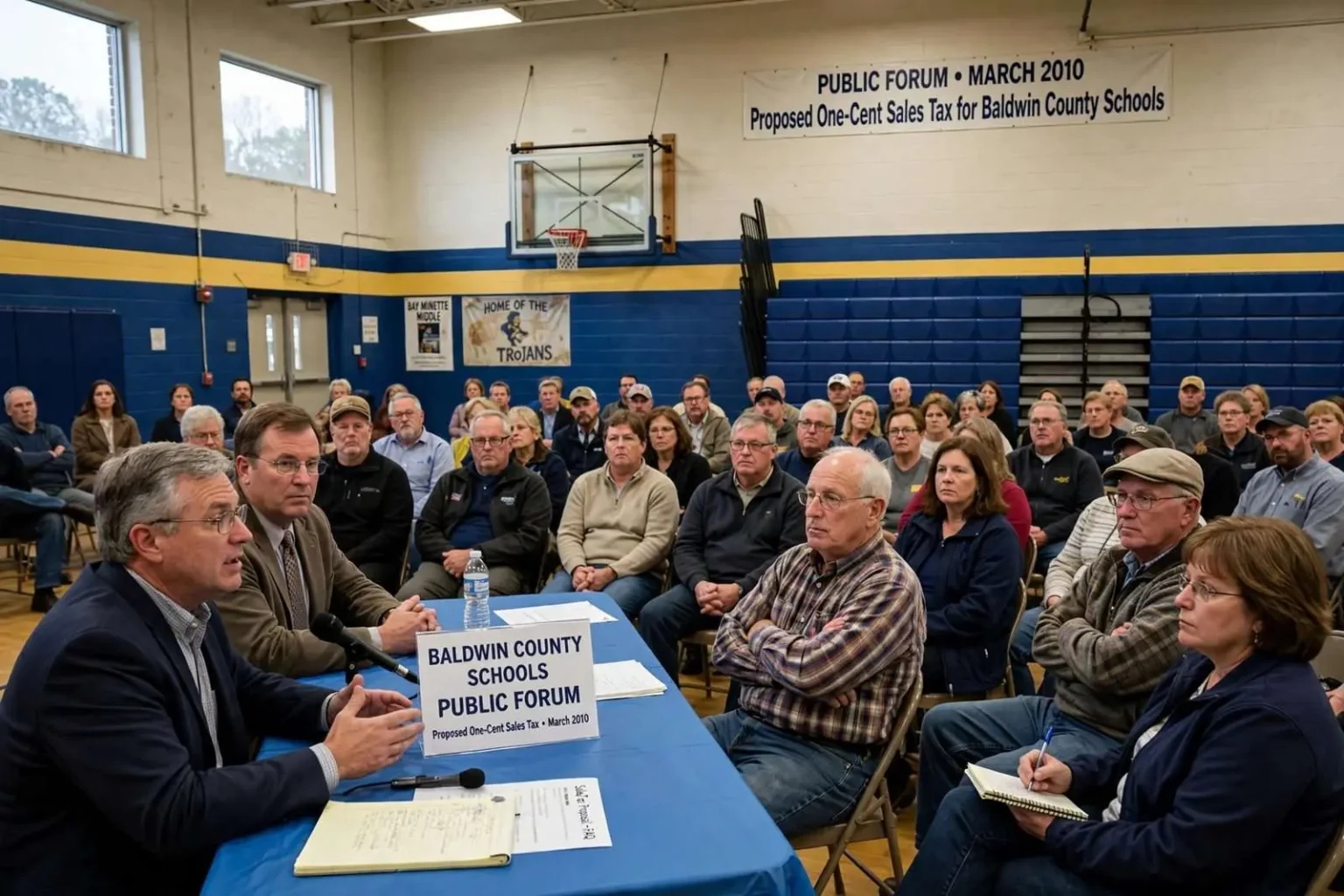
Baldwin County residents gathered at Bay Minette Middle School in March 2010 to question school officials about a proposed one-cent sales-tax increase for public schools. The forum came ahead of a March 23 referendum, giving voters in the county seat area one of their last chances to press school leaders directly on the measure before ballots were cast.
More than 50 people attended, and the conversation centered on whether voters trusted the school system to direct additional revenue toward classrooms, staffing and core educational needs. The gathering was one of the public-facing moments in a campaign that had been building across Baldwin County as the district laid out its case for new revenue amid tightening budgets.
The proposed penny would ride on top of the sales taxes already collected across the county, and its supporters framed it as the difference between protecting the school system’s core work and watching programs and positions disappear. Its skeptics, many of them in the room that night, framed it as a test of whether the district had earned the benefit of the doubt with the money it already had.
Jobs and spending priorities
School-system human resources director Lester Smith told those attending that more positions could be at risk if the measure did not pass. The warning tied the referendum directly to the district’s payroll, making the choice facing voters about jobs as much as about budgets and putting a concrete face on what a failed vote would mean for staffing levels in the county’s schools.
Participants pressed leaders about how the money would be allocated and whether it could be spent on athletic facilities rather than instruction. The question reflected a recurring anxiety in school-tax campaigns, where taxpayers want assurance that new revenue will reach the classroom before it reaches the bleachers, and it drew a direct response from the officials on the panel.
School Board member Robert Wills said teachers and education were the priority. His answer aligned the board’s position with the classroom-first framing that supporters of the measure had been advancing, and it sought to draw a line between the system’s needs and the capital projects that voters often suspect new taxes will fund.
Smith said the proposal was not intended to fund new classrooms or other new construction, responding to concerns that voters wanted a clearer accounting of where tax proceeds would go. The clarification aimed to separate the operating needs the penny was designed to address from the building projects that a different stream of money would have to cover, if it was ever sought at all.
A debate about confidence
Several residents said the referendum turned on confidence in public institutions as much as on the value of school funding. Some wanted tighter assurances that money would not be wasted; others argued that the system needed resources to avoid further reductions. The split in the room mirrored the argument playing out across the county in the days before the vote.
Smith acknowledged the concern, saying public trust was a challenge for government at every level. His answer conceded the core of the skeptics’ position — that the referendum was a referendum on credibility as much as on policy — while making the case that the district’s stewardship of its existing dollars had earned it the chance to ask for more.
The exchange reflected a difficult financial period for Baldwin County schools, which had already been navigating budget pressure, layoffs and questions about long-term funding. The district, one of the largest and fastest-growing in Alabama, had watched state education dollars contract in the aftermath of the recession, and local leaders had turned to the county’s voters with the argument that local revenue was the stabilizer the state could no longer be.
The economic backdrop mattered to the audience in Bay Minette as much as to the officials answering questions. Households across the county were feeling the same downturn that had squeezed school budgets, and every dollar the penny represented was a dollar residents said they were hard-pressed to spare — a tension that ran through nearly every question asked that night.
What the forum showed
The questions from the floor ranged beyond the tax itself, touching on the district’s priorities, its communication with taxpayers and the standard of proof voters should demand before approving new revenue. The officials on the panel took the questions in turn, and the tone of the evening stayed with the respectful give-and-take that public forums are designed to produce.
This account preserves a public meeting held before the referendum. It reports the proposal and the competing views expressed at the time; it does not represent the result of the March 23 vote or later decisions about school funding. What the record shows is a district making its case directly to the public it serves, and a public willing to ask hard questions before answering at the ballot box.
Baldwin County schools in the recession era
The timing of the 2010 forum placed the referendum in one of the hardest budget stretches Baldwin County schools had faced. State education funding had been cut repeatedly as revenue collapsed, and districts across Alabama were trimming positions, freezing hiring and drawing down reserves to keep classrooms staffed. Baldwin County, with a student population spread across one of the largest geographic school districts in the state, felt each round of state cuts across a long list of campuses.
The county’s growth added pressure of its own. New residential development in communities along the Eastern Shore and the Interstate 10 corridor kept enrollment climbing, meaning the district needed more teachers, more classrooms in use and more buses on routes even as its funding shrank. That arithmetic — growing needs and shrinking revenue — was the case supporters carried into meetings like the one at Bay Minette Middle School.
Sales taxes have long been the local funding tool Alabama school systems turn to, precisely because property tax limitations leave districts dependent on other sources for anything beyond their base budgets. A one-cent countywide sales tax, if approved, would have joined the ranks of the local levies that separate Alabama’s best-funded school systems from the rest, with proceeds flowing to the operating costs that keep schools open.
The forum format itself reflected how such campaigns are run in Baldwin County. Rather than a rally or a single presentation, the district faced its public in a question-and-answer setting where the audience set the agenda, and the honesty of the answers — including the acknowledgment that public trust was the real obstacle — became part of the record on which voters would judge the request.
The wider meaning of the vote
For the residents of Bay Minette and the surrounding communities, the referendum was a local decision with countywide consequences. School funding shapes property values, workforce recruitment and the tax base itself, and the officials and residents in that gymnasium were negotiating, in effect, what kind of school system Baldwin County would choose to maintain in a lean decade.
Whatever the March 23 vote produced, the meeting preserved the terms of the debate as it stood in the spring of 2010: a district asking for a penny, residents asking for accountability, and a school system whose staffing and classrooms hung on the answer.
Bay Minette and the county’s school politics
The choice of Bay Minette Middle School as the forum site put the meeting in the geographic heart of the county. As the county seat, Bay Minette sits north of the population boom along the bay, and its schools serve communities that sometimes feel overshadowed by the fast-growing cities to the south. Hosting the referendum conversation there gave north county residents a direct line to the officials asking for their votes.
Meetings of this kind also served the district’s own understanding of the electorate. Questions asked in a gymnasium in March tend to reappear in later campaigns, and the concerns raised that night — about waste, about athletics versus academics, about trust in institutions — are the standing themes of school-finance debates across Baldwin County and Alabama alike.
The forum’s attendance of more than 50 residents was a serious turnout for a weeknight tax discussion, reflecting how much rode on the measure for the families and employees of the school system. Parents calculating what larger class sizes would mean, and school employees weighing the job warnings that Smith delivered, had concrete reasons to fill the seats that night.
The debate over the proposed one-cent sales tax in 2010 remains a reference point in Baldwin County’s ongoing conversations about how its schools are paid for. Every subsequent request the district has made to its voters has been measured against the arguments heard that spring: the urgency of protecting teachers and classrooms, the demand for accountability in how new revenue is spent, and the enduring question of whether the public’s confidence in its institutions can bear the weight of a penny.