Baldwin School Leaders Warned of Possible Closures During 2009 Budget Crisis
Baldwin County school leaders warned in November 2009 that more layoffs and possible school closures could follow without relief from the district’s budget crisis.
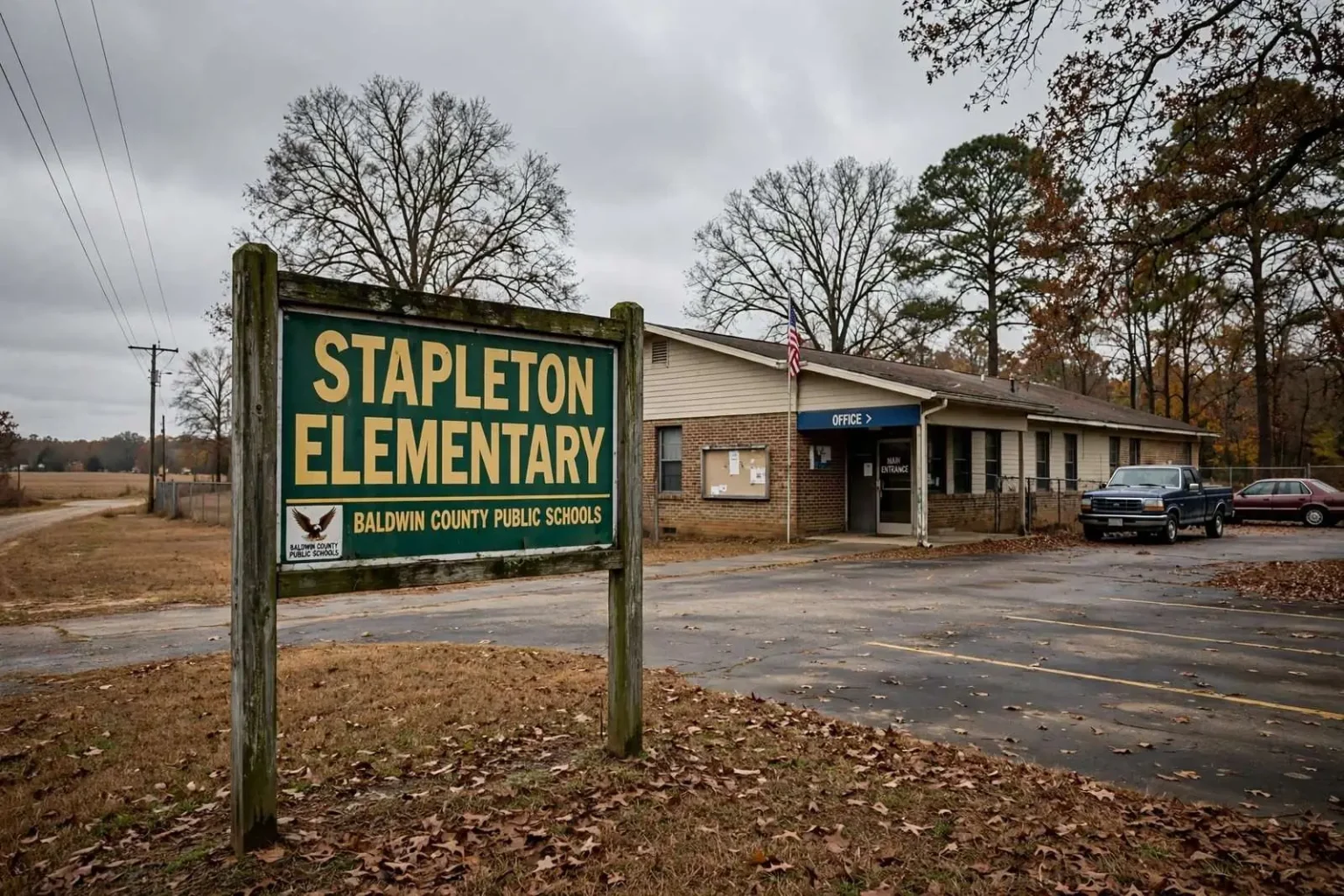
Baldwin County school leaders warned in November 2009 that continuing financial problems could lead to more layoffs and possible school closures. The Board of Education said the budget crisis threatened to deepen unless the district found new revenue or other financial relief.
School system spokesman Terry Wilhite described the situation as severe and said additional cuts could affect both employees and campuses. The warning put Baldwin County’s families on notice that the recession squeezing tax revenues across Alabama had reached the point where the district’s discussion had moved past trimming budgets and toward the most drastic option a school system can consider — shutting a school down.
The context made the warning credible rather than rhetorical. Baldwin County Public Schools serves one of the fastest-growing student populations in Alabama across one of its largest geographic districts — a county that stretches from the suburban corridors along Mobile Bay through farming communities, bayou towns, and beach-fronting municipalities. Growth of that kind normally means building; a fiscal crisis of the kind 2009 delivered meant the opposite conversation. The district’s funding, like every Alabama district’s, rides on the state Education Trust Fund, which depends on income tax and sales tax collections — exactly the revenue streams the recession was collapsing.
Stapleton Elementary discussed as a possibility
Officials did not confirm a list of schools that might close, but said Stapleton School could be among the locations considered. Wilhite said schools with lower enrollment and higher operating costs were often examined during difficult budget periods. Stapleton Elementary had fewer than 300 students, and the school system said closing a campus could save millions of dollars needed to address the larger shortfall.
The arithmetic behind such a discussion is stark. A small school carries fixed costs — staff, utilities, maintenance, transportation routing — that do not scale down with its enrollment. Fewer than 300 students in a county of the district’s size makes a campus a candidate for the kind of review Wilhite described, precisely because its per-pupil operating cost runs higher than a larger school’s, and because consolidating its students into nearby schools could eliminate an entire building’s overhead.
Stapleton sits in northern Baldwin County, a rural community whose elementary school functions as more than a classroom building. In communities of that size, the school hosts ballgames, meetings, and the everyday gatherings that make a place a community; the prospect of losing it lands differently there than a spreadsheet suggests. The prospect alarmed families in a community already facing the impact of recession-era reductions.
The caution in the announcement was deliberate. Naming no confirmed list of schools avoided panic and avoided pinning a target on any single campus before the district had made a decision; acknowledging Stapleton as a possibility acknowledged what the enrollment math already showed. Between those two positions lay months of budget work that would determine whether the discussion became a plan.
Options appeared limited
School leaders said borrowing money or receiving federal and state assistance could help avoid closures and further layoffs. But they also acknowledged that statewide proration and the broader recession could make those options difficult.
Proration is Alabama’s mechanism for mid-year education cuts, and by late 2009 every district in the state had felt it: when Education Trust Fund collections fall below forecast, the state slashes allocations across the board, and districts absorb the reductions in the middle of a school year with budgets already committed. No local savings plan can fully insulate a district from that kind of cut, which is why the Baldwin County board’s warning extended beyond its own management to the state’s fiscal condition.
Borrowing, the other option on the table, carries its own constraints. Districts that secure short-term credit to bridge a cash-flow gap must repay it from future allocations — and future allocations were the very thing proration kept reducing. Federal stimulus money of the era offered partial relief, but it arrived with eligibility rules and time limits, and it could not paper over a structural revenue shortfall. School leaders were effectively saying: help exists, but every form of it is strained, conditional, or temporary.
The warning came amid a sequence of financial actions by Baldwin County schools, including staffing cuts, program reductions and efforts to secure short-term credit. Those steps — the standard recession playbook of attrition, trimming, and bridge financing — had already been taken, and the district’s message in November 2009 was that they had not been enough: the discussion had reached closures.
What a closure decision involves
Closing a school is never a single decision but a sequence: enrollment and cost analysis, board discussion, public meetings, and a vote — with families along the way given the chance to argue for their campus. In a district the size of Baldwin County’s, the conversation also touches transportation, since consolidating a rural school re-routes its students onto buses that may travel significantly farther, and it touches staffing, since consolidation reshapes which teachers and staff work where.
The millions a closure can save come from the elimination of an entire building’s operation — its utilities, custodial and administrative staffing, maintenance, and the duplication of services a small campus requires. But the savings arrive alongside costs the spreadsheet captures less easily: longer bus rides for young children, the loss of a community anchor, and the signal a closure sends to a rural area already watching its institutions consolidate away.
That is why the November 2009 warning’s careful language mattered. The board did not announce a closure; it announced that closures had entered the range of options. In school finance, that shift is itself news — it tells employees that jobs beyond the staffing cuts already made are in question, and tells communities that the buildings at the center of their towns are on a list of possibilities.
The district’s financial sequence
The discussion around possible closures reflected how far the district might need to go if revenue did not improve. The steps already taken — staffing cuts, program reductions, and efforts to secure short-term credit — represent the standard order of operations in a school fiscal crisis, and Baldwin County had worked through them.
Staffing cuts reach a district’s largest expense, its people, and Baldwin County’s reductions in that period meant positions eliminated through attrition and layoffs alike. Program reductions trim electives, instructional support, and the enrichment offerings that are easiest to cut and hardest to restore. Short-term credit — borrowing against anticipated allocations — bridges the months when state money arrives late or under-filled, at the price of interest and of future flexibility.
Each step postpones the last resort. None of them eliminates a building; only a closure does that. The board’s November message — that the crisis threatened to deepen unless new revenue or relief arrived — was in effect a deadline: the district could not repeat the same three moves indefinitely.
The state backdrop
Baldwin County’s crisis was Alabama’s crisis in miniature. The same recession that battered the county’s coastal economy and its growth-driven tax base had cut state education revenue statewide, and districts across Alabama spent 2009 and the years that followed absorbing proration, cutting staff, and debating the same hard options Baldwin County’s board was discussing. Rural districts with small campuses — of which Alabama has many — faced the closure question most acutely, because a small school’s economics are most exposed when revenue falls.
For Baldwin County specifically, the paradox was that its student population kept growing even as its funding fell. Rapid growth normally brings new tax revenue with it, but school funding lags growth — new residents’ children arrive before the taxes that follow them — and the recession suppressed the revenue growth while doing nothing to slow the enrollment. The district was, in effect, being asked to serve more students with less money per student, year after year.
The historical record
This article preserves the November 2009 warning as a historical record. It does not state whether Stapleton School or any other campus ultimately closed as a result of that discussion.
That boundary matters for readers encountering the account years later. A warning issued in a budget crisis is not an outcome; districts revisit, negotiate, find revenue, and sometimes reverse course entirely. What the record shows is where Baldwin County stood in November 2009: a large, fast-growing district that had cut staffing, reduced programs, sought short-term credit, and was now discussing — publicly, through its board and its spokesman — the possibility of closing schools, with Stapleton Elementary named as the kind of campus under consideration.
The warning’s substance can be summarized from the record as it stood: severe financial condition; layoffs and closures on the table; borrowing and outside assistance identified as possible relief, but constrained by proration and recession; and no confirmed list of schools — only the acknowledgment that a campus of Stapleton’s size and cost profile could be considered. Whatever the district’s subsequent decisions, the November 2009 document of that discussion stands as a snapshot of an Alabama school system confronting, out loud, the arithmetic of the recession.