
Coastal Money Rallies to Robert Bentley After GOP Gubernatorial Nomination
Campaign finance records showed a wave of Mobile and Baldwin County support flowing to Republican gubernatorial nominee Robert Bentley after he won the party's nod, with several coastal donors giving five figures.
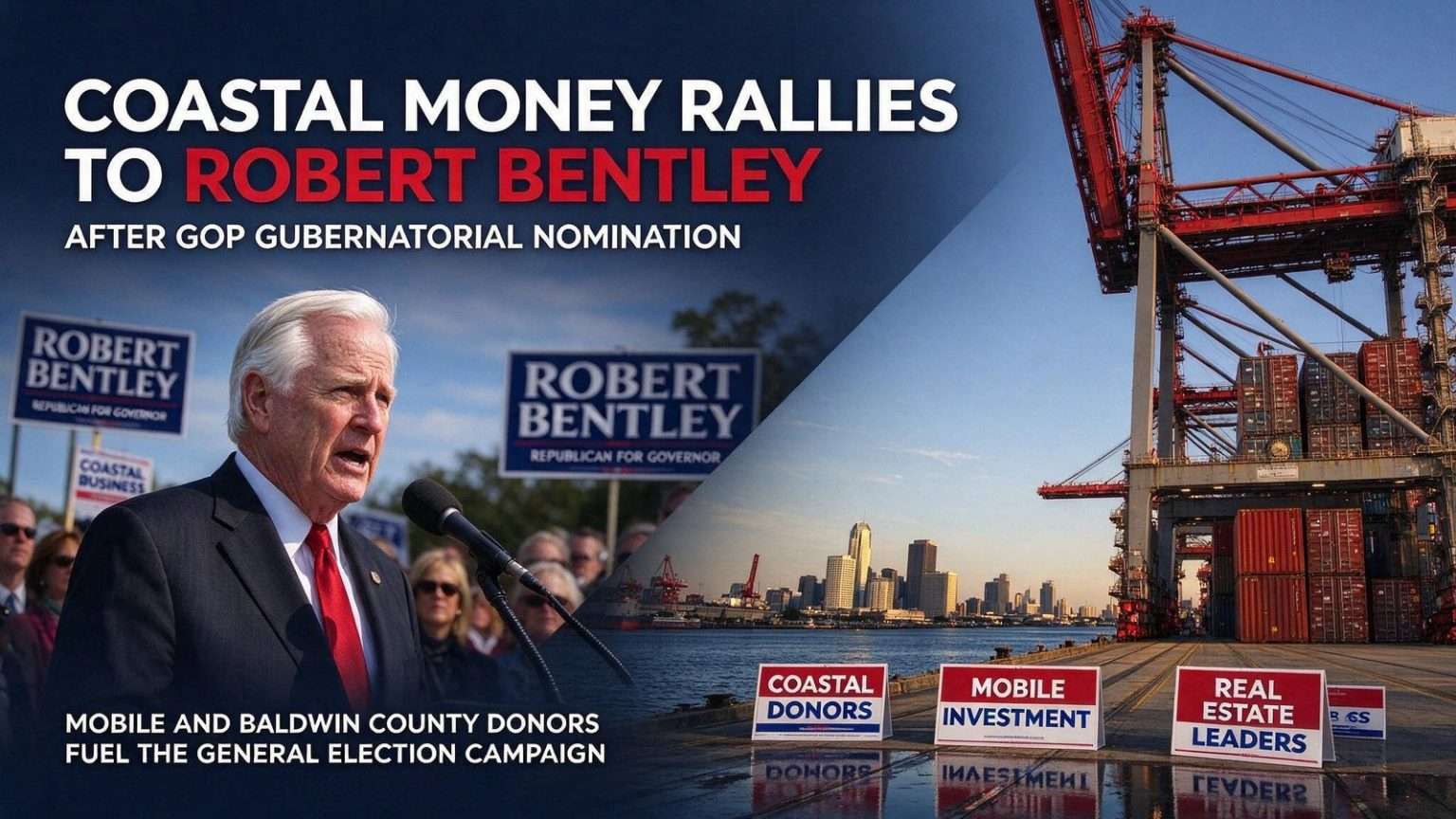
Broad and generous support from Mobile and Baldwin countians for Robert Bentley made itself evident after the Tuscaloosa physician won the Republican nomination for governor, campaign finance records suggested. The filings, covering the stretch between the June primary and the fall campaign, gave a precise picture of who was funding the nominee’s push — and the picture was overwhelmingly coastal. In Alabama politics, where a handful of metro areas supply most of the money in statewide races, that kind of regional consolidation is noticed as soon as the reports post.
A surge of coastal contributions
The records showed a coastal donor base consolidating behind Bentley as the general election against Democratic nominee Ron Sparks approached. Several contributors gave at the top of the range. Real Estate Equity Investments and Theodore Industrial Port each reported $25,000, and Maisel Properties gave $20,000. The largest checks came from exactly the sectors that dominate the coastal economy: commercial real estate, port-side industrial development and property management, each with a direct stake in how Montgomery regulates growth and infrastructure.
A cluster of $10,000 contributions came from names well known along the coast, including Sonny Callahan and Associates, Matt Metcalfe, Steve Dampier, John Ramsey, John McInnis, General Insulation and Kenny McLean. The list reads like a directory of the region’s business and civic leadership — realty firms, contractors, insurers and the families behind them — the layer of donors who give at the maximum levels and then ask their peers to do the same.
Beneath those headline figures ran a long list of smaller checks, many at the $1,000 and $5,000 levels, from businesses, professionals and civic figures across Mobile and Baldwin counties. Contributors such as Angus Cooper, Harris Morrissette, David Cooper Sr. and a range of physicians, developers, contractors and family names filled out a roster that reflected the reach of Bentley’s coastal fundraising. It is that second tier — broad rather than deep — that campaigns prize, because a wide donor base supplies both money and the volunteers, hosts and introductions that turn contributions into organization.
From primary underdog to unifying nominee
The pattern was notable given Bentley’s path to the nomination. A relatively low-profile state legislator and dermatologist when the campaign began, he had emerged from a crowded and expensive Republican field to claim the nomination. Few observers had marked him as the frontrunner at the start; his rise was built on a plain-spoken message and a debate-season momentum that outlasted better-funded rivals. Winning such a field left him, in June, as the first choice of some coastal donors and the reluctant second choice of others.
The post-primary flow of coastal money signaled that the region’s Republican donor establishment, some of whom had backed other candidates during the primary season, was closing ranks behind the party’s standard-bearer for the fall. That consolidation carried strategic weight. Mobile and Baldwin counties formed one of the most reliable Republican strongholds in the state, and the willingness of the area’s business and professional leaders to invest in Bentley’s campaign suggested confidence in his prospects against Sparks.
For a nominee who had run as a Washington-skeptic conservative promising to focus on jobs and to clean up Montgomery, the coastal backing added financial muscle to a message aimed squarely at the region’s voters. Bentley’s campaign theme — a governing agenda built on job creation and a promise to clean up Montgomery — found a natural constituency among coastal business leaders who had spent years pressing Montgomery on economic development, port investment and education reform.
Reading the money
Campaign finance disclosures offer one of the clearest windows into a candidate’s coalition, and Bentley’s coastal filings told a story of momentum. The mix of large corporate and real estate contributions alongside a broad field of individual donors indicated both institutional and grassroots enthusiasm within the coastal GOP. Analysts and rival campaigns read such reports the way scouts read box scores — not just the totals, but the geography, the pace of giving and the names that appear together.
As the calendar turned toward the Nov. 2 election, the disclosures underscored how quickly a nominee can convert a primary victory into a fundraising base. Donors who hedge during a contested primary — spreading checks among several candidates or waiting out the field — move quickly once a nominee emerges, and Bentley’s filings captured that post-primary thaw in real time. Money that had been parked went to work: advertising buys, mail programs and the field infrastructure a statewide general election demands.
For Bentley, the Mobile and Baldwin County support represented not just dollars but a statement of regional alignment, the sort of backing that campaigns count on to fund advertising, organization and turnout in the closing weeks. A nominee who owns the coast’s donor list also tends to inherit its networks — the civic clubs, trade associations and church communities through which volunteers are recruited and early votes are banked.
Whether that financial edge would translate into votes remained for the electorate to decide, but the records left little doubt about where much of the coast’s Republican money had landed. The concentration of large gifts from real estate, industrial and business interests along the coast also hinted at the priorities those donors hoped a Bentley administration would advance, from economic development to a lighter regulatory hand, themes the nominee had emphasized throughout the campaign.
What the pattern signaled
Viewed from the coast, the filings confirmed something local Republicans had long taken for granted: the region functions as the financial engine of the state party, and its leaders expect their priorities — port and infrastructure spending, coastal insurance and environmental policy, education and workforce training — to travel with their money. Bentley’s challenge in the fall was to convert that regional confidence into a statewide margin; the records suggested he would not lack for the means to try.
The coast’s role in statewide politics
The coast’s fundraising clout is a standing feature of Alabama campaigns. Mobile’s port economy, Baldwin’s building boom and the professional class both counties support give the region a donor depth that few other parts of the state can match outside Birmingham and Huntsville. Statewide candidates from both parties have historically scheduled their coastal visits early, knowing that the checks gathered in Mobile and Fairhope often underwrite the campaign’s first television flights.
The 2010 cycle heightened that usual importance. Republicans across the state were riding an energized political environment, and the party’s donors were more engaged — and more willing to consolidate behind a single nominee — than in many recent elections. For a gubernatorial nominee whose primary had drained his rivals’ networks, an energized donor class meant the general-election money race could begin immediately rather than after a lag.
Where the money points
Reading the donor list sector by sector also sketches the issues the coast cares most about. Real estate and development interests watch zoning, insurance and infrastructure spending; port-related businesses follow dredging schedules, trade policy and the state’s industrial recruitment incentives; physicians and health-sector donors track Medicaid and professional regulation. Bentley, a physician turned legislator, spoke comfortably to all three audiences during the campaign, which helps explain why the checks arrived from such a wide professional spread.
The depth of the roster — from $25,000 institutional checks down to $1,000 individual ones — also matters for what happens after Election Day. Donors who invest early become stakeholders in the administration that follows, and coastal leaders have historically used that access to press for the region’s priorities in Montgomery. Bentley’s coastal ledger, read that way, was less a snapshot than a down payment on a governing relationship.
For Sparks, the filings delivered an unwelcome but familiar reality: the opposition would be well funded in the state’s most reliable Republican region, with the business community’s blessing. The Democratic nominee’s own coalition would have to be built elsewhere — and the money race, by the disclosures’ evidence, was already tilting as the fall campaign opened.
The campaign’s closing arithmetic
The final weeks of a general election are, in practical terms, a media-buying exercise, and the coastal money arrived in time to matter. Television markets do not respect state lines or county boundaries, and the Mobile-Pensacola market reaches voters across the entire southern tier of Alabama — which means dollars raised on the coast buy advertising seen on the coast. Local donors can watch their contributions at work on the evening news, a feedback loop that keeps a region’s giving steady once it starts.
Organization follows the money in a second way as well. A campaign flush in the fall can pay for the unglamorous infrastructure — field offices, printed literature, phone banks and the GOTV push — that turns name recognition into votes on the first Tuesday of November. Candidates who limp out of a contested primary into a broke general election rarely get to build any of it; Bentley’s coastal ledger meant he would not be one of them.
Whatever the final totals showed after the pre-election disclosures posted, the direction was already fixed by the middle of the fall: the coast’s Republican establishment had chosen its candidate, funded him at the top of its range, and put its smaller donors in line behind the effort. The electorate would render its verdict in November, but the region’s money had spoken first — loudly, and with one voice.