Best Hospitals in Alabama 2027: Providence, Springhill and South Baldwin Regional Make Top 15
USA Health Providence, Springhill Medical Center and South Baldwin Regional made a 2027 national list of Alabama's 15 best hospitals, led by Huntsville Hospital.
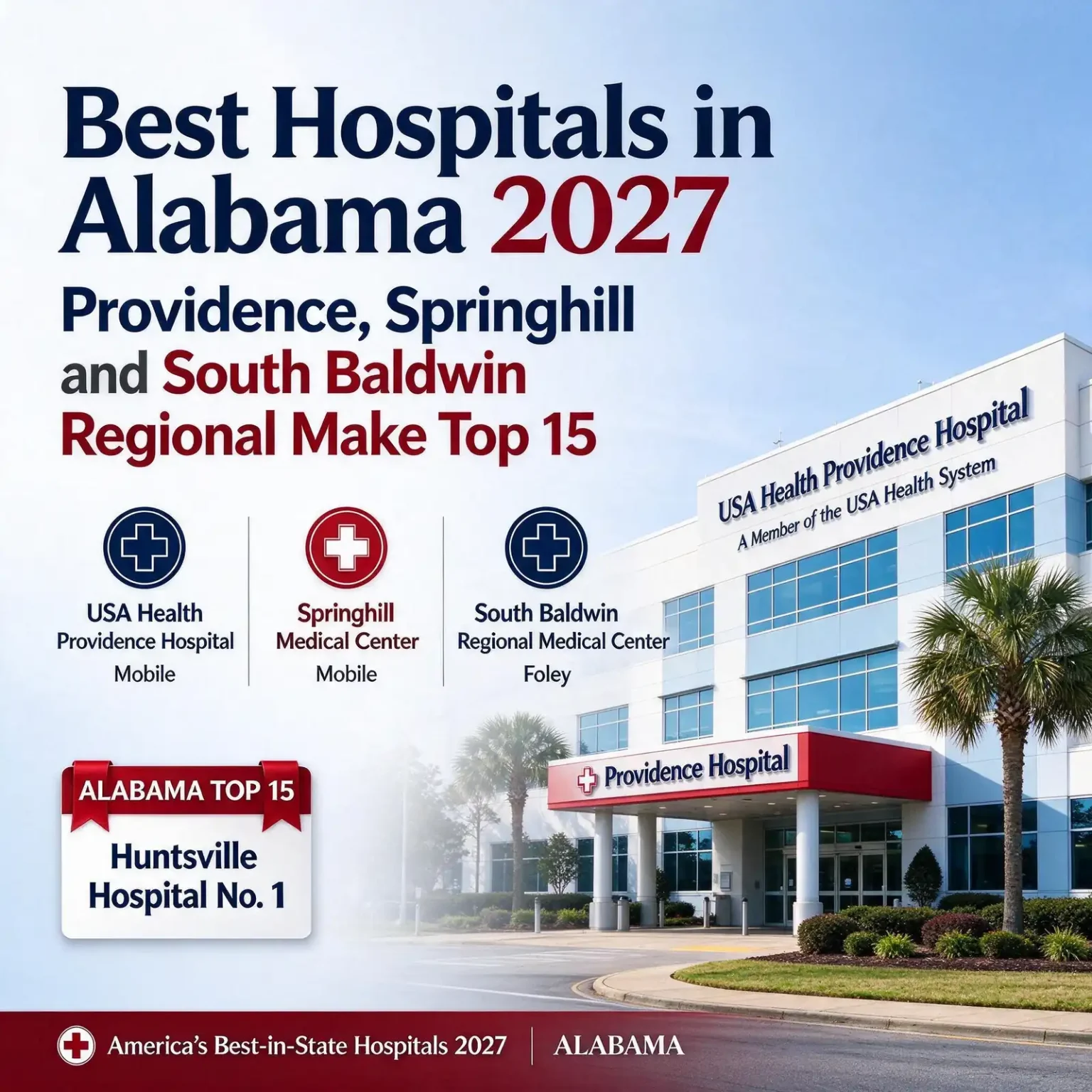
MOBILE, Ala. — Three hospitals that serve the Mobile and Baldwin County area have been named among the 15 best in Alabama in a new national ranking. USA Health Providence Hospital and Springhill Medical Center in Mobile and South Baldwin Regional Medical Center in Foley all made the state list in America’s Best-in-State Hospitals 2027, which put Huntsville Hospital at No. 1 in Alabama.
The recognition places the three Gulf Coast hospitals among a select group. Out of more than 5,000 hospitals evaluated across the country, about 800 were recognized nationwide, and only 15 of those are in Alabama.
Where Local Hospitals Landed
South Baldwin Regional Medical Center in Foley posted the strongest showing among hospitals in the southern part of the state, appearing eighth on Alabama’s list. USA Health Providence Hospital in Mobile was 12th, and Springhill Medical Center, also in Mobile, rounded out the list at No. 15.
For residents of coastal Alabama, the results mean that three of the state’s top-rated hospitals are within a short drive for many families in Mobile and Baldwin counties. South Baldwin Regional serves a fast-growing part of Baldwin County that includes Foley, Gulf Shores, Orange Beach and surrounding communities, while Providence and Springhill draw patients from across Mobile County and neighboring areas.
USA Health Providence Hospital is part of USA Health, the academic health system affiliated with the University of South Alabama.
The Full Alabama List
Birmingham had the strongest presence of any city, with five hospitals on the list. Mobile was the only other city with more than one. Here are the 15 Alabama hospitals recognized in the 2027 ranking, in the order they appeared:
- 1. Huntsville Hospital, Huntsville
- 2. Grandview Medical Center, Birmingham
- 3. Fayette Medical Center, Fayette
- 4. UAB St. Vincent’s, Birmingham
- 5. UAB St. Vincent’s East, Birmingham
- 6. Russell Medical Center, Alexander City
- 7. East Alabama Medical Center, Opelika
- 8. South Baldwin Regional Medical Center, Foley
- 9. Baptist Health Princeton Hospital, Birmingham
- 10. Baptist Health Brookwood Hospital, Birmingham
- 11. Southeast Health Center, Dothan
- 12. USA Health Providence Hospital, Mobile
- 13. Riverview Medical Center, Gadsden
- 14. Decatur Morgan Hospital, Decatur
- 15. Springhill Medical Center, Mobile
The mix includes large regional medical centers, hospitals that are part of university health systems and smaller community hospitals. Fayette Medical Center, in a rural west Alabama county, finished third, showing that the ranking is not limited to the state’s largest facilities.
How the Hospitals Were Scored
The ranking combined four categories of information into a single score for each hospital. Data came from online surveys and from statistics gathered by Statista Healthcare, a research and data company. The four pillars and their weights were:
- Hospital quality metrics: half of each hospital’s score (50 percent)
- Reputation among health care professionals: 28.5 percent
- Patient experience: 15 percent
- Implementation of Patient Reported Outcome Measures: 6.5 percent
Half of each hospital’s score came from quality metrics, which generally track measurable results such as how patients fare after treatment, how often complications occur and how closely a hospital follows accepted standards of care. Reputation, the second-largest factor, reflects how a hospital is viewed by people who work in health care. Patient experience measures how patients themselves describe their stay, including communication with staff and the overall environment.
What Patient Reported Outcomes Mean
The smallest of the four pillars may be the least familiar to most readers. Patient Reported Outcome Measures, often shortened to PROMs, are standardized questionnaires that ask patients to rate their own health, symptoms, pain, mobility and ability to carry out daily activities, typically before and after treatment.
Rather than relying only on lab results or clinical observations, PROMs capture what a patient actually experiences. A knee replacement, for example, may look successful on an X-ray, but a PROM survey can show whether the patient can climb stairs comfortably months later. Hospitals that build these surveys into routine care can use the results to spot problems, compare treatment approaches and adjust care. The ranking gave credit to hospitals that have put such measures into practice.
Reaction From the Top-Ranked Hospital
Leaders at Huntsville Hospital, which led the state list, credited the hospital’s workforce. They said employees care every day for people who are depending on them, often during some of the hardest moments of their lives, and that the work requires a great deal of skill, compassion and teamwork.
Hospital leadership said the ranking reflects the effort employees put in on every shift, and described the honor as something both the staff and the communities the hospital serves can take pride in.
How Patients Can Use Rankings
Hospital rankings can be a helpful starting point, but health care experts generally advise patients to treat them as one piece of information rather than the final word. Each ranking uses its own method, weights different factors and may draw on different data, so a hospital’s position can vary from one list to another.
When choosing where to receive care, especially for a planned procedure, patients may want to consider several factors:
- Specialty strength: A hospital that ranks well overall may be especially strong, or less so, in the particular service a patient needs, such as cardiac care, orthopedics or maternity care.
- Insurance coverage: Checking whether a hospital and its physicians are in network can prevent unexpected bills.
- Doctor recommendations: A primary care physician or specialist can offer guidance based on a patient’s individual health needs.
- Location and access: For follow-up visits, therapy and family support, distance from home can matter.
- Public quality data: Federal and state agencies publish information on hospital safety and patient satisfaction that patients can review.
In an emergency, however, the guidance is simple: call 911 or go to the nearest emergency room. Rankings should never delay urgent care.
Behind the Patient Experience Scores
Patient experience is one of the more familiar measures for anyone who has spent a night in a hospital. Across the United States, hospitals that participate in Medicare routinely survey a sample of discharged patients using a standardized federal questionnaire known as HCAHPS, short for the Hospital Consumer Assessment of Healthcare Providers and Systems. The survey asks patients how well nurses and doctors communicated, how quickly they received help when they asked for it, how well pain was managed, whether medications were explained, how clean and quiet the room was, and whether they would recommend the hospital to others.
Results from these surveys are posted publicly by the federal government, so patients can compare hospitals on the same questions. Because every participating hospital uses the same instrument, the scores make it possible to compare a large academic medical center with a small community hospital on the basics of how patients feel they were treated.
Patient experience carried 15 percent of the weight in this ranking. That share is smaller than the clinical quality pillar, but it reflects a broad view in health care that how a patient is treated as a person, including communication, respect and comfort, is part of good care and can influence how well people follow through on treatment after they go home.
Why reputation counts
Reputation, which accounted for 28.5 percent of each score, is drawn from survey responses. Rankings that use reputation as a factor generally ask people with health care experience which hospitals they would recommend. Supporters of that approach say professionals who see many facilities have insight into which hospitals handle complex cases well, while critics note that reputation can lag behind real changes in quality. Combining reputation with hard quality data and patient feedback is meant to balance those strengths and weaknesses.
A reminder about preventive care
No matter where a hospital ranks, health professionals stress that the best hospital visit is often the one that can be avoided. Routine checkups, recommended screenings and seasonal vaccinations, including flu shots as winter approaches, help people catch problems early and stay out of the hospital. Residents without a regular doctor can check with local clinics or the county health department about available services.
What It Means for the Gulf Coast
For Mobile and Baldwin counties, having three hospitals among Alabama’s 15 best offers a measure of reassurance as the region continues to grow. Baldwin County in particular has been one of the fastest-growing counties in the state, adding demand for hospital beds, emergency services and specialty care. A strong showing by South Baldwin Regional reflects the role the Foley hospital plays for families and visitors along the coast.
In Mobile, the recognition of both Providence and Springhill gives the state’s oldest city two hospitals on the list. Together with the region’s other hospitals and clinics, they make up a health care network that serves not only local residents but also patients who travel from southwest Alabama, coastal Mississippi and northwest Florida.
Rankings like this one are typically released once a year, which means the hospitals on this list will have another chance to defend or improve their positions when the next edition is published. For now, the 2027 list gives Alabama patients one more tool to compare their options, and it gives three Gulf Coast hospitals a reason to celebrate their staffs.