University of South Alabama Mobile
USA Health Stroke Program Leader Receives American Heart Association Heart of the Community Award
A nurse leader with the USA Health Stroke Program received the American Heart Association's Heart of the Community Award, named for Jeff St. Clair, at the Nov. 7 Mobile Heart Walk.
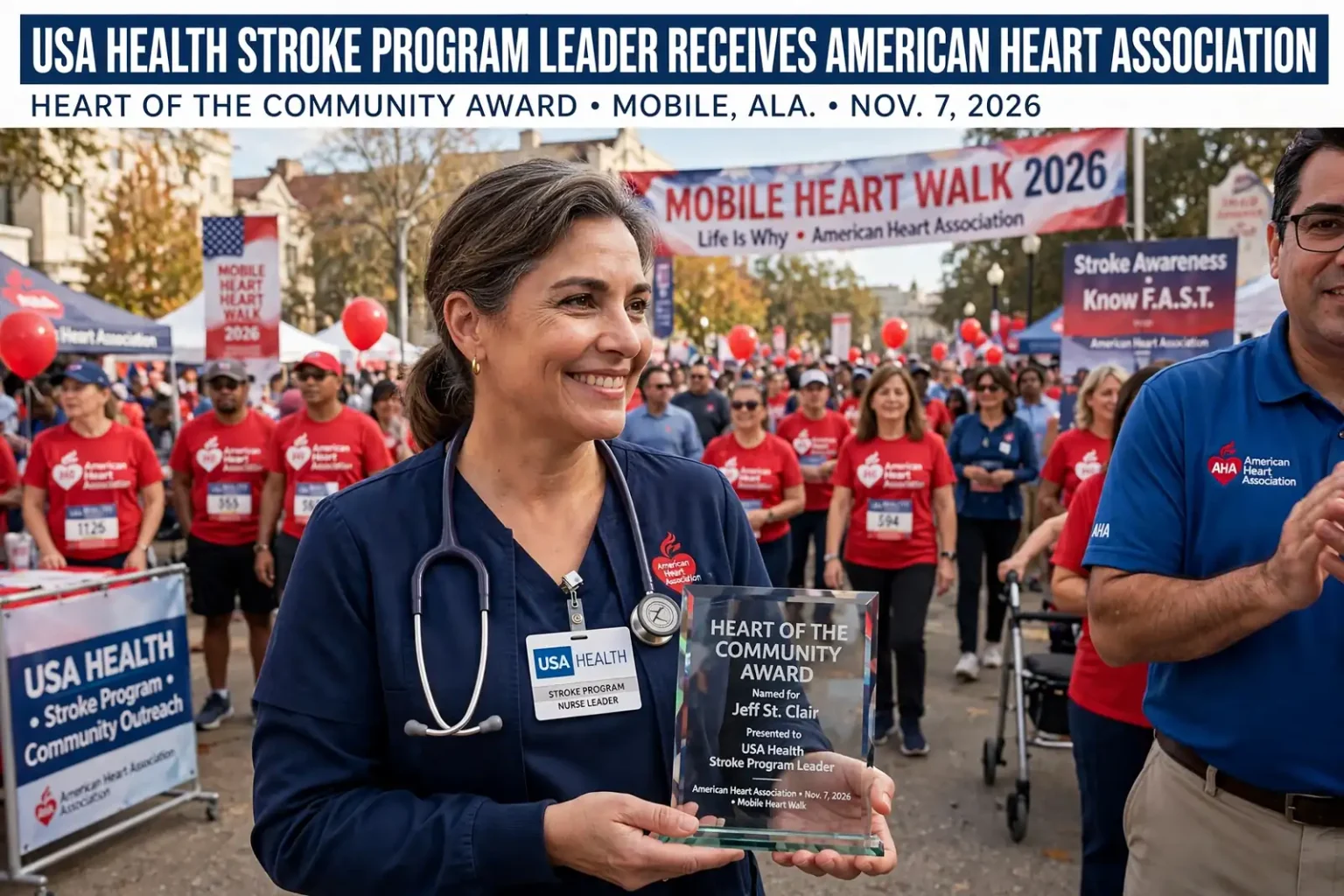
MOBILE, Ala. — A nurse leader who helps steer stroke care and prevention work at USA Health is the newest recipient of the Heart of the Community Award named for Jeff St. Clair, an honor the American Heart Association gives each year to a volunteer whose leadership has made a meaningful difference for the organization and the people it serves. The Heart of the Community Award was handed out on Saturday, Nov. 7, as hundreds of walkers, health care workers and supporters gathered for the Mobile Heart Walk.
The recognition highlights a theme that runs through much of the region’s public health work: hospitals and clinics can only do so much inside their own walls, and lasting improvements in heart and brain health often depend on people who are willing to give their time in schools, churches, neighborhoods and community events.
Why the Honor Matters to the Community
Southwest Alabama carries a heavy burden when it comes to cardiovascular disease. Alabama sits squarely in what researchers have long called the Stroke Belt, a band of Southeastern states where stroke death rates have historically run higher than the national average. Heart disease remains the leading cause of death in the United States, and stroke is among the top causes of death and a major driver of long-term disability.
Against that backdrop, volunteers who help residents understand their risks, recognize warning signs and seek care quickly play an outsized role. The American Heart Association created the Heart of the Community Award to spotlight exactly that kind of commitment, and this year’s honoree was chosen for years of service that extend well beyond a regular workday.
After receiving the award, the honoree said it was a tremendous honor and that being recognized under St. Clair’s name carried special meaning, given his many years of work on behalf of the community. She also said her dedication to community health does not stop when she leaves the hospital, and she pledged to keep doing all she can to help local residents live healthier lives. She added that she hoped her example would encourage others to take part in future Heart Walks and to approach their own communities with a spirit of service.
How the Award Came to Be and Whom It Honors
The award was established in 2025 to honor the legacy of Jeff St. Clair, who served for many years as president and chief executive officer of Springhill Medical Center, a hospital in Mobile. St. Clair himself became the first person to receive it, a nod to his long record of leadership and steady backing of the American Heart Association.
His support went well beyond lending his name. For more than 15 years in a row, St. Clair brought in more Heart Walk donations than any other individual supporter, a remarkable run that made him one of the most recognizable champions of the cause in the Mobile area.
Each year since its creation, the honor is reserved for an American Heart Association volunteer who displays outstanding leadership and whose efforts substantially advance the group’s mission. That mission centers on helping people live longer, healthier lives by fighting heart disease and stroke through research, education, advocacy and community programs.
Key details at a glance
- Award: Heart of the Community Award, named for Jeff St. Clair
- Presented by: American Heart Association
- Recipient: A nurse leader with the USA Health Stroke Program
- When: Saturday, Nov. 7, 2026, during the Mobile Heart Walk
- Established: 2025, with St. Clair as the first honoree
- Namesake: Former longtime chief executive at Springhill Medical Center in Mobile
The Mobile Heart Walk and What It Supports
The Heart Walk is the American Heart Association’s signature community fundraising event, held in cities across the country each year. The Mobile event draws residents, medical professionals, employers and families who walk together to raise money and awareness for cardiovascular health.
Money raised through Heart Walks helps the American Heart Association pay for scientific research, public education campaigns, training in cardiopulmonary resuscitation, and efforts to improve how hospitals treat heart attack and stroke patients. Teams often form around workplaces, churches, schools and groups of friends, and many participants walk in honor of a loved one who has lived with or died from heart disease or stroke.
Baldwin County residents had their own chance to participate earlier this fall, when a separate Heart Walk was held at OWA in Foley. Together, the two events give people on both sides of Mobile Bay a way to support the cause close to home.
Stroke Care at USA Health
USA Health is the academic health system of the University of South Alabama, and its stroke program works to improve how quickly people across the region are diagnosed and treated when a stroke strikes. The honoree helps guide that effort, which includes stroke awareness, education and patient care.
The program has also invested heavily in outreach. This fall, USA Health announced renewed funding from Chiesi USA to expand community education about stroke, with a focus on underserved neighborhoods, health fairs, schools and events involving first responders, along with work aimed at pregnant women and new mothers. An earlier project backed by the same funder studied stroke risk factors by ZIP code and helped the team target its outreach where it is needed most.
That type of grassroots education is closely aligned with the American Heart Association’s goals, and it is one reason the honoree’s volunteer contributions stood out.
Knowing the Warning Signs of Stroke
Much of the community education that stroke programs and the American Heart Association provide boils down to one message: act fast. During a stroke, blood flow to part of the brain is blocked or a blood vessel in the brain bursts, and brain cells begin to die within minutes. The sooner a patient reaches a hospital, the more treatment options are available.
The American Stroke Association, a division of the American Heart Association, teaches the acronym F.A.S.T. to help people spot a stroke:
- F — Face drooping: One side of the face droops or feels numb, or the smile looks uneven.
- A — Arm weakness: One arm is weak or numb and drifts downward when both are raised.
- S — Speech difficulty: Speech is slurred, or the person has trouble speaking or being understood.
- T — Time to call 911: If any of these signs appear, call 911 right away, even if the symptoms seem to go away.
Health experts also advise noting the time symptoms first appeared, because that information helps emergency teams decide on treatment. People should not drive themselves to the hospital if they suspect a stroke; emergency medical crews can begin care on the way and alert the hospital ahead of arrival.
Lowering risk through everyday choices
Many strokes and heart attacks can be prevented or delayed. Leading risk factors include high blood pressure, diabetes, high cholesterol, smoking, physical inactivity and excess weight. Regular checkups, taking prescribed medications as directed, staying active, eating a diet rich in fruits, vegetables and whole grains, and avoiding tobacco can all reduce risk.
High blood pressure in particular is often called a silent threat because it usually causes no symptoms. Community screening events, like many of those supported by local stroke and heart programs, give residents a simple way to learn their numbers and follow up with a doctor when readings are high.
Learning CPR and Being Ready to Help
Heart Walk events frequently double as reminders that ordinary bystanders can save lives. When someone suffers sudden cardiac arrest, the heart stops pumping blood effectively, and survival depends on how quickly someone calls 911, begins chest compressions and uses an automated external defibrillator if one is nearby. The American Heart Association promotes Hands-Only CPR for untrained bystanders who see a teen or adult suddenly collapse: call 911, then push hard and fast in the center of the chest until help arrives.
Many workplaces, schools, churches and hospitals in the Mobile area offer CPR courses, and the training takes only a few hours. Organizers of community health events often encourage participants to take that step, noting that most cardiac arrests outside a hospital happen at home, where the person nearby is likely to be a family member.
The Value of Volunteer Leadership
Awards like this one are designed to show that improving community health is not only the job of doctors and hospitals. Volunteers organize walk teams, share information with neighbors, staff screening tables and recruit new supporters. Their work helps carry the American Heart Association’s messages into places where formal health care may not reach.
By honoring a stroke care leader who also gives her personal time to the cause, the organization is underscoring how professional expertise and volunteer energy can work hand in hand. The award also keeps alive the example set by St. Clair, whose years of fundraising helped make the Mobile Heart Walk a fixture on the local calendar.
What Comes Next
The award bearing St. Clair’s name will continue to be presented each year to a volunteer who demonstrates the same kind of leadership. Residents who want to get involved can join or form a team for a future Heart Walk, take a CPR class, or attend a local health fair to learn more about protecting their hearts and brains.
For the newest honoree, the recognition comes with a renewed commitment to the work she has already been doing: helping people across the Mobile area understand stroke, act quickly when symptoms appear and make choices that support healthier lives.