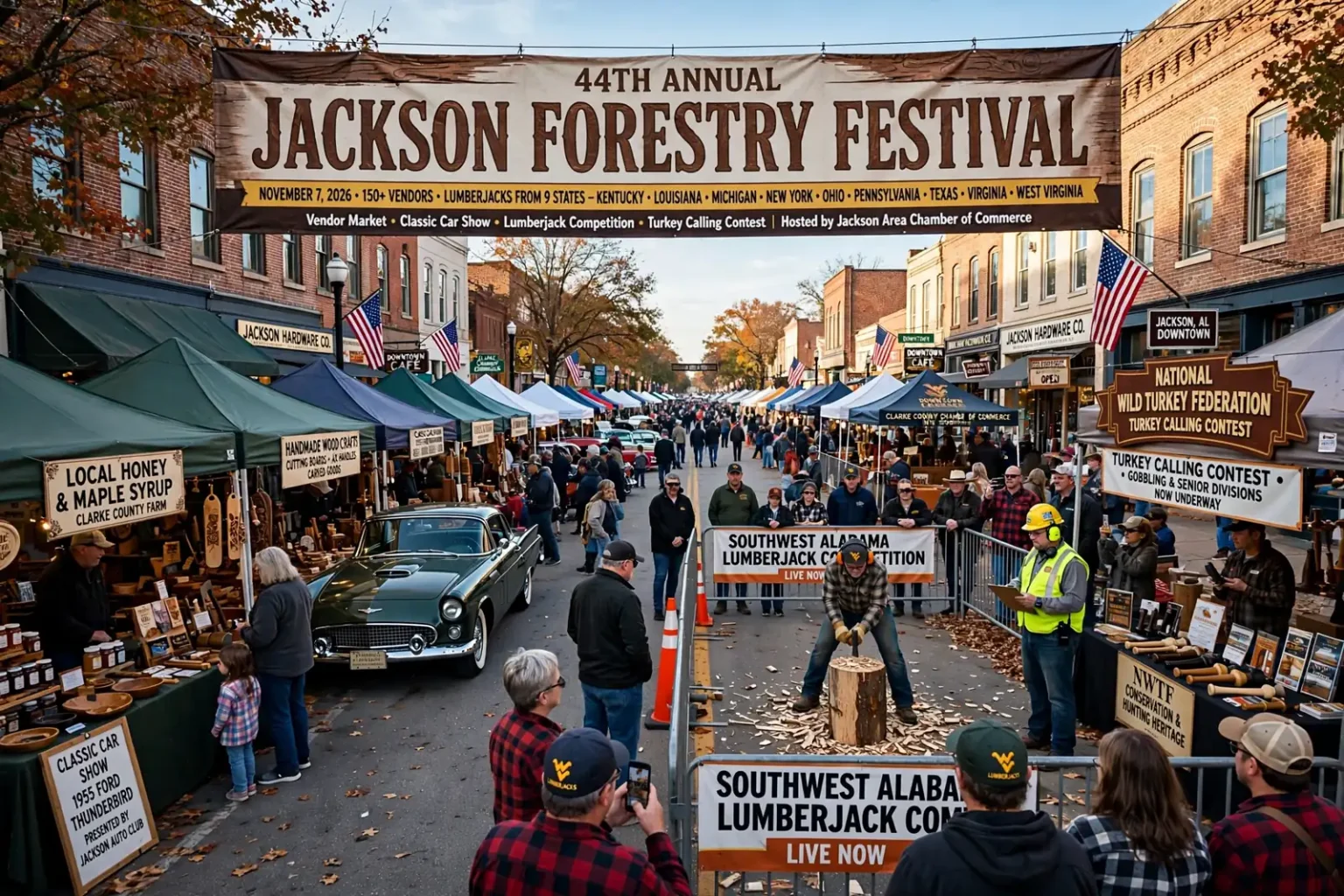
JACKSON, Ala. — Chainsaws, axes and turkey calls filled downtown Jackson on Saturday, Nov. 7, as the 44th annual Jackson Forestry Festival drew one of its biggest turnouts yet, with more than 150 vendors lining the streets and competitors arriving from nine states to test their skills.
Organizers with the Jackson Area Chamber of Commerce said this year’s edition ranked among the largest in the festival’s history. Families, longtime locals and out-of-town visitors spent the day browsing booths, admiring a classic car show and watching two headline competitions: the Southwest Alabama Lumberjack Competition and a turkey-calling contest held under the banner of the National Wild Turkey Federation.
Festival Highlights at a Glance
- Date: Saturday, Nov. 7, 2026
- Location: Streets of downtown Jackson in Clarke County
- Edition: 44th annual festival
- Vendors: More than 150
- Main attractions: Vendor market, classic car show, lumberjack events and turkey calling
- Visiting competitors’ home states: Kentucky, Louisiana, Michigan, New York, Ohio, Pennsylvania, Texas, Virginia and West Virginia
Lumberjack Champions Crowned
The lumberjack competition is built around 12 separate events, each run in multiple heats, and the overall contest is split into two divisions: one for manual events powered by muscle and hand tools, and one for machine events that use motorized saws.
The 2026 manual division title went to a returning competitor from West Virginia, who said it was his third time winning that division. He also took first place in the standing block chop and the single buck. He said he has been involved in the sport for more than two decades and has made the trip to Jackson for roughly 11 or 12 years, and that he provides the wood used for the show.
The machine division crown went to a competitor from Ohio who travels to contests across the country. He swept the four-cube, five-cube and six-cube saw events and also shared the win in the two-man crosscut with Robert Freeman. He said he has competed in Jackson for about five or six years and regularly runs into many of the same rivals at events in other states, including West Virginia and Michigan.
Other event winners included:
- Ax throwing: Mike Slingerland
- Three-cube saw: Joe Lang
- Hot saw: Robert Freeman
- Unlimited saw: Melvin Lentz
- Two-man crosscut: Robert Freeman and the machine division champion
An organizer of the lumberjack competition described the contest as top-tier this year and said the field included people from all over the country.
Understanding the Lumberjack Events
For spectators new to timber sports, the lineup can look like a blur of sawdust, but each event tests a specific skill. Chopping events measure how quickly and cleanly a competitor can sever a block of wood with an ax, with the standing block chop requiring the athlete to cut through a vertical log, much as a logger would notch a standing tree. Sawing events with hand tools, such as the single buck, pit one competitor against the clock with a long crosscut saw, while the two-man crosscut requires a pair to pull a saw back and forth in steady rhythm.
Ax throwing adds an element of precision, rewarding accuracy at a target rather than raw speed. The machine events, by contrast, are about power and control. Competitors race to make clean cuts through a log using motorized saws in different classes, with the unlimited and hot saw events featuring some of the most powerful equipment in the sport.
Across all of these events, safety is a constant priority. Competitors work with sharp tools and powerful engines, so contests typically rely on protective gear, marked-off competition areas and officials who oversee each heat. Spectators are kept at a distance from the cutting area, which still leaves plenty of room to hear the engines roar and watch the wood chips fly.
Turkey-Calling Contest Draws a Crowd
The turkey-calling contest, sanctioned through the National Wild Turkey Federation, gave spectators a different kind of competition. Kenny Weiss Jr. of Mobile won both the gobbling division and the senior division.
Turkey-calling contests reward callers for how realistically they imitate the sounds wild turkeys make, from the yelps and clucks of hens to the booming gobble of a tom. The National Wild Turkey Federation is a national nonprofit conservation organization devoted to the wild turkey and to hunting heritage, and calling contests are a familiar part of its outreach at community events.
Calling is a practical skill for hunters as well as a competitive pastime. In spring, hunters use calls to draw gobblers within range, and many callers sharpen their technique in the off-season by entering contests. Competitive callers often use a variety of tools, including mouth calls, box calls and friction calls, each producing a slightly different sound. A fall contest such as the one in Jackson gives callers a chance to compare notes and test themselves against others ahead of the next season.
Like the lumberjack field, the turkey-calling competition attracted participants from well beyond Alabama, adding to the out-of-state traffic that helped fill downtown.
Why Forestry Takes Center Stage in Jackson
The festival’s theme reflects the role timber has long played in this part of Alabama. Jackson sits in Clarke County, in the heavily forested southwest corner of the state near the Tombigbee River, where logging, sawmills and related industries have shaped local jobs and community identity for generations.
Modern forestry looks very different from the days of crosscut saws and mule teams. Today’s timber operations rely on heavy equipment, planned harvest cycles and replanting, and many landowners manage pine stands over decades as a long-term investment. Forest products also support a wide chain of jobs beyond the woods themselves, including trucking, mills, equipment dealers and the many small businesses that serve those workers. A festival dedicated to forestry is, in that sense, a celebration of an industry that still touches many households in the region.
Lumberjack sports grew out of that working tradition. Events such as the standing block chop and single buck mirror the tasks loggers once performed by hand, while the motorized saw events showcase the speed and power of modern equipment. The hot saw, in particular, uses chainsaws fitted with modified, high-powered engines, making it one of the loudest and most dramatic events for spectators.
For many visitors, the competitions offer a rare chance to see these skills up close. For the athletes, they are part of a circuit that brings the same competitors together at events in several states each year, which helps explain the long list of home states represented in Jackson.
Community Effort Behind a Growing Event
Chamber leaders said a great deal of planning went into coordinating this year’s festival, and they credited sponsors, vendors and the people who showed up for making it a success. Organizers also thanked volunteers, city employees and local businesses for helping make the event possible.
One of the festival’s organizers said she was very pleased with how the day turned out, pointing to the size of the crowd and the sight of families, vendors and visitors coming together as the reward for all the work. Organizers said they hoped everyone who attended enjoyed the day as much as they did.
Community festivals of this size typically depend on a mix of financial sponsors, in-kind donations and volunteer labor, from setting up vendor spaces and managing parking to running competitions and cleaning up afterward. City crews often handle street closures and other logistics that allow a downtown to host thousands of visitors for a day.
A Boost for Downtown Jackson
With more than 150 vendors, the festival doubles as one of the biggest shopping days of the year for many small sellers, including crafters, food vendors and local businesses. Out-of-town competitors and their families also add to the local economy through meals, lodging and fuel.
Events like the Forestry Festival also give smaller towns a way to showcase their downtowns to people who may not otherwise visit. The mix of a vendor market, a car show and live competitions gives the day broad appeal, drawing everyone from car enthusiasts to hunters to families looking for a fall outing.
The festival’s location in the heart of downtown also helps connect visitors with the businesses that operate there year-round. Shoppers who come for the vendor booths often stop into local stores and restaurants, and the event provides a chance for merchants to introduce themselves to customers from neighboring towns and counties.
Looking Ahead
After 44 years, the Forestry Festival remains one of Jackson’s signature community events, and this year’s turnout suggests continued interest. With returning champions who have made the trip for years and new competitors arriving from across the country, the lumberjack and turkey-calling contests remain the festival’s main draw.
Residents and visitors interested in future festivals, vendor opportunities or sponsorships can contact the Jackson Area Chamber of Commerce, which organizes the event. Details for the 45th annual festival have not yet been announced, but organizers said they were grateful for the support that made this year’s event one of the largest to date. The chamber’s contact information and festival updates are typically shared through its office in Jackson, and vendors who want to secure a booth for a future year are encouraged to reach out early.