

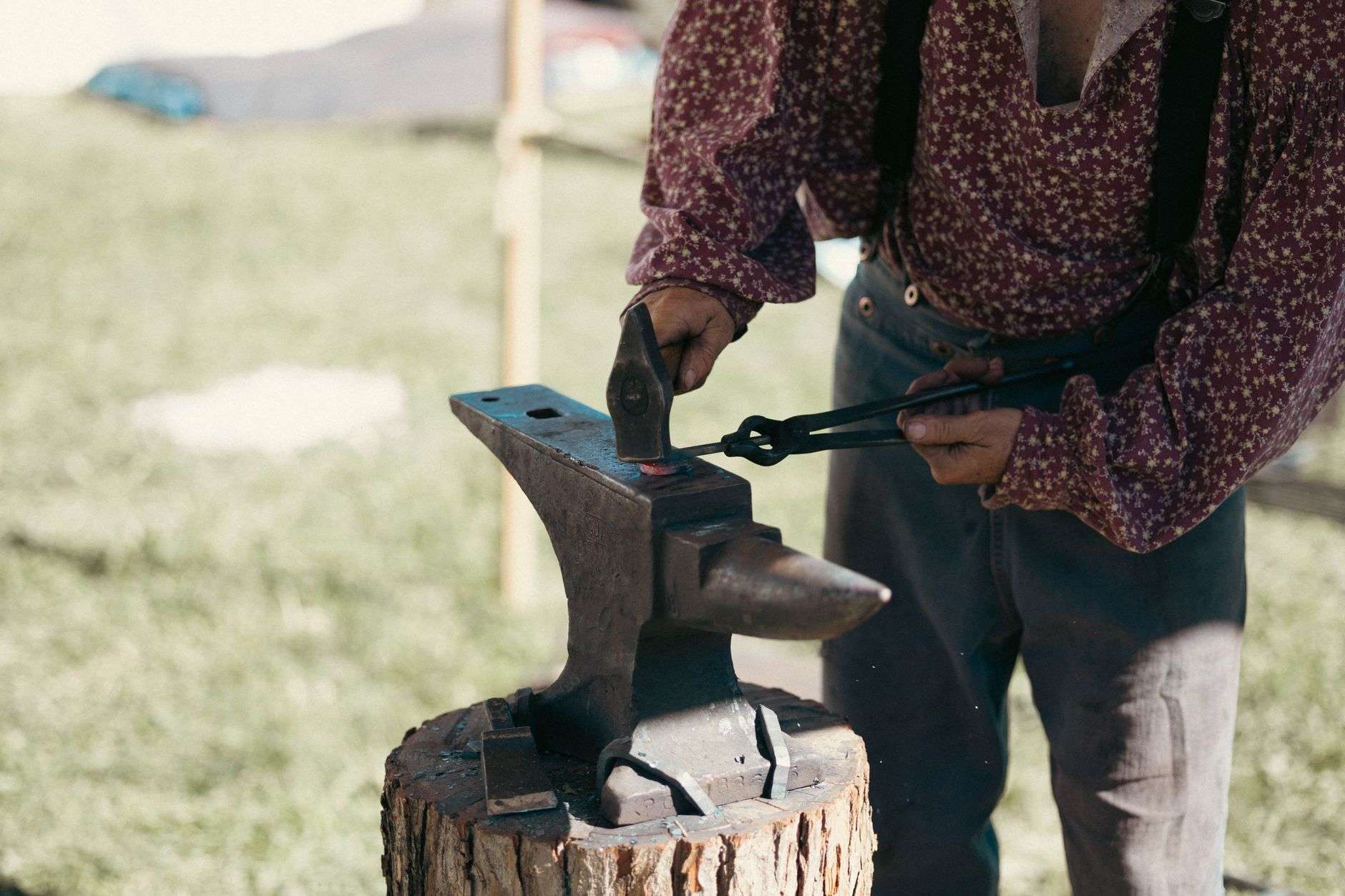
DAPHNE, Ala. — The first thing most people learn at The Blacksmith Experience is that hot steel does not behave the way they expected. It moves. It sags. It tells you, through the sound it makes under a hammer, whether it is still workable or whether it is time to put it back in the fire.
Jerry Gardner has been teaching that lesson in a workshop at 25421 Highway 181 in Daphne for years now, to several hundred people annually who arrive with no particular metalworking background and leave with a knife, an axe or a hook they made themselves. Gardner is the owner and founder of the business, a former military and construction management professional who has lived in Daphne for the past 17 years.
He did not set out to run a teaching forge. He set out, as he tells it, to solve a problem he could not shake.
A Sidewalk in Oil City
Gardner was living in Oil City, Pennsylvania, when he came across a group of blacksmiths gathered in public, working steel together for the better part of a day. The gathering has a name among smiths: a hammer in.
“I was so enamored with it,” Gardner said. “I decided, like, ‘Man, I got to figure out how to do this.’”
Figuring it out took the ordinary route — a couple of lessons, then an apprenticeship, then a small fabrication shop he ran from 2003 to 2008. He is candid about how that chapter ended. He made, in his words, “every bad business decision under the sun,” and went back to construction management.
The craft stayed with him anyway. Around 2017, the idea of teaching it began to take shape.
“I just had always thought it’d be really cool just to teach,” Gardner said. “We had just bought a house that had a really large shop, so I had the space to do it. I just didn’t have the time to do it because I was traveling a lot. I was on the road a lot, and then eventually that settled down. It’s just something in me that I always wanted to pass along, and so I started doing lessons and it kept growing and growing and growing from there.”
What a Hammer In Actually Is
The event that hooked Gardner is a fixture of the blacksmithing world and almost unknown outside it. A hammer in is exactly what the name suggests: smiths gather at a shop, a fairground, a farm or a festival, set up portable forges and anvils, and spend a day forging together. There is usually a demonstration by someone with a specific skill to share — forge welding, a particular joinery technique, a tool-making method. There is usually an iron-in-the-hat raffle. There is almost always a table of tools and steel changing hands.
What makes the format matter is that blacksmithing is difficult to learn from a book or a video. The critical judgments — when the steel is at the right temperature, how hard to strike, when a piece has been worked too cold and is about to crack — are sensory. They are learned by standing next to someone who already knows and watching what they do. For most of human history that transfer happened through apprenticeship. When industrial manufacturing made the village smith obsolete across the 20th century, the apprenticeship chain broke, and a body of knowledge thousands of years old came close to disappearing in North America.
The Revival That Kept the Craft Alive
It did not disappear, largely because a generation of hobbyists and artist-craftsmen rebuilt the teaching network from scratch. The central institution in that effort is the Artist-Blacksmith’s Association of North America, founded in 1973 as a nonprofit dedicated to preserving and advancing blacksmithing as both a profession and a hobby.
ABANA now counts more than 80 affiliate groups across North America — regional guilds that hold their own hammer ins, maintain shared shop space and run classes. The national organization publishes The Anvil’s Ring and Hammer’s Blow, maintains a graduated national curriculum across three skill levels, offers educational grants, and hosts a biennial conference. Its 2026 conference is scheduled for November in the Ozarks.
The practical effect of all that structure is that a person in Baldwin County who wants to learn to forge no longer has to find a working smith willing to take on an apprentice. They can take a class. Teaching forges like Gardner’s are the retail edge of a revival that has been building for half a century, and the craft today is healthier in North America than it has been since roughly the First World War — not as an industry, but as a living skill passed hand to hand.
Four Hours, and Something to Take Home
Gardner calls his classes experiences, and the most popular ones run about four hours. That is enough time for a first-timer to work through a project start to finish with guidance at the anvil.
Beyond the introductory sessions, he offers more advanced work: forging railroad spikes, hooks, nails and tools, along with more intricate knife and axe classes that take a student through the entire process from raw stock to finished edge. Those can run anywhere from six hours to several days depending on what the student is after.
There is also Knife Date Night, in which a couple learns knife crafting together and the evening includes dinner for two. It is an unusual pitch for a date, and an effective one, because the thing you take home at the end of it is an object you made with your hands.
The basic toolkit has not changed much in centuries. A forge brings the steel up to a working heat. Tongs hold it. An anvil provides the hard surface to move metal against, and its shape — the flat face, the rounded horn, the square hardy hole — is itself a set of tools. A hammer does the shaping. For a blade, the forging is only the first half of the job: the steel then has to be ground to shape, hardened by heating and quenching, and tempered by reheating at a lower temperature so the edge holds without shattering. A knife class that takes a student through the entire sequence is teaching metallurgy as much as it is teaching hammer work.
Gardner said The Blacksmith Experience holds between 300 and 400 classes a year.
Forging a Difference
Alongside the classes, Gardner runs Forging a Difference, a Daphne-based 501(c)(3) nonprofit dedicated to using blacksmithing and knife making to serve active duty service members, veterans, law enforcement officers and first responders. The organization offers classes, open shop time and family day events.
The pairing of forge work with veteran and first responder support is not unique to Baldwin County — similar programs have taken root in Virginia, Manitoba and elsewhere — and there are reasons the model recurs. Forging demands complete attention; a moment of distraction at a 2,000-degree fire is immediately consequential, which leaves little room for anything else in the mind. The work is physical and repetitive in a way that many people find settling. It produces a finished object at the end of a session, which is not something every kind of work offers. And it happens shoulder to shoulder with other people doing the same thing, in a shop where conversation is optional.
For men and women who came out of environments built on shared mission and physical work, a forge can be a familiar kind of room.
An Experience, Not a Product
The Blacksmith Experience belongs to a category of small business that has expanded noticeably along the Eastern Shore over the past decade: enterprises that sell participation rather than merchandise. Pottery studios, cooking classes, guided kayak and paddleboard outfitters, art workshops and the like have multiplied across Daphne, Fairhope and Spanish Fort, and the reasons are not mysterious.
Baldwin County is among the fastest-growing counties in Alabama, and Daphne is its most populous city. That growth has brought both a larger year-round customer base and a steady flow of new residents looking for ways to spend a weekend. Layer on the region’s tourism economy — millions of visitors a year moving through the Gulf Coast, many of them looking for something to do on a rainy afternoon or an evening away from the beach — and a business that sells four memorable hours has a market on both sides.
Experience businesses also have a structural advantage that a retail shop does not: their product cannot be ordered online, shipped overnight or price-compared against a national competitor. You cannot have a forging lesson delivered.
Fathers, Sons and Return Customers
Ask Gardner what he values most about the work and he does not talk about the knives. He talks about who shows up together.
“It’s where you get an opportunity to see fathers and sons connect outside of playing video games or something,” he said. “It’s just such a cool thing to offer people, and then just kind of see how those people come back for follow up classes.”
That last detail is the tell. A novelty business gets a customer once. Gardner’s students come back, which suggests what the four-hour class actually sells is not a souvenir but an entry point — the moment a person discovers that a skill they assumed was locked away in history is, in fact, teachable, and that they are capable of learning it.
It is the same discovery Gardner made standing on a Pennsylvania sidewalk, watching strangers hammer steel and deciding he had to figure out how to do that.