Cantonment family rescued from flooded home after Hurricane Sally
A Cantonment family was rescued by boat from their flooded Harlington Street home after Hurricane Sally, returning hours later to find their koi fish in.
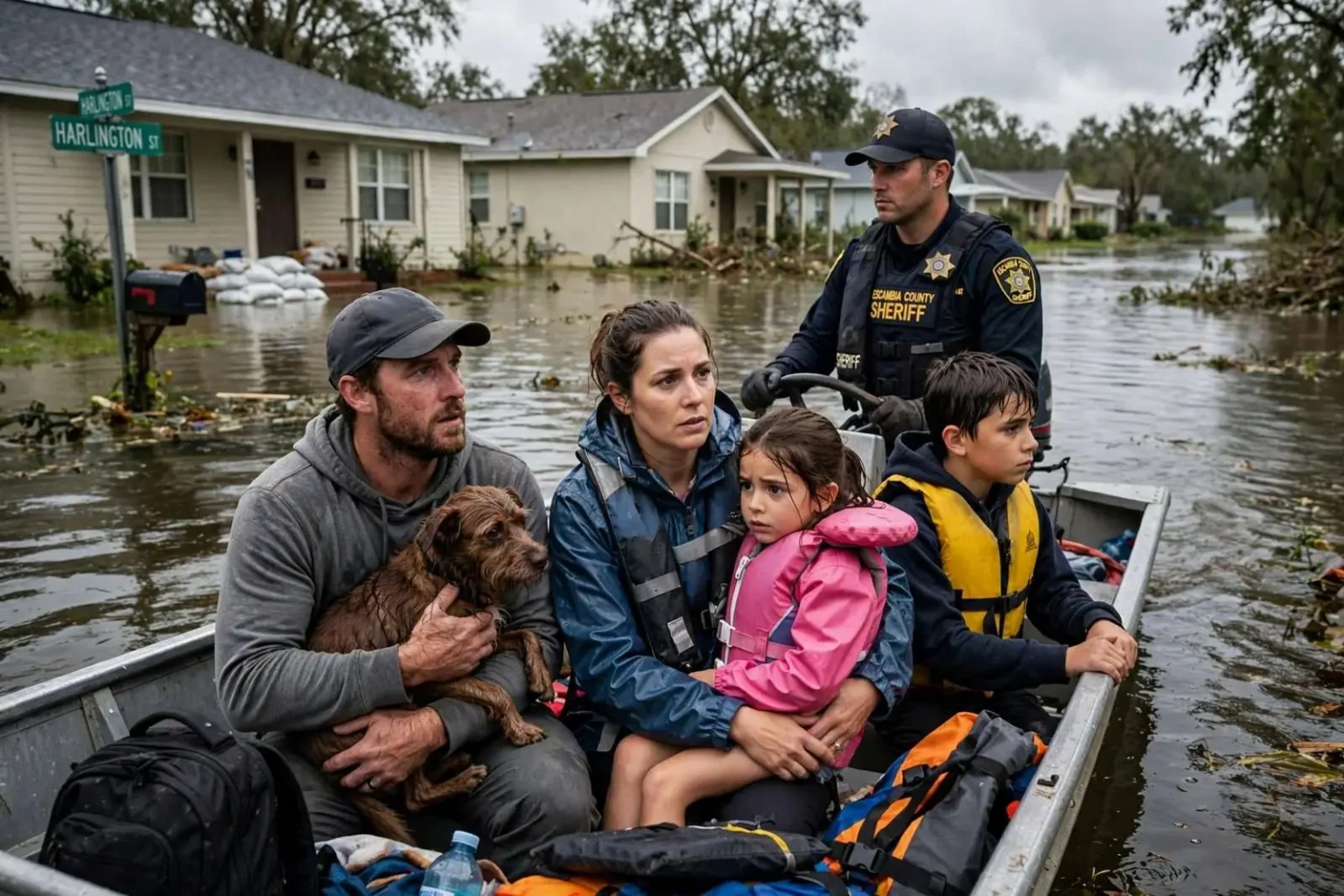
A Cantonment family is sharing their story after being rescued from their home as floodwaters rose in the hours after Hurricane Sally came ashore. The account illustrates the speed with which the storm’s sluggish approach turned rainfall into a life-threatening emergency across Northwest Florida, trapping residents in neighborhoods that had survived far stronger hurricanes with far less damage.
Nic Schuck said water began closing in on his Harlington Street home from both the front and back, reaching 10 to 12 inches deep inside by about 9 a.m. The rising water at both ends of the house left the family with no dry path out, a situation repeated in hundreds of homes across the region as creeks and drainage systems overflowed faster than they could carry the storm’s rain away. Sally’s slow crawl toward land meant that rainfall totals piled up hour after hour, turning streets into channels long after the wind had done its damage.
He and his family heard jet skis and rescue boats moving through the neighborhood and waded out to flag one down. Good Samaritans and first responders alike had launched personal watercraft, fishing boats and anything else that could float, threading flooded streets to reach families who called for help when rising water made waiting unsafe. The improvised flotilla became one of the defining images of Sally’s aftermath in the Pensacola area, where official rescue assets were stretched thin by the sheer number of calls.
Schuck, his wife, their children and the family dog were taken to dry land. About six hours later, after the water receded, they returned home — and discovered all five of their koi fish, including one that is 17 years old, had drifted into the swimming pool. The small surprise offered the family a moment of relief in an otherwise disorienting day, and the koi’s unlikely survival became one of the storm’s gentler stories.
The rescue came six years after a historic 2014 flood and during the same Sally flooding that forced hundreds of Northwest Florida residents from their homes. For families in Cantonment and neighboring communities, the two events bracketed a difficult decade of water: a 2014 rainstorm that submerged neighborhoods with no hurricane at all, and a 2020 hurricane whose rain did the same work while the wind tore roofs apart.
Sally’s slow assault on the Gulf Coast
Hurricane Sally made landfall near Gulf Shores, Alabama, as a Category 2 storm after an agonizingly slow approach through the northern Gulf. The system’s crawling forward speed — a few miles per hour at times — turned its rain bands into a relentless drumbeat over the same communities for many hours, producing rainfall totals measured in feet of water across parts of the Panhandle and south Alabama. Forecasters had warned for days about flooding, but the storm’s erratic track kept residents guessing about exactly where the worst would fall until it was nearly upon them.
Cantonment sits in Escambia County, Florida, just north of Pensacola, in the low terrain of the Perdido River basin where rainfall gathers quickly. The community’s creek networks and drainage ditches, sized for ordinary Gulf Coast storms, were overwhelmed by Sally’s totals, and water that had nowhere to go found its way into homes on Harlington Street and throughout the area. Residents reported water moving between houses, filling yards from multiple directions and cutting off escape routes — exactly the pattern the Schuck family described.
The storm’s wind damage compounded the flooding across the region. Roofs peeled away, trees fell across roads and power lines, and hundreds of thousands of utility customers lost electricity, some for days. But it was the water that drove rescues: families who had shuttered their windows and planned to shelter in place found that the danger rose from below, and calls for help poured into agencies already dealing with blocked roads and downed lines.
Rescue by boat and jet ski
When Sally’s flooding reached its peak, the rescue effort took on a character unique to water-driven disasters. Fire rescue teams, sheriff’s deputies, the National Guard and plain neighbors used boats, jet skis and heavy vehicles to reach stranded residents, since flooded streets made conventional response impossible. Families waded out to flag down passing boats, as the Schucks did, and rescuers ferried them — along with pets, carriers and whatever belongings could be carried — to staging points on higher ground.
The hundreds displaced across Northwest Florida spent the hours and days that followed in shelters, with relatives or in hotels, waiting for the water to drop and assessing what it had left behind. Flood recovery differs from wind recovery in punishing ways: water-soaked drywall, flooring and insulation must be stripped to the studs, and families who lacked flood insurance — common in inland neighborhoods not mapped as flood zones — faced the costs alone. Federal assistance programs eventually processed claims across the affected counties, but the first weeks after Sally tested every household’s resourcefulness.
The Schuck family’s return home six hours after their rescue reflected how quickly Sally’s flooding could recede once the rain stopped. Unlike surge-driven coastal flooding, which can linger, the inland flooding that characterized Sally in Cantonment pooled and drained with the storm’s rainfall, leaving behind mud, ruined belongings and a soaked house — and, in one lucky household’s case, five koi fish that had ridden the floodwater into the swimming pool and waited there for their owners’ return.
An echo of the 2014 flood
The comparison to 2014 was unavoidable for longtime residents of the Pensacola area. In late April of that year, a stationary rainstorm dropped more than 20 inches of rain on the region in about a day, flooding thousands of homes and killing several people — a disaster with no name and no hurricane, remembered locally as a 500-year rain event. Neighborhoods that flooded then flooded again with Sally, and residents’ memories of 2014 shaped how quickly they called for help the second time around.
The two events together have reshaped how Northwest Florida thinks about water risk. Stormwater systems built decades ago were never designed for rainfall of that intensity, and local governments across Escambia and Santa Rosa counties have studied drainage improvements since both floods. Residents, meanwhile, have learned to treat rising water with an urgency that wind warnings alone never produced — a lesson families like the Schucks carried directly from their living rooms to the rescue boats.
Sally’s flooding also redrew the map of vulnerability for insurance and planning purposes. Homes well outside the coastal surge zone took water when creeks and ditches overflowed, and the storm joined the 2014 flood as an argument for flood coverage among households that had historically declined it. For the Cantonment family who watched their home fill from both directions, the decision points were never abstract: the water at 10 to 12 inches inside by 9 a.m. made every subsequent choice for them.
What the family’s story leaves behind
Stories like the Schucks’ endure because they capture the human arithmetic of a hurricane: the moment a family realizes that sheltering in place has become unsafe, the improvised rescue that follows, and the strange details — a 17-year-old koi waiting in the pool — that make a disaster’s chaos memorable. They also record the region’s volunteer spirit, the neighbors with jet skis and flat-bottom boats who moved through Sally’s floodwaters alongside official responders.
Six years after the historic 2014 flood, and in the same days that Sally forced hundreds of Northwest Florida residents from their homes, the family’s rescue from Harlington Street stands as a representative account of the storm in the neighborhoods north of Pensacola: sudden water, improvised rescues, a safe landing for people and pets alike, and a long recovery that began the moment the family waded back home.
How Sally caught the Gulf off guard
Sally’s path to landfall was marked by forecast uncertainty that tested residents’ patience and planning. The storm drifted for days as it interacted with weather systems over the northern Gulf, wobbling between potential landfall zones from Louisiana to the Florida Panhandle before settling on a track aimed at the Alabama coast. Communities from Mobile Bay east to Pensacola braced for different scenarios at different times, and the final hours before landfall brought a rushed scramble to finish preparations as the storm’s outer bands arrived.
What the storm delivered instead of catastrophic wind was historic water. Rainfall totals across the Panhandle reached levels that would qualify as major flooding events on their own, and the slow landfall meant those totals accumulated over roughly a day rather than a few hours. Rivers and creeks across south Alabama and Northwest Florida stayed above flood stage for days after the storm moved inland, keeping some communities underwater long after the skies cleared.
Along the immediate coast, Sally’s surge pushed water into streets in Gulf Shores, Orange Beach, Pensacola Beach and the waterfront neighborhoods between them, tossing boats ashore and flattening dunes. Farther inland, as in Cantonment, creek flooding did the damage. The combination meant that a single storm produced every variety of water disaster the Gulf Coast knows — surge, rain flooding and river flooding — across a contiguous stretch of the coast and its hinterland.
The recovery that followed the rescue
For the families rescued by boat, the days after the water receded brought the long inventory of loss. Flooring, drywall and furniture carried to the curb; photographs dried on lawns; dehumidifiers humming for weeks. Crews and volunteers from across the region — church groups, disaster relief organizations and neighbors — moved through flooded subdivisions in the weeks that followed, and the rhythms of recovery replaced the urgency of rescue.
Schools in the affected counties reopened around damaged buildings, businesses along flooded corridors assessed whether they could return, and utility crews finished the job of restoring electricity neighborhood by neighborhood. Storm debris — from Sally’s winds and water alike — lined streets for months, and the piles of sodden household goods became the storm’s lasting visual signature for residents of Cantonment, Pensacola and the communities across the state line in Alabama.
The Schuck family’s story closes, unusually, on a light note: five koi survived, including a 17-year-old fish that had outlasted a hurricane. But the account they share also documents the essential facts of Sally for Northwest Florida — water rising from both directions, a family flagged from a flooded street, and the improvised rescue network that carried them to dry land and home again within a single long day. It stands among the representative stories of a storm that tested the Gulf Coast’s resilience from below the waterline rather than above it.