Clarke County Approves a $17.66 Million Budget With a 3 Percent Merit Raise for Employees
The Clarke County Commission approved a fiscal year 2027 budget of $17,662,126, including $8.6 million in the general fund and just over $4 million for law enforcement. Commissioners also authorized a confidential letter of intent after an executive session.
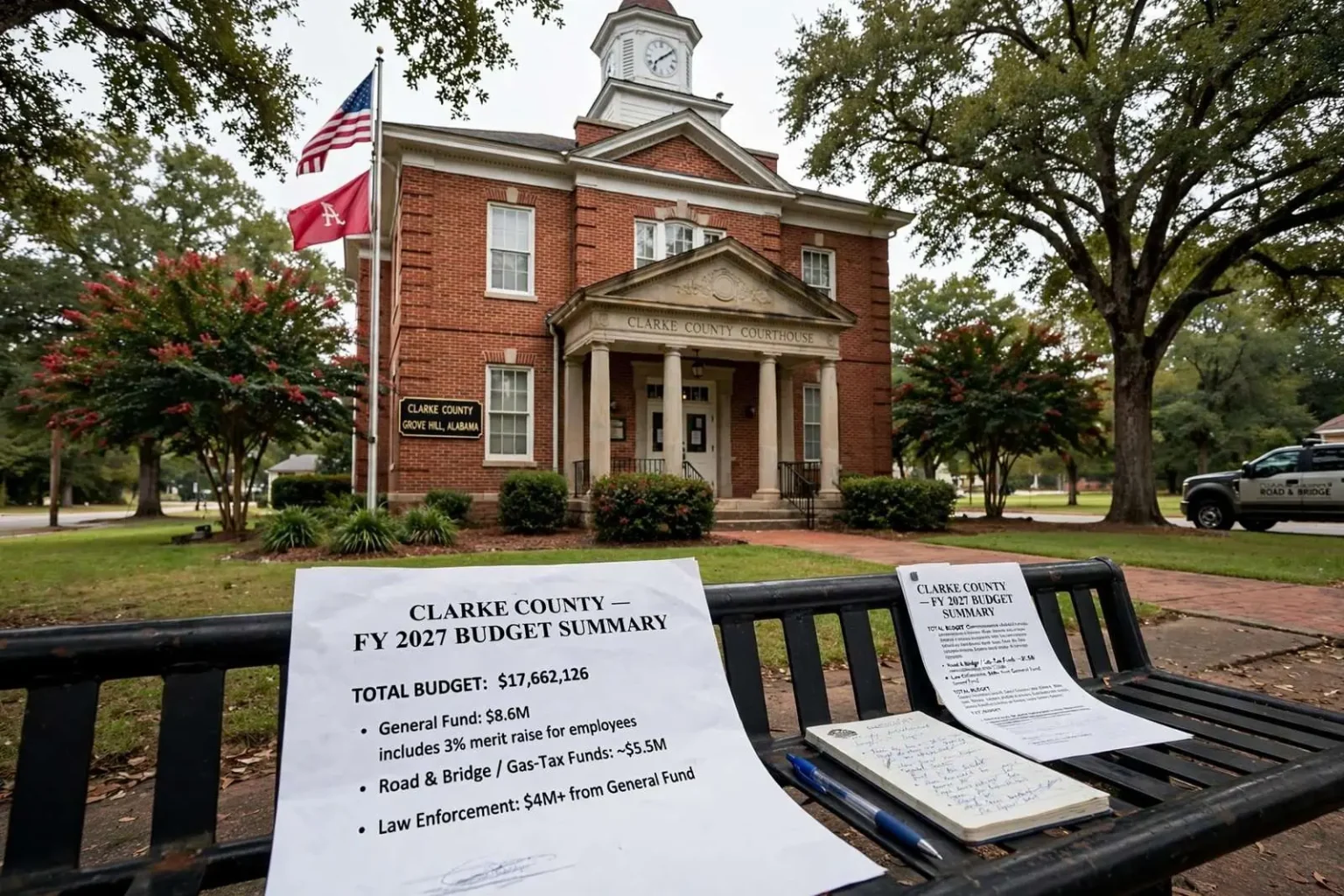
GROVE HILL, Ala. — The Clarke County Commission approved a $17.66 million budget for fiscal year 2027 on Tuesday, including a 3 percent merit raise for county employees.
The budget totals $17,662,126, with $8.6 million in the general fund — the operating fund for most of county government. Of that $8.6 million, just over $4 million is designated for law enforcement.
County administrator Christy Roberts said the budget is close to last year’s numbers. Commission Chairman Jackie Ray Rush noted that the budget was $12 million when he took office in 2012.
Reading a County Budget
A budget sheet presented Tuesday showed a zero balance for the road and bridge department, which invites an obvious question. Roberts explained that funds for that department are reflected in just over $3 million in the gas-tax fund, designated for road-related use.
That structure is standard in Alabama county finance and worth understanding, because it explains why a county’s total budget and its general fund are very different numbers.
Much of a county’s revenue arrives restricted. Fuel tax proceeds may be spent only on roads. Federal aid comes with program requirements. Warrant proceeds are tied to the projects they financed. Those dollars appear in the total budget but cannot be moved to cover general operating needs.
The general fund is the discretionary portion — the money commissioners actually allocate among competing priorities. At $8.6 million out of $17.66 million, less than half of Clarke County’s budget is discretionary in that sense.
The Road Funds
Road-related funds in the fiscal 2027 budget include:
- Gas-tax fund: just over $3 million
- RRR gas-tax fund: $808,000
- Secondary road fund: $347,000
- Rebuild Alabama Fund: $960,000
- Federal aid exchange fund: $425,000
The RRR designation refers to resurfacing, restoration and rehabilitation — a category of road work distinct from new construction, covering the maintenance of existing pavement.
The Rebuild Alabama Fund derives from the Rebuild Alabama Act, the 2019 state law that raised the fuel tax and dedicated a portion of the proceeds to counties and municipalities for transportation infrastructure. For rural counties with extensive road mileage and limited property tax bases, that revenue stream has been consequential.
The federal aid exchange fund reflects a program under which a county trades federal transportation dollars — which carry substantial administrative and compliance requirements — for a somewhat smaller amount of state funds with fewer strings. For small counties without the staff to administer federal-aid projects, the exchange is frequently the more practical option even at a discount.
Taken together, the road-related funds total roughly $5.5 million, nearly a third of the county’s entire budget.
Law Enforcement’s Share
Just over $4 million of the $8.6 million general fund is designated for law enforcement — slightly less than half of the county’s discretionary spending.
That proportion is not unusual for an Alabama county. The sheriff’s office and the county jail together represent the largest general fund obligation in most rural counties, and the jail is the most expensive component. Detention operates around the clock, requires staffing regardless of population, and carries medical costs that have proven difficult to contain.
The commission separately approved new inmate housing rate schedules Tuesday, charging municipalities inside and outside the county for detainees held at the Clarke County Jail — revenue that offsets a portion of that $4 million.
Debt Service
General obligation warrant totals in the budget include:
- Nearly $170,000 for a county courthouse addition
- Nearly $222,000 for economic development
- More than $297,000 for the recently completed energy savings project for the county courthouse and jail
General obligation warrants are the instrument Alabama counties commonly use for capital financing, backed by the full faith and credit of the county. Debt service on them is a fixed annual obligation that must be paid before discretionary spending.
The energy savings project is a particular type of arrangement worth noting. Performance contracting for energy efficiency — upgrading lighting, HVAC systems and building controls — is typically financed on the premise that reduced utility costs will offset the debt service. Whether that premise holds depends on whether projected savings materialize, and courthouse and jail facilities, with their continuous operation, are among the better candidates for such projects.
The Industrial Development Line
The budget designates $425,000 for the industrial development fund, alongside the nearly $222,000 in warrant debt service tied to economic development.
For a rural county, industrial development spending is a bet on the future tax base. Clarke County’s economy has historically rested on timber and forest products, and counties in that position have generally sought to diversify by preparing sites, extending infrastructure and pursuing manufacturing prospects.
The commission’s actions Tuesday included a step in that direction. Near the end of the open meeting, the commission entered executive session to discuss “commerce, trade or sale of property,” according to county attorney Lamar Johnson. Afterward, Rush was authorized to sign a confidential, non-binding letter of intent. Economic developer Jessica Ross participated in the executive session.
Alabama’s Open Meetings Act permits executive sessions for a limited set of purposes, including discussion of the sale or purchase of property and matters related to competitive economic development recruitment where public disclosure would harm the county’s position. Non-binding letters of intent are an early step in industrial recruitment, establishing a framework for further discussion without committing either party.
The Merit Raise
The 3 percent merit raise for county employees is the budget’s most direct effect on the people who deliver county services.
Rural county governments across Alabama compete for employees — particularly correctional officers, deputies, road crew operators and clerical staff — against municipalities, state agencies and private employers that frequently pay more. Turnover in those positions carries real costs in recruitment, training and continuity.
Other Business
The commission also opened bids for projects including traffic striping, asphalt, other materials and grader blades. Those bids will be evaluated and voted on later. The county is also bidding culvert pipe this year, with those bids to be opened at the first meeting in October.
Routine as they sound, these items are the substance of county road maintenance: striping for visibility and safety, asphalt for resurfacing, culvert pipe for drainage, and grader blades for maintaining the unpaved roads that make up a significant share of mileage in a rural county.
The Fourteen-Year Arc
Rush’s observation that the budget stood at $12 million when he took office in 2012 offers a measure of the county’s trajectory: an increase of roughly $5.6 million, or about 47 percent, over fourteen years.
Some of that reflects inflation, some reflects the Rebuild Alabama revenue that did not exist before 2019, and some reflects growth in the cost of services the county is obligated to provide. Roberts’ observation that this year’s budget is close to last year’s suggests a county holding steady rather than expanding.
The fiscal year 2027 budget takes effect Oct. 1.