Book Signing, Classic Car Show and Art Festival Fill Free Weekend on Dauphin Island
A book signing, classic car show and nature art festival bring free family fun to Dauphin Island over an early June weekend.
A Weekend Built Around Free
DAUPHIN ISLAND, Ala. — Families looking for a free, low-key weekend getaway had plenty of reasons to head to Dauphin Island, where a local author’s book signing, a classic car show and a nature-themed art festival were all scheduled within a few days of each other. None of the events carried an admission price, an approach that has long defined how the barrier island courts visitors during the slower stretches of its calendar.
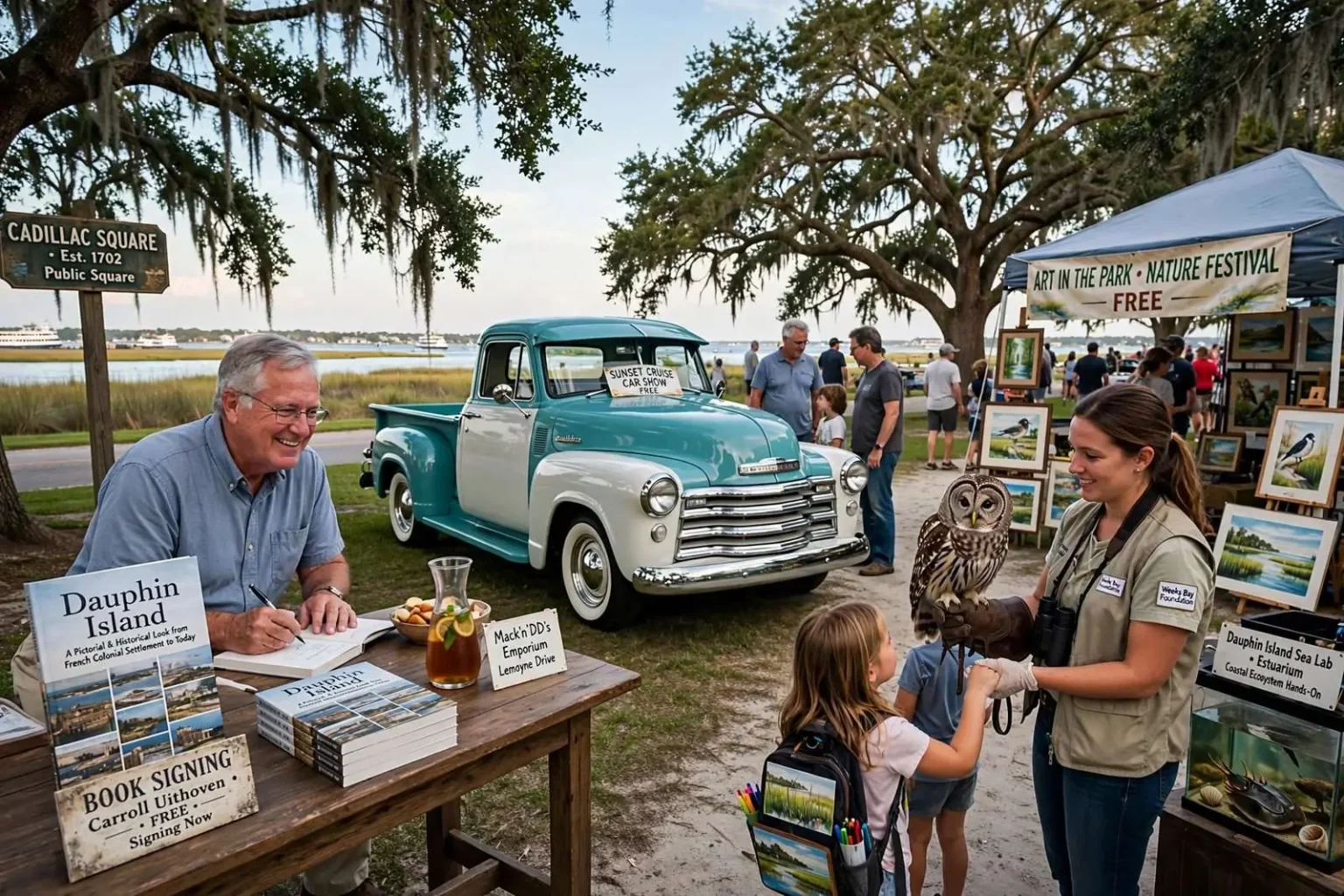
The weekend kicked off Friday evening with a signing for local author Carroll Uithoven’s debut book, simply titled “Dauphin Island,” a historical and pictorial look at the island from its earliest days to the present. The book features more than 100 photographs shot by local photographers Joy Russell and Sjon Hopkins, giving readers a visual tour of a community whose story runs from French colonial settlement to its modern life as a fishing and beach town at the mouth of Mobile Bay.
Uithoven met readers at Mack’n’DD’s Emporium on Lemoyne Drive, where organizers offered snacks, wine and tea alongside the signing. The shop setting suited the occasion: island book events tend to double as neighborhood gatherings, and an evening built around a book about the island naturally drew the people who have lived its recent chapters themselves.
Saturday brought two more free events for residents and visitors, splitting the day between machines and marsh. A Sunset Cruise Car Show lined up classic and antique automobiles at the Dauphin Island Rodeo Site and along West End Beach for much of the day, while a companion swap meet ran from sunup to sundown at Green Park, giving car enthusiasts a chance to browse parts and memorabilia. In the afternoon, an antique car parade and judging session took place, with winners announced by early evening — a procession that sent gleaming fenders rolling past beach houses and live oaks as the day cooled off.
Art and Raptors in Cadillac Square
At the same time, Historic Cadillac Square hosted the Art in the Park Nature Festival, combining local artwork with live animal programs under the spreading oaks of one of the island’s most storied public spaces. Featured artists Benno and Regina Kollegger displayed pieces throughout the day, while raptor programs gave visitors an up-close look at birds of prey — hawks and owls presented at arm’s length, close enough to see the structure of a feather and the reach of a talon.
The raptor programs carried particular weight on an island that doubles as one of the Gulf Coast’s premier birding destinations. Dauphin Island sits along a major migration route, and its maritime forest and dune habitat rest and refuel thousands of songbirds, butterflies and raptors each spring and fall as they cross the Gulf of Mexico. The Audubon Bird Sanctuary at the island’s east end protects much of that habitat, and the Audubon Society has recognized the island as a globally important bird area.
The Weeks Bay Foundation and the Dauphin Island Sea Lab Estuarium both set up educational tents at the festival, offering hands-on exhibits about the island’s coastal ecosystems. Weeks Bay, the reserve protecting the waterways along the eastern shore of Mobile Bay, brought its conservation message across the water, while the Sea Lab — the island’s marine science campus and home to a public aquarium — gave the festival a direct link to the research done a short drive away on the island’s east end.
For families, the pairing of art and science in one park was the point. Children could move from a painting booth to a touch tank to a hawk on a glove within a few steps, the kind of low-cost, high-touch programming that the island’s volunteer-driven event calendar has specialized in. With no admission gate and no parking fees, the barrier to entry was little more than the drive across the bridge.
Why Free Events Matter to the Island
The string of free events reflects Dauphin Island’s ongoing effort to draw both day-trippers and overnight visitors during the early summer season, blending history, art and outdoor recreation into a single weekend without an admission cost. The island’s economy is built on vacation rentals, fishing charters, restaurants and small shops, and events that bring foot traffic onto the island translate directly into busy tables and booked rooms even when the main attraction costs nothing.
Geography shapes that strategy. The island is reachable by a single bridge from the mainland, by the passenger ferry that crosses Mobile Bay from Fort Morgan in season, and by boat — a remoteness that is both its charm and its challenge. Visitors who make the trip tend to linger, walk the beaches and patronize local businesses, which is exactly why community organizations invest in programming that gives them a reason to come rather than simply hoping for a good beach day.
The venues themselves tell the island’s story. Cadillac Square has anchored public gatherings on Dauphin Island since the French colonial era, when the island served as the first capital of the Louisiana Territory, and its oaks have shaded generations of festivals, reunions and church picnics. The rodeo site on the island’s west end and the beaches along West End have long hosted everything from fishing rodeos to community fundraisers, spaces that belong to the island’s collective memory as much as its event calendar.
The classic car circuit, meanwhile, has become a fixture of small-town tourism across south Alabama, and barrier islands are no exception. Car shows reward exactly what the island offers in abundance: open space, scenic backdrops and an audience that enjoys an unhurried afternoon. The Sunset Cruise name captured the appeal — machines on display through the day, with the Gulf’s evening light as the closing act.
Organizers pointed visitors to the “Friends of Dauphin Island” Facebook page and the island’s tourism website for details on the weekend’s schedule and future events, the standard channels through which the island’s all-volunteer event scene publicizes what’s next. For a community of a few year-round residents, that online word-of-mouth is the difference between a well-attended festival and an empty square.
For visitors plotting a weekend around the schedule, the island’s other free attractions rounded out the trip. The public beach at the east end, the fishing pier, the Audubon trails and the historic Fort Gaines all offered hours of activity without admission for the events themselves, and families who stayed through Sunday found the island’s unhurried pace as much a draw as any single program.
The weekend also underscored the island’s habit of folding its history into its recreation. A book about the island, a festival in the square where the island’s colonial-era story is commemorated, and a car show on ground that has hosted community gatherings for decades all pointed the same direction: on Dauphin Island, the past is not a museum exhibit but a working part of the present, wheeled out with the classic cars and displayed alongside the hawk feathers.
By Sunday evening, the weekend had delivered what its organizers intended — a stretch of days in which a visitor could browse photography of the island’s past, admire a restored pickup, watch an owl take a perch and walk a beach at sunset, all without buying a ticket. For a small Gulf town competing with bigger beach destinations down the road, that bargain remains the island’s signature offer.
The book signing added its own layer to that continuity. A pictorial history assembled by a local author, built on photographs from photographers who live on the island, is the kind of project that exists only where people feel their story is worth recording. Hurricanes, bridge-building, the shrimp fleet, the ferry, the storms that have reshaped the shoreline — the visual record captures a place that has always lived at the mercy of the water while making its living from it.
Events of this scale also depend on the network of volunteers and small businesses that sustain the island’s calendar. The emporium hosting the signing, the parks accommodating the shows, and the organizations setting up educational tents all contribute time and materials, a division of labor that keeps admission prices at zero. In a town where the tax base is small and seasonal, donated effort is the currency that makes a festival weekend possible.
The nature festival’s educators brought a broader regional mission with them as well. The Weeks Bay Foundation’s work along Mobile Bay’s eastern shore and the Sea Lab’s research and education programs both extend across the coastal counties, and appearances like these are how those organizations reach the families whose daily lives intersect with the estuaries they study. A child who holds a horseshoe crab at a festival tent on Saturday is a more likely future steward of the bay than one who only reads about it.
Weather, as always on the coast, was the uninvited variable in the weekend’s plans. Island events run on the assumption that Gulf breezes cooperate, and organizers have learned to build flexibility into schedules that can be washed out by an afternoon storm. The run of clear weather that let the car show, swap meet and festival proceed side by side was its own quiet gift to the weekend’s success.
For residents, weekends like this one serve a second purpose beyond tourism: they mark the rhythm of a community’s year. The same families who staff the booths and enter the car shows return each season, and the events double as reunions for a scattered community of current residents, former residents and regular visitors who measure their summers by what is happening on the island.