Mobile’s Davis Avenue Recreation Center Joins the National Register
The National Park Service added Mobile's Davis Avenue Recreation Center, founded in 1921 as the city's first public recreation center for African Americans, to the National Register of Historic Places.
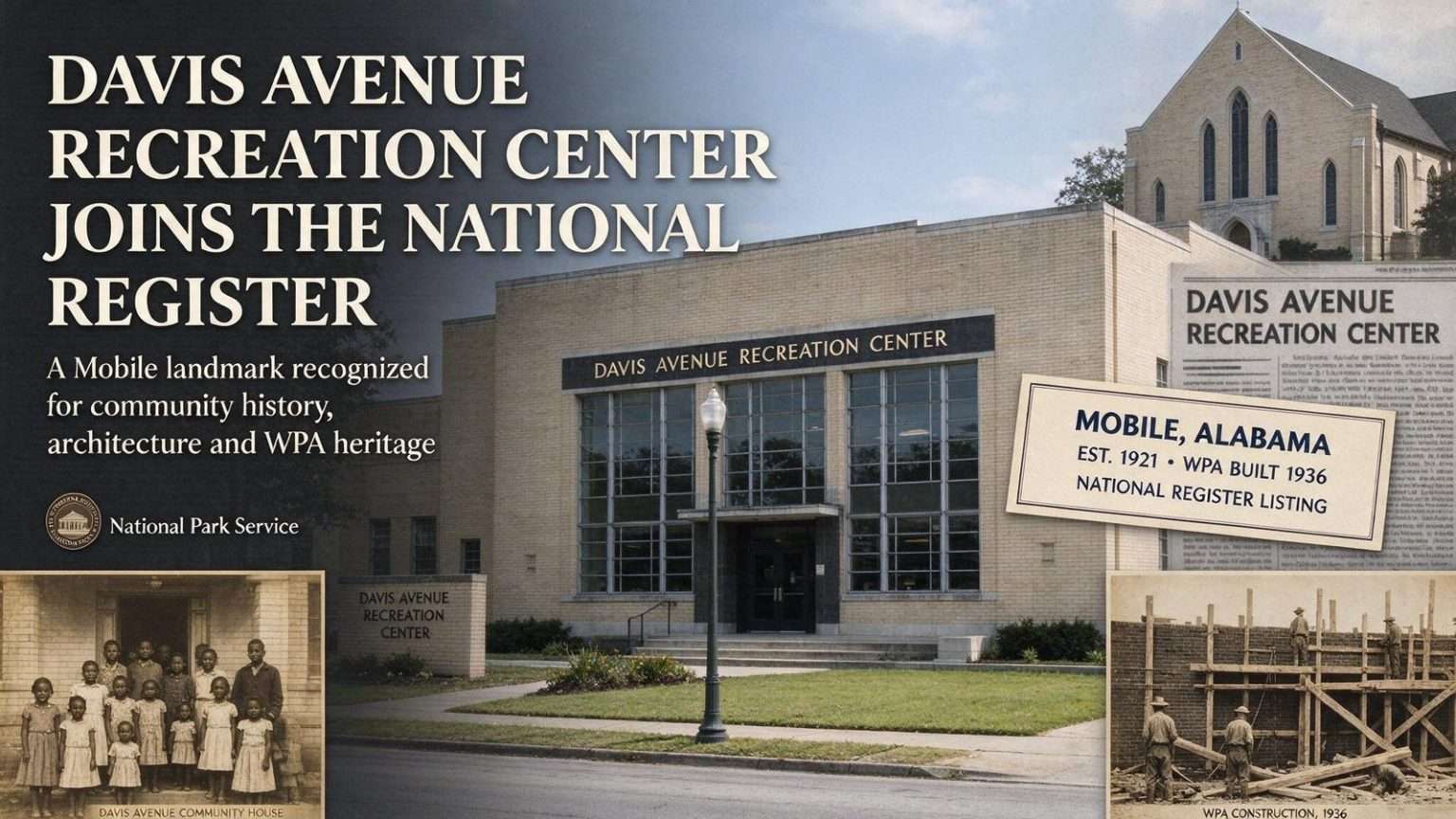
The National Park Service listed Mobile’s Davis Avenue Recreation Center in the National Register of Historic Places, formally recognizing a building that had served as the city’s first public recreation center for African Americans. The designation placed a nine-decade institution among the nation’s officially recognized historic properties, honoring both its architecture and its place in the story of Mobile’s Black community.
The National Register is the country’s official inventory of places worth keeping in public memory — buildings, districts, sites and objects whose stories explain how a community and a nation came to be. Listing does not transfer ownership or dictate how a property is used, but it changes how a place is seen. A recreation hall becomes a document. A neighborhood building becomes part of the American record, eligible for the recognition and protections that follow formal acknowledgment.
For Mobile, the decision added an important entry along the Davis Avenue corridor, the historic spine of Black commerce, culture and civic life in the city during the era of segregation. The corridor produced and supported businesses, churches, schools and social institutions even as the city’s public amenities were divided by race. The recreation center stood at the middle of that world, and its listing brought the corridor’s history back into focus.
Roots in the 1920s
The center traced its origins to 1921, when it opened as the Davis Avenue Community House. The original facility included tennis courts, a swimming pool and a small park for children — a full range of recreation amenities for a community that received few of them from the city at large. In an era when public leisure spaces were scarce for Black families across the South, the community house gave the neighborhood a place that was unmistakably its own.
Its founding came a year after the city of Mobile had constructed a whites-only recreation center on Spring Hill Avenue, and the timeline underscored the segregated realities of the era. The two facilities were not an accident of planning; they were parallel institutions built for parallel communities. That the Black community’s center arrived only after pressure and need made it unavoidable says much about how public resources were distributed in Mobile in the 1920s.
Demand quickly outstripped the first facility. Mobile’s African American community soon outgrew the community house, and in 1936 the city replaced it with the current building, naming it the Davis Avenue Recreation Center. The replacement was itself a sign of the center’s importance — the community had used the original so heavily, for so many purposes, that a larger and more modern building became a necessity rather than a luxury.
A New Deal legacy
The 1936 building carried a distinction beyond its role in community life. It was the only public recreation center in Mobile built with Works Progress Administration funds, tying it directly to the federal public-works programs that reshaped American cities during the Great Depression. Across the country, the WPA put millions of unemployed Americans to work building schools, post offices, parks and civic buildings — structures designed to serve generations, not just get through an economic crisis.
That Mobile’s one WPA-funded recreation center went to the Davis Avenue community gave the building a double significance. It was both a product of one of the largest federal investments in everyday American life and a rare instance of that investment reaching the city’s Black neighborhoods. Few physical reminders of that combination survive, which made the building’s survival all the more consequential for historians and preservationists.
Its design reflected the modernist sensibilities of the period. The center featured simple volumetric forms and an open interior arrangement of multipurpose rooms, lit by large plate glass windows. That combination of functional planning and clean lines helped make the case for its historic significance. Modernism in public buildings of the 1930s favored honesty of purpose over ornament — a gymnasium should look like a gymnasium, a meeting hall like a meeting hall — and the center followed that logic throughout.
The multipurpose layout also explains the building’s longevity. A structure designed to host athletics one hour and community meetings the next can adapt as neighborhoods change, and the Davis Avenue Recreation Center did exactly that across decades of use. Large windows and open floor plans kept the interior flexible and welcoming, qualities that modernist designers prized and that community users came to depend on.
Preserving the record
Listing in the National Register does not by itself guarantee a building’s future, but it formally documents a property’s importance and can open the door to preservation incentives. Registered properties become eligible for grant programs and tax benefits aimed at rehabilitation, and the nomination process itself produces a detailed architectural and historical record that outlives any single owner’s plans. For aging buildings, that documentation is often the difference between a forgotten structure and a protected one.
For the Davis Avenue Recreation Center, the recognition affirmed a legacy that spanned generations of residents who had gathered there for recreation, activity and community. Swimmers, athletes, dancers, club members and families all passed through its rooms, and the memories attached to the building are part of what the designation protects. Architectural significance and community significance are usually weighed separately; at the Davis Avenue center, the two are inseparable.
The center’s history also offered a window into a broader chapter of Mobile’s past, when public amenities were divided by race and the Black community built and sustained institutions of its own. The 1921 community house and its 1936 successor had stood as fixtures of that world, and their endurance made the buildings a tangible link to it. Preservationists often note that buildings like this one carry history that no textbook can replicate — the physical evidence of how people lived, gathered and made a community under constraint.
A landmark acknowledged
With the National Park Service’s action, the Davis Avenue Recreation Center took its place alongside other recognized landmarks in the city and state. For a facility that had begun as a modest community house and grown into a WPA-built center, the designation marked a measure of overdue acknowledgment. The building had spent decades serving a community that official Mobile often overlooked; the National Register listing made that service part of the official record at last.
The listing invited residents to consider the building not merely as a recreation hall but as a document in brick and glass, one that recorded both the constraints of its era and the resilience of the community it served. Its segregated origins and its community triumphs are both written into the structure, and neither part of the story is complete without the other.
In preserving that record, the National Register ensured that the story of the Davis Avenue Recreation Center would remain part of Mobile’s public memory. For the neighborhoods along Davis Avenue and for the city as a whole, the designation is an invitation — to visit, to learn, and to treat the building as what it now formally is: a historic place that belongs to everyone.
What the designation means locally
For residents of Mobile, a National Register listing is more than a plaque. It signals to visitors, researchers and potential funders that a building matters, and it gives community groups a recognized anchor when they argue for restoration over demolition. In older Southern cities where Black historic sites have historically been underrepresented in official inventories, each new listing helps correct the record — and the Davis Avenue Recreation Center is exactly the kind of property those inventories have often missed.
The designation also connects the center to a wider network of WPA-era and civil-rights-era sites across Alabama, where state and local preservation groups have worked to document places tied to Black community life. That network matters in practical terms: shared research, shared grant strategies and shared visibility all make it easier to keep individual buildings standing. It also gives teachers and tour organizers ready-made destinations for lessons on the Great Depression, segregation and community resilience, all of which the center’s own story touches directly.
The architecture itself rewards a second look from anyone walking the corridor. The plate glass windows, the open multipurpose floor and the simple massing of the 1936 building stand out among the older commercial storefronts of the area, a visible reminder that civic buildings of the New Deal era were built to communicate permanence and public purpose. That the center remains recognizably itself — uncluttered, functional, welcoming — is precisely what preservationists look for when they evaluate a property’s integrity, and it strengthened the case for listing.
Nine decades after the community house first opened its doors, the Davis Avenue Recreation Center has gone from a neighborhood necessity to a recognized piece of Alabama’s historic fabric. The building that once answered a simple need — a place for a community to gather — now answers a different one: a place where the city’s full history is written down, protected and remembered.