University of South Alabama Mobile
Langham Bows Out of Treasurer’s Race, Leaving Democrats Scrambling Before Friday’s Deadline
Retired labor leader Don Langham decided against a run for Mobile County treasurer, reopening the question for Democrats with the qualifying deadline hours away. Party chairman Brad Warren reconsidered his own bid.
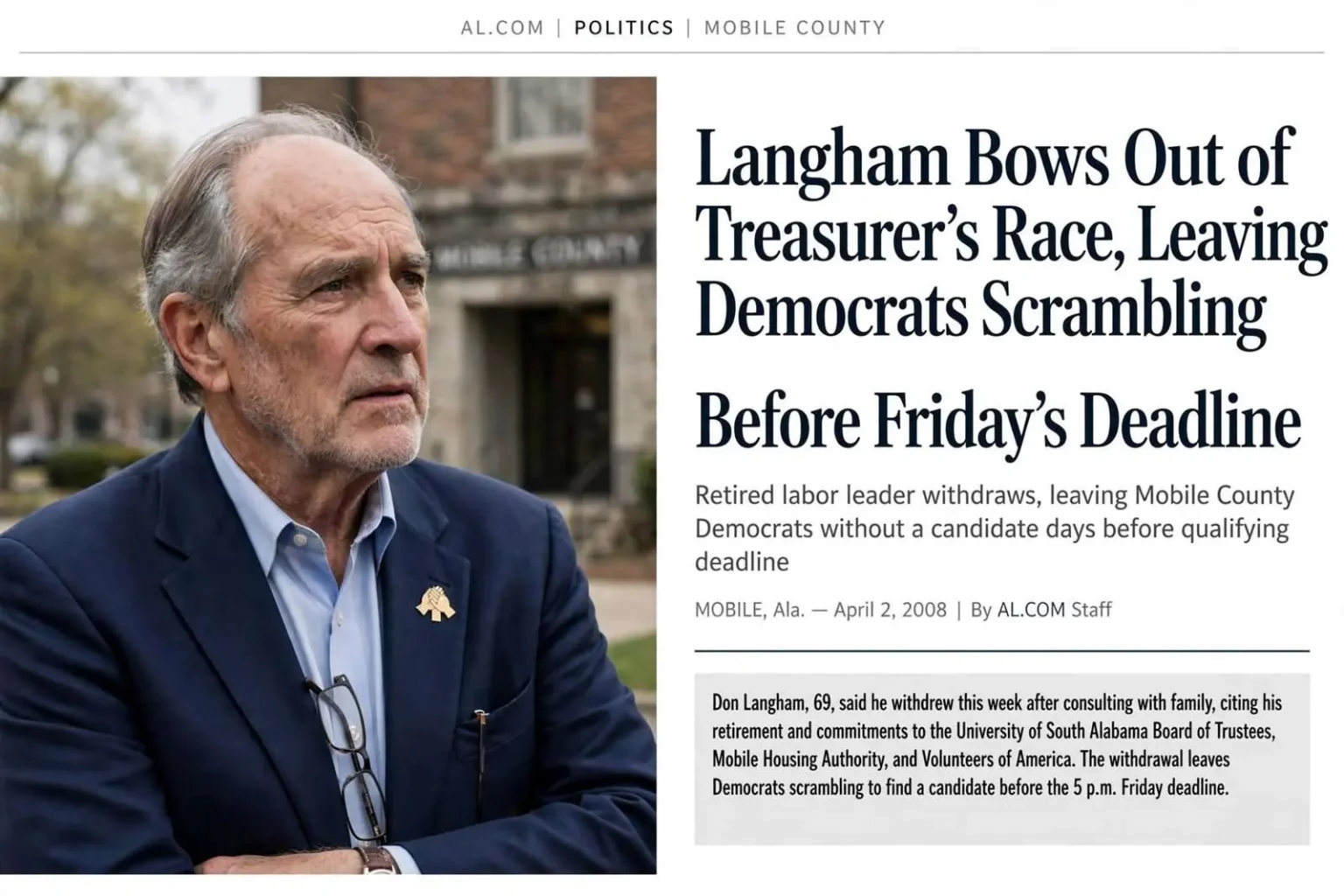
The retired labor leader who had been the Mobile County Democratic Party’s most likely candidate for county treasurer took himself out of the running this week, scrambling the party’s plans with the qualifying deadline only days away.
Don Langham, 69, who stepped back from a long career in organized labor about nine months earlier, said he had reconsidered after talking it over at home.
“After more consideration and consultation with my family, I have made a decision not to be a candidate for Mobile County treasurer,” Langham said. “I am enjoying retirement and my involvement with the University (of South Alabama, where he serves on the Board of Trustees), (Mobile) Housing Authority (board of directors), Volunteers of America and outdoor activities.”
The withdrawal left the party without a candidate for a countywide office and with almost no time to find one — a familiar position for Mobile County Democrats, and an uncomfortable one with the June primary approaching.
A Candidacy Tied to Someone Else’s
Langham’s earlier position had been conditional in an unusual way. He had said he would run for treasurer unless Ben Lodmell, the putative Democratic congressional contender, qualified as the party’s challenger to incumbent U.S. Rep. Jo Bonner, R-Mobile.
The logic was ticket-building rather than ideology: a credible Democrat in one countywide or federal race encourages others to run, and Langham had positioned himself as the fallback — willing to carry the treasurer’s banner if the congressional slot was empty, or to step aside if a congressional candidate emerged and the party’s attention could shift.
Lodmell’s own standing, however, was clouded. He faced charges of allegedly soliciting a prostitute on the Eastern Shore, and whether he would appear on the ballot at all remained uncertain. A candidate’s legal troubles rarely make him more attractive to a party searching for credibility, and the uncertainty contaminated the ticket logic Langham had been working from.
In the end, Langham did not wait for that question to resolve itself. He simply declined to run, leaving the party’s dominoes standing exactly where they had been before he touched them.
The office he passed on is held by Republican Al Sessions, whose incumbent position meant the Democrats’ struggle was not merely about finding a name but about finding one willing to take on an established officeholder with the machinery of a sitting constitutional officer behind him.
The Chairman Reconsiders
Langham’s withdrawal reopened a door that had already swung shut once. Mobile County Democratic Party Chairman Brad Warren had previously announced his own intention to run for treasurer, then backed off when Langham signaled interest.
With Langham out, Warren was weighing the race again and expected to decide Thursday. The reversal was an awkward one for a party chairman — first entering, then exiting, then possibly re-entering a race inside a single season — but the arithmetic of the deadline allowed no leisure. Party chairs in Alabama serve as the default recruiters of last resort, and when the bench is thin, the recruiter is frequently the recruit.
The deadline concentrated the minds of everyone involved: 5 p.m. Friday, April 4, was the last moment to qualify as a candidate in either party’s June primary. Whatever the party decided, it had to decide fast. Qualifying in Alabama requires paperwork, a qualifying fee and a public commitment that a candidate cannot take back casually, and the clock left room for none of the deliberation that serious candidacies usually receive.
A Thin Bench in a Shifting County
The episode illustrated the position Mobile County Democrats found themselves in during the 2008 cycle. Countywide constitutional offices — treasurer, license commissioner, revenue commissioner — had been trending Republican for years, and the party’s difficulty in fielding a candidate for a down-ballot office until the final week said as much about the local landscape as any single race.
The decline had been gradual and structural. As Mobile County’s electorate shifted, the party’s strongest candidates increasingly looked to city and legislative seats — where Democratic strengths in the city of Mobile persisted — rather than to countywide offices that required carrying the suburbs and the unincorporated county. A treasurer’s race, largely administrative and low-visibility, attracted fewer volunteers than any office on the ballot.
Langham’s own résumé illustrated the other half of the picture. A figure of long standing in Mobile civic life, he sat on the University of South Alabama Board of Trustees, the Mobile Housing Authority board of directors and served with Volunteers of America. He was the kind of candidate a party recruits precisely because he does not need the job — and, as it turned out, the kind who can decide he would rather not have it.
Democrats to Gather Saturday
Whoever ended up on the ballot, the party’s activists had a date on the calendar. The Mobile Area Democratic Association was set to meet Saturday, April 5, at 10 a.m. at the IBEW (Electrical Workers) Local 505 offices at 2244 Halls Mill Road, across from the old Farmer’s Market area.
Mobile Mayor Sam Jones, the city’s first Black mayor and by 2008 the most prominent Democrat in Mobile County, was scheduled to address the gathering — an appearance that would come less than 24 hours after the qualifying books closed, with the shape of the county’s Democratic ticket finally settled.
The venue said something about the party’s base. Union halls — and an electrical workers’ local in particular — have been organizing ground for Mobile Democrats for generations, and a Saturday morning meeting there drew the precinct workers, club officers and activists who would staff whatever ticket the party fielded. The association’s meeting functioned as both morale event and logistics session: candidates confirmed, volunteers assigned, the fall campaign sketched out regardless of the odds.
Jones’s own position made the appearance notable. Elevated to the mayor’s office after a long career in city government, he inherited both the city’s top job and, by default, the informal leadership of a county party that had grown accustomed to losing countywide. His presence at the union hall was an acknowledgment that the party’s fortunes now ran through City Hall — and that the mayor’s participation in down-ballot races mattered.
For the party faithful arriving at the union hall that Saturday morning, the practical question was simple enough: who, if anyone, would be carrying the Democratic banner into races that had lately produced more vacancies than victories.
What the Episode Revealed
Recruitment stories rarely make the front page, but they are where elections are actually won and lost. A party that cannot persuade a respected civic figure to sign a qualifying form by a Friday deadline is a party whose problem is not messaging but supply — of candidates willing to lose, perhaps, in order to keep a ticket whole.
Langham’s decision, friendly as it was framed, was also a data point: even for a man with no electoral future to protect, a race against a seated Republican for an office nobody sees was not worth the giving up of a retirement already well stocked with boards and causes. That calculation, multiplied across every prospective candidate in the county, was the real condition of the Mobile County Democratic Party in the spring of 2008 — and the union hall gathering would take it up first thing Saturday morning.
The Office Langham Passed On
The county treasurer’s office is among the least examined of the countywide constitutional posts, and that invisibility cuts both ways. The treasurer’s responsibilities — receiving and disbursing county funds, managing accounts and serving as one of the fiscal checkpoints on the commission’s spending — are essential to how a county with hundreds of millions in annual obligations actually functions, but they generate few headlines and rarely decide elections.
That makes the office a strange kind of political object. Incumbents accumulate long tenures because nobody campaigns against them aggressively; challengers find it hard to articulate why the office matters; and voters, given little information, default to name recognition and party label. In a county trending one direction, those defaults favored whoever held the seat — and made the search for a serious challenger correspondingly harder.
Sessions’s incumbency also meant the Democratic candidate would start with a structural deficit in fundraising. Down-ballot challengers to seated constitutional officers struggle to raise money in the best of circumstances, and local donors who must work with the county’s fiscal offices have little incentive to fund a challenger’s lists.
None of which excuses the last-week scramble, in the view of party regulars — but all of which explains it. The treasurer’s race was the purest expression of the county’s political geography: an office Democrats once held routinely, now difficult even to staff, contested in a year when the party’s energy flowed toward the presidential contest and the mayor’s office rather than the county courthouse annex.
The qualifying deadline of 5 p.m. Friday would settle at least the arithmetic of the ballot. Whether the party could convert a name filed at the last hour into a campaign by November was the harder question, and one that the activists at the IBEW hall would begin working on the moment the gavel came down Saturday morning.