

After 21 years in business, most restaurant owners would be content to coast. Jennifer Knight is doing the opposite: the owner of Pensacola’s End of the Line Café has just wrapped a three-year renovation and expansion that doubled her footprint, added a full bar and a new kitchen, and turned the beloved vegan restaurant into what she describes as an event space for the community — complete with a stage in the courtyard for live music.
“We stayed open through the entire construction, so I am really excited about what we’ve created at End of the Line,” Knight says. “We have specials every day and grab-and-go dinners available for pickup. With the new event space, we are not just a restaurant, but a community space for everyone to enjoy.”
The renovation has been a patient, phased project. Knight purchased the building next door to the original café at 601 Wright Street, just across from the railroad tracks that gave the restaurant its name, and renovated it first — a larger kitchen, a full bar with beer, wine, and spirits, more dining areas, and a coffee shop and bakery with its own side courtyard. When that building was ready, operations moved over while the original space was renovated; a big opening now connects the two buildings into one flowing space. The old kitchen has become a community room hosting authors, music, and art shows that had gone dormant during construction. “These have always been popular, and I’m excited to bring them back,” she says.
Out back, a large courtyard with a stage has already hosted weddings and fundraiser benefits, with landscaping finishing the look. The expansion also extends the café’s menu ambitions — a coffee shop and bakery next door, expanded catering, and a rehabbed food truck — supported by a full bar offering beer, wine, and spirits.
From bartending to the vegan vanguard
Knight’s path to running one of the Panhandle’s pioneering vegan restaurants started far from Pensacola. She was born in San Diego, lived in Des Moines, Iowa, until her family moved to Pensacola when she was in the third grade, and after high school headed to San Francisco with an appetite for travel. For a year she bounced between Europe, Costa Rica, Hong Kong, Thailand, and Ireland — funding the wandering from a San Francisco apartment she could barely afford. “It was challenging living in San Francisco, keeping an apartment, because you really couldn’t afford to pay rent and travel at the same time,” she says.
She came home to Pensacola and spent five years bartending at Dharma Blue, the restaurant of Gulf Coast restaurateur Charles Morgan — the same Charles Morgan who would eventually tip off a regional newsletter that Knight “has a great thing going on.” Next came a coffee shop called Van Gogh, which she and three partners took over; the shop featured live music and showed local artists’ work, keeping Knight in the community-building business from the start. When the partnership thinned to just her, she leaned into the food she knew best: vegan muffins, desserts, and sandwiches.
She had been a vegan for years by then, and had noticed a gap in the market. “There wasn’t anything in the area that offered vegan food,” she says. “Basically, people interested in clean eating like to dine out, and there was a big void for healthier vegan options in Pensacola.” Menu options inspired by her California years expanded into a full restaurant. End of the Line Café was born — named, as locals guess correctly, for its spot near the end of the rail line.
More than a restaurant: a health education
What distinguishes End of the Line Café from an ordinary eatery is Knight’s second vocation: health coach. As her vegan fare attracted diners, she found that more and more people arrived with health issues and no idea how to adjust their diets. “I began to focus on honest, healthy food,” she says. She started teaching cooking classes — halted by the pandemic but slated to return — for people who wanted to eat healthier but didn’t know where to begin. “It’s like learning a new language. Customers didn’t even know what products were available or how to use them.”
Her teaching philosophy is plainspoken. “If it has labels with words that have six consonants or numbers, it probably is not good for you,” she says. “Clean eating with minimal ingredients is fresh, simple, chemical-free, and preservative-free. It’s empowering to learn how to cook for yourself, and to be in control of your own health.” She talks about cravings as the body’s signals of vitamin and mineral deficiencies, and about dehydration as an overlooked driver of many common complaints — soda and coffee work against you, and water has to make up the difference. “You have to make a first step to healthy living.”
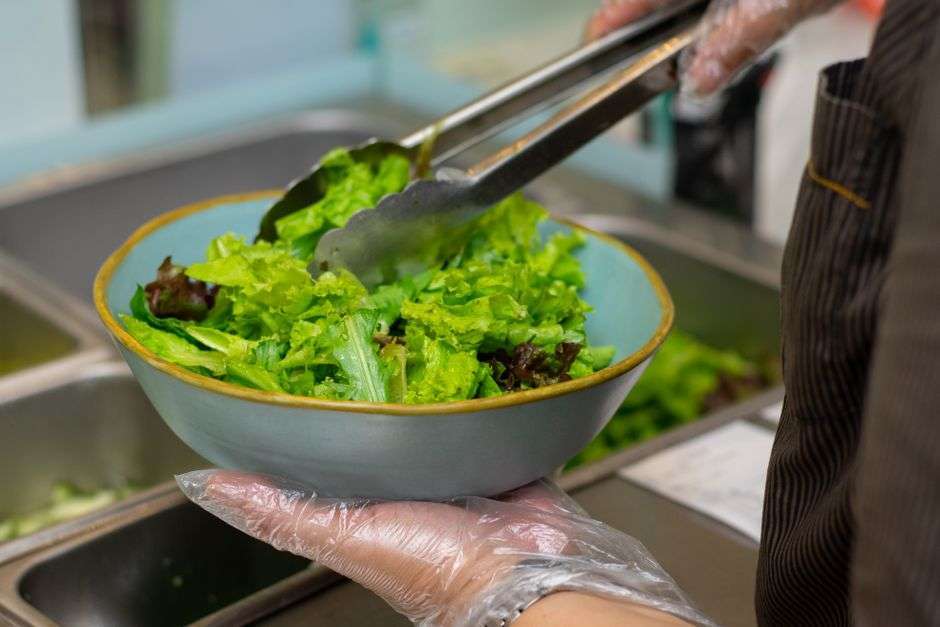
The café’s own standards match the sermon. Everything is made in-house, with as many locally grown ingredients as possible, and only Fair Trade organic products — including sugars and coffees. “We rely on Mother Nature to keep us on top of our game,” she says. “It feels good to make clean, house-made food by hand using pots and pans.”
Ownership, against the odds
The expansion nearly didn’t happen. Knight had begun looking for a second location before the pandemic, and when the building next door came up for sale, she moved — exercising the first right of refusal she held on the space she had rented for years and buying both buildings at the same time. “We were out of room,” she says simply. “Our kitchen is too small and we can’t meet the demand for producing food people want.” She worked with Dalrymple Sallis Architecture and Hanto & Clarke General Contractors on the renovation, helping design it and overseeing the work herself.
The demand she describes is part of a broader shift. “There is a rise in veganism,” she says. “People are more aware of what’s out there. There are all these amazing products in grocery stores now, whereas before you could only find vegan products in specialty shops.” The numbers back her up: plant-based eating has moved from fringe to mainstream across the country over the past decade, with mainstream grocers stocking plant-based alternatives that once lived only in specialty shops, and restaurants of every kind adding vegan options to their menus. Knight noticed the tide early — End of the Line was serving the niche before it had a name on every corner — and the café’s longevity through two decades, a recession, and a pandemic suggests that when a restaurant owns a category honestly, the category eventually comes to it.
End of the Line has ridden that wave from the front: the café has been the sole vegan vendor for Pensacola’s Earth Day celebration and has served Vegan Fests in Tallahassee, Destin, and Fairhope, extending its reach across the Panhandle long before its food truck hit the road.
Community, through everything
Through the pandemic, the renovation, and the demands of single parenthood, Knight kept the enterprise whole. When COVID closed dining rooms, the café pivoted to family-style take-home meals — and she kept her entire staff. Her husband passed away seven years ago, when their daughter was three and a half, and Knight folded her grief into the work. “I decided to focus my energy solely on my daughter and this restaurant,” she says. “It was something tangible as opposed to inward. It was therapeutic.”
“Being a single mom, you find more reasons to work harder and be proud of what you do,” she says. “I enjoy what I do and what we have accomplished. We have a great team, and I’m looking forward to the future.”
That future is now on display at 601 Wright Street: twice the space, two courtyards, a bar, a bakery, a community room, and a stage — a restaurant that never closed while it was being rebuilt, and a business that treats clean food, local art, and neighborhood gathering as parts of the same recipe. For Pensacola, which has watched several beloved kitchens vanish in recent years, End of the Line’s expansion is the rare story of a neighborhood institution getting bigger on purpose — and staying true to its name at the end of the line.