Fairhope to Host Community Forum on Future of Local Education After Failed Tax Vote
Fairhope's Education Advisory Committee is hosting a community forum to gather input on the city's education future after a countywide tax vote failed.
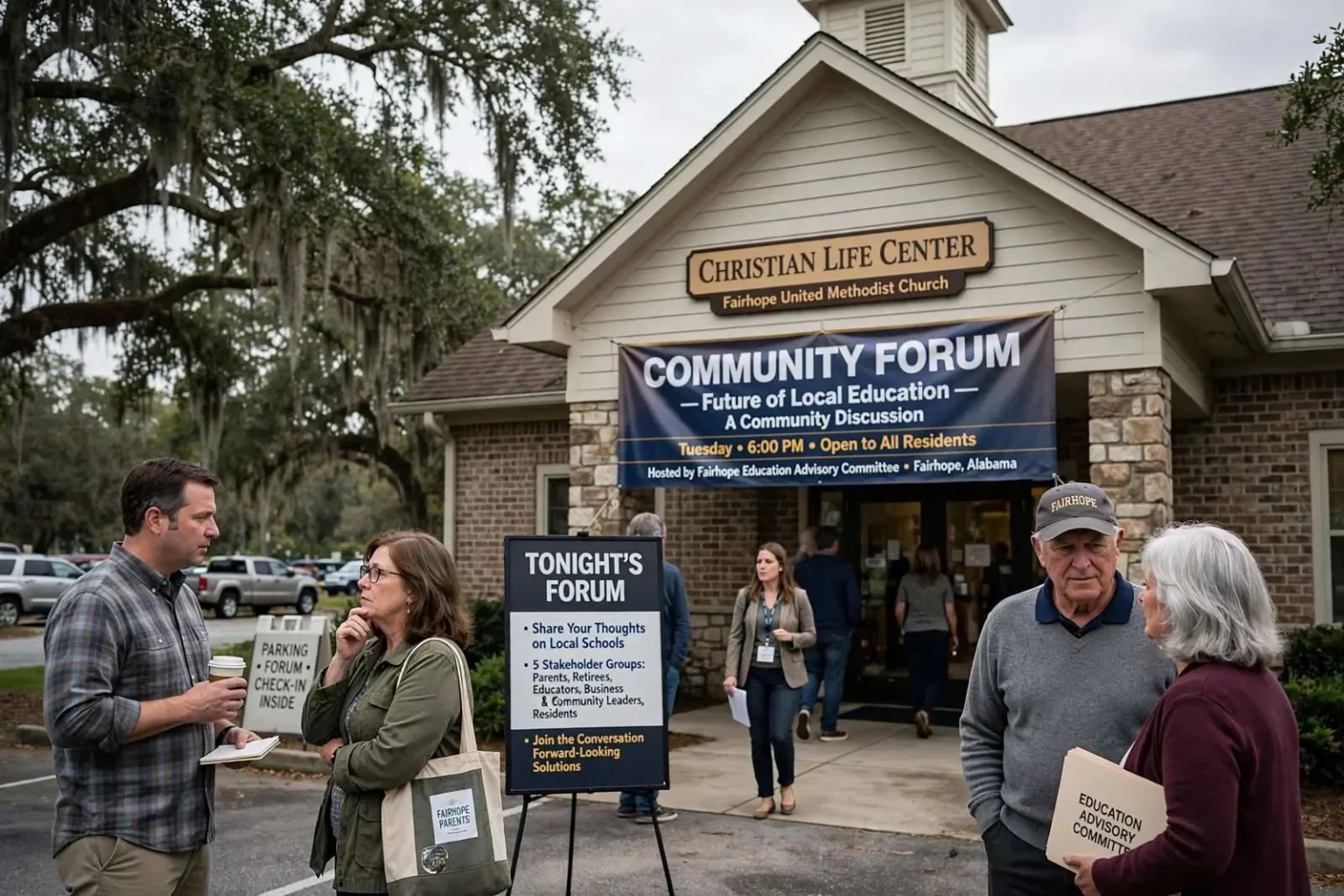
FAIRHOPE, Alabama – Fairhope’s Education Advisory Committee is hosting a community forum aimed at gauging resident sentiment about the future of local schools, coming just weeks after Baldwin County voters rejected a proposed property tax increase intended to fund a major school expansion initiative. The forum is designed to move the conversation forward at a moment when the county’s fast-growing communities are still absorbing the consequences of the vote.
The forum, scheduled for the Christian Life Center at Fairhope United Methodist Church, is intended to give residents a chance to share their thoughts about where the community should go from here rather than simply revisiting the failed referendum, according to the city council’s liaison to the education committee. Organizers described the event as forward-looking, with an emphasis on solutions rather than grievances, a framing intended to keep the discussion productive even as feelings about the tax vote remain raw on both sides.
The March referendum at the center of the debate would have raised property taxes by 8 mills to fund a 10-year, $350 million school expansion initiative, alongside the renewal of existing tax measures that support the county school system. A majority of Baldwin County voters rejected the proposal, leaving the county school board and several municipalities searching for alternative ways to address a looming funding shortfall at a time when the county’s population growth is driving rapid enrollment increases across its school district.
Baldwin County is one of the fastest-growing counties in Alabama, and its school system has absorbed waves of new students from families moving to the Gulf Coast, particularly along the Interstate 10 corridor and the Eastern Shore. That growth has strained classroom capacity in communities like Fairhope, Gulf Shores and Spanish Fort, and it is the underlying reason the school system sought the decade-long construction program in the first place. The referendum’s failure did not make the need disappear; it simply left officials without the tax revenue that was meant to pay for meeting it.
How other cities are responding
In the weeks since the vote, different communities have begun charting their own responses. Gulf Shores has continued pursuing a new high school campus along the Foley Beach Express, a project aimed at accommodating the city’s booming beachside population. Bay Minette has been grappling with an aging elementary school that needs attention regardless of the countywide vote, and other cities have discussed the possibility of city-funded school initiatives that would supplement the county system’s budget with municipal dollars. The divergent approaches reflect a fundamental reality of Alabama school governance: while the county board operates the schools, cities hold their own tax authority and have demonstrated a growing willingness to use it on behalf of their students.
For Fairhope’s part, the Education Advisory Committee plans to organize five stakeholder groups during the forum: parents of students in the Fairhope feeder pattern, older residents with and without school-aged children, retirees, community and business leaders, and current or former educators. Each group will be asked to weigh in on how the tax vote’s outcome might affect academic quality over the next five years, and what steps elected officials should take to keep education a top city priority. The structure is intended to ensure that every segment of the community has a voice in the discussion, not only the households most directly connected to the schools.
The forum will open with a presentation from the committee’s chairman outlining the group’s mission, followed by a presentation highlighting the city’s financial contributions to the Fairhope feeder pattern. That pattern includes Fairhope High, Fairhope Middle, Fairhope Intermediate, Fairhope Elementary and J. Larry Newton schools, the sequence of campuses that serves students from kindergarten through graduation as they move through the Fairhope attendance zone. City officials say Fairhope has contributed more than $1 million toward academic programs across those five schools over the past three years, along with roughly $500,000 annually in in-kind services.
Those in-kind contributions – services the city provides at no charge that the school system would otherwise have to purchase – can take forms ranging from facility maintenance support to resource sharing, and they represent a continuing municipal commitment that doesn’t show up in a single check. Taken together with the direct program funding, the figures position Fairhope among the Baldwin County cities most actively investing in their schools, a record organizers want attendees to consider as they discuss what the city’s role should look like going forward.
The economics of school quality
An economist with the Gulf Coast Center for Impact Studies is also expected to speak at the forum, discussing the broader relationship between school quality and local economic growth, along with the long-term implications of an underfunded county school system. The connection is one that Fairhope residents understand intuitively: strong schools support property values, attract new families and businesses, and shape the workforce that local employers can draw from. Research on fast-growing metro areas has repeatedly tied school system performance to residential demand, making education spending not just a social investment but an economic one for communities competing for growth.
In a city like Fairhope, whose downtown shops, waterfront parks and highly regarded schools have made it one of the most desirable addresses on the Eastern Shore, the stakes of that relationship are particularly visible. Homebuyers choosing among Baldwin County’s growing communities routinely weigh school quality alongside commute and cost of living, and real estate professionals have long credited the Fairhope feeder pattern with supporting the city’s housing market. A county school system stretched thin by growth, economists warn, could erode that advantage over time if classroom quality slips relative to competing communities.
The forum also arrives amid a broader conversation about how Alabama funds its schools. Property tax millages, which are voted on locally in Alabama, form a critical share of school revenue, and the state’s historic reliance on local property taxes means that fast-growing counties with rising enrollments face persistent pressure to pass new taxes or find substitute funding. An 8-mill increase would have added $8 per year for every $1,000 of assessed value, with owner-occupied homes assessed at 10 percent of appraised value under Alabama’s property tax system – a structure that keeps headline rates low but can make substantial funding packages politically difficult to pass.
Committee leaders say the forum is intended to serve as a first step toward developing a longer-term plan for the city’s ongoing role in local education funding. The input gathered from the five stakeholder groups is expected to inform recommendations that the committee can carry back to the city council, giving elected officials a structured picture of what residents want prioritized as the school system searches for a path forward after the failed tax vote.
The advisory committee itself represents a form of government that has become increasingly common across Baldwin County, where city leaders frustrated with the pace of countywide solutions have created formal channels for municipal involvement in education. By design, such committees do not replace the county school board’s authority, but they give cities a vehicle for directing local money, advising on community priorities and keeping education at the center of municipal planning.
For the families whose children fill the Fairhope feeder pattern’s classrooms, the forum’s practical question is straightforward: will academic quality hold as enrollment grows and the funding formula remains unchanged? Teachers and administrators in the pattern have benefited from the city’s sustained contributions, and the committee’s challenge is to identify what those dollars should support next as the district’s construction and staffing needs evolve. For older residents and retirees, the discussion often centers on value – what the community receives in return for municipal education spending, and how schools fit into the quality of life that draws them to the city.
The business and community leader group brings yet another perspective, connecting school outcomes to the labor market and to the recruitment of new employers along the Eastern Shore. Current and former educators, meanwhile, can speak to what funding changes look like inside a classroom, where crowded sections and stretched resources are felt first. Bringing all five perspectives into one room is the committee’s attempt to model the kind of community-wide decision the failed referendum left unresolved.
Whatever recommendations emerge, they arrive at a consequential moment for Baldwin County’s schools. The county board must still deliver education to a student population that continues to expand, municipalities must decide how far they will go with city-funded support, and residents must decide whether the community conversation that follows the failed tax vote produces a workable alternative or simply postpones the reckoning. The Fairhope forum’s organizers hope the evening at the Christian Life Center marks the beginning of an answer – a first step toward a longer-term plan that keeps education at the top of the city’s priorities even after the voters’ verdict on the tax increase.