Fairhope Parents Sought Study of Independent School District in 2009
Fairhope parents asked city leaders in 2009 to study forming an independent school district as Baldwin County schools faced a $56 million budget shortfall.
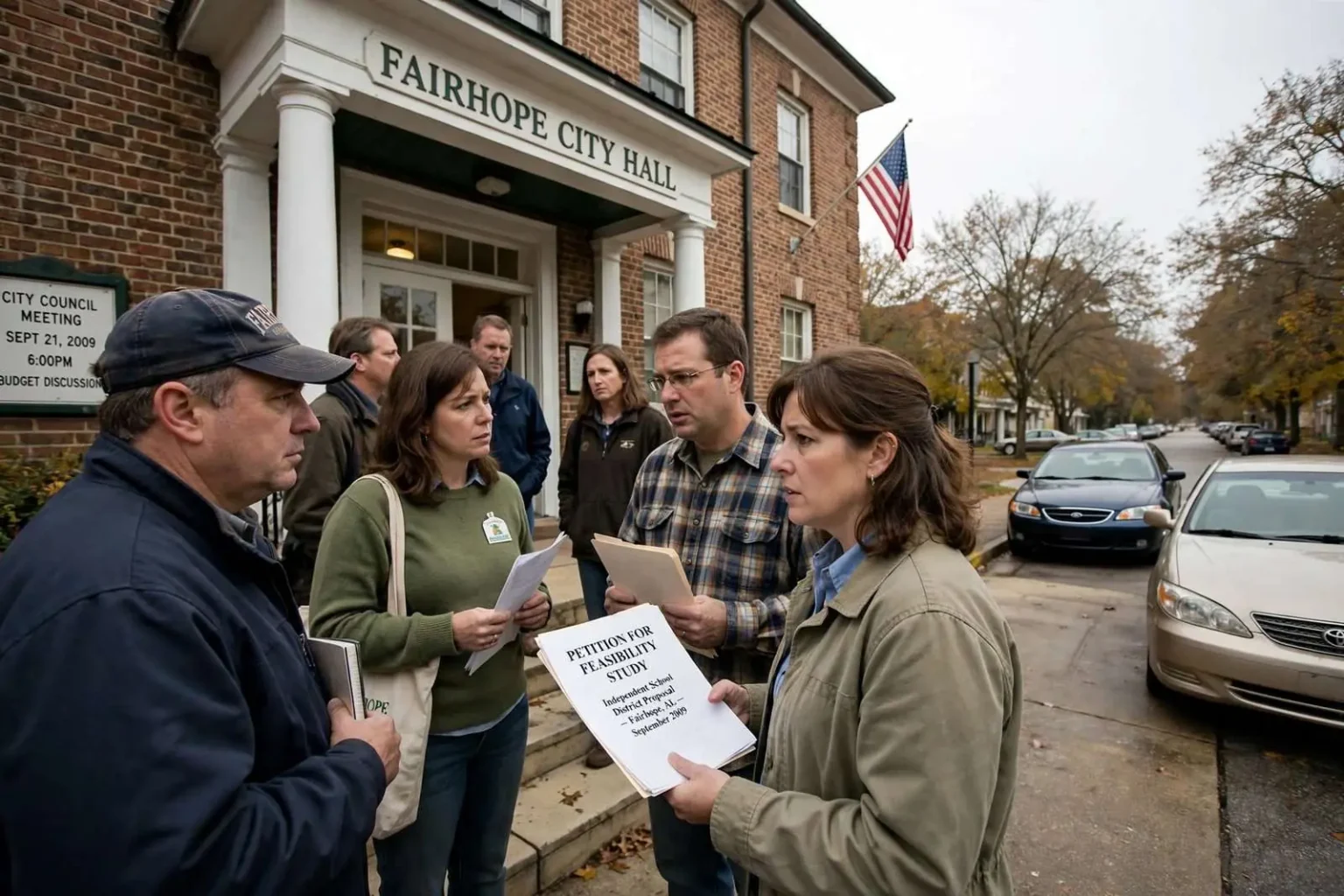
A group of Fairhope parents asked city leaders in 2009 to consider a feasibility study on whether the city could form an independent school district separate from the Baldwin County system. The request came as Baldwin County schools faced a $56 million budget shortfall, and it captured the anxiety of a community watching class sizes grow and programs shrink as the recession squeezed school budgets across Alabama.
Parents cited concern about larger class sizes, program reductions and the uncertainty surrounding future cuts. Fairhope’s schools have long been among the system’s most valued assets — a draw for families moving to the eastern shore and a foundation of the city’s identity — and the prospect of deep countywide cuts landed differently in a town where the schools are woven into the community’s sense of itself.
Proposal for a Feasibility Study
The group sent a letter to Mayor Tim Kant and the City Council asking them to explore the independent-district idea. Supporters discussed a study estimated at about $25,000 and argued that it could help the community understand the financial and educational implications. The study, as supporters framed it, would not commit the city to anything — it would simply answer the question of whether Fairhope could afford to run its own system, and what separating from the county would mean for students, taxpayers and the schools themselves.
City leaders did not immediately say whether they would authorize the study or whether funds were available in the city budget. The mayor and council were expected to discuss the request that week, and the question of paying for even a study was significant in a year when municipal budgets, like school budgets, were being squeezed by the economic downturn.
Under Alabama law, forming a city school system requires action by the municipal government, including the assumption of substantial financial obligations. Cities that operate their own systems levy and dedicate tax revenues to their schools, take on transportation and facilities costs, and manage everything from payroll to curriculum that the county system otherwise handles. The $25,000 study price tag, small compared to what separation itself would cost, was still a real ask of a city budget in the middle of a recession.
The County System’s Response
Baldwin County school officials said they understood the parents’ concern but believed the countywide system was better positioned to educate students. Terry Wilhite, the district’s communications director, said creating an independent system was more complicated than it might appear and argued that schools were stronger working together.
The county’s argument rested on scale. A countywide system spreads fixed costs — administration, transportation, specialized programs, maintenance — across tens of thousands of students, while a small city system carries those costs on its own. County officials also pointed to the mutual dependence within the system: families and staff move between communities, and the schools in one part of the county benefit from the shared resources and state support that flow through a single district.
Supporters of the Fairhope idea countered with the fiscal realities of 2009. A $56 million shortfall meant real cuts no matter how the district was configured, and Fairhope parents feared their schools would bear a disproportionate share of them. The debate reflected a broader local response to the recession-era school funding crisis. Families were looking for ways to protect educational quality while leaders weighed the cost, governance and equity consequences of changing how schools were organized.
The Recession’s Grip on School Budgets
The 2009 shortfall arrived as Alabama school systems absorbed wave after wave of state budget cuts. The state’s education trust fund — funded largely by income and sales taxes — contracted sharply as unemployment rose and consumer spending fell, forcing proration announcements that sliced state allocations mid-year. Local systems leaned harder on local tax bases, which were themselves weakening, and Baldwin County’s rapid growth, usually an asset, added pressure in the form of new students arriving in schools already stretched thin.
Against that backdrop, the Fairhope letter was one of the more concrete responses to emerge from a Baldwin County community. Rather than simply petitioning the county for protection from cuts, the parents asked city government to investigate whether the community could take control of its own schools’ funding — an idea with deep precedent in Alabama, where city systems from Mountain Brook to Hoover to Saraland have formed or separated over the decades, each following a period in which local families concluded that a city-run system better served their schools.
What the Request Meant for Fairhope
The September 2009 request preserved here did not by itself change the structure of Baldwin County education, and the record does not show the city commissioning the study or moving to form a district. Fairhope’s schools remain part of the Baldwin County system, which continued to absorb the recession’s cuts, recover through the years that followed, and grow with the county’s population boom. But the episode left a mark on how the community talks about its schools: the idea of an independent Fairhope district has resurfaced in local discussions in the years since, whenever funding pressures or growth strains have tested the county system.
The 2009 debate also illustrated the trade-offs that advocates of school separation always confront. An independent system would have given Fairhope control over its own tax dollars, budget priorities and curriculum decisions — and insulated its schools from proration decisions made at the county and state level. It would also have left the city responsible for every cost the county system currently absorbs, from school buses to special education services to the aging-building maintenance that countywide scale makes more manageable. The $25,000 study existed precisely to quantify that trade-off, which is why supporters saw it as a reasonable first step and why city leaders, staring at their own recession-era budget, hesitated.
For the parents who signed the letter, the immediate stakes were the classrooms their children sat in that fall: class sizes climbing as positions went unfilled, programs scaled back as the shortfall worked its way through the budget, and no clear end to the cuts in sight. For city and county leaders, the request posed the longer question of whether Baldwin County’s communities would continue to share one school system or begin, as some Alabama cities had before them, to go their own way. In 2009, Fairhope chose to ask the question — and the asking itself became part of the city’s educational history.
How Independent Districts Form in Alabama
The feasibility study the parents proposed would have examined the machinery that every Alabama city system has had to build. A city that forms its own district must establish a school board, negotiate the division of assets and obligations with the county system, hire a superintendent and central staff, and — most consequentially — commit a dedicated funding stream, typically through local property or sales taxes approved by the council. State aid follows the students, but state aid alone has never covered the full cost of running a system, which is why local tax effort is the true dividing line between communities that separate and communities that stay.
Alabama’s history with city systems gives the question texture. Some of the state’s best-known school systems — Mountain Brook, Vestavia Hills, Hoover, Madison City — exist because a city chose to run its own schools, and more recent separations, including Saraland’s split from Mobile County, showed that the process remains live even in the modern era. Each case followed the same arc the Fairhope parents were proposing to begin: community concern about a shared system, a feasibility study, a hard look at taxes, and a decision that reshapes education for a generation.
In Fairhope’s case, the study’s modest $25,000 estimate covered only the question of feasibility — not the tens of millions in annual funding a city system would require, nor the tax votes needed to secure them. Supporters knew that even a favorable study would start a conversation measured in years. What they wanted in the fall of 2009 was simply to put the question on the city’s agenda while the cuts were still arriving.
The Schools at the Center of It
Fairhope’s school community in 2009 included elementary, intermediate, middle and high school campuses serving a city that had grown steadily as a destination for families relocating to the eastern shore. The schools’ reputations were a pillar of the local economy — real estate marketing in Fairhope has leaned on the schools for decades — and parents argued that letting the quality erode would cost the city more than any study or tax ever could. That argument, connecting school quality to property values and the city’s future growth, has been the consistent thread in every Alabama community that has pursued school independence.
The county’s counterargument was equally consistent: Baldwin County’s system educated students from Gulf Shores to Daphne to Fairhope under one budget, one administration and one set of standards, and pulling the county’s most affluent community out would leave the remainder with fewer resources. Equity — the effect of separation on students in less wealthy communities — was the unspoken weight behind Wilhite’s caution that schools were stronger working together. It is the same tension that shadows every school-separation debate in the state, and it remains unresolved in the abstract even where separations have gone forward.
What the 2009 letter ultimately demonstrates is how a budget crisis turns abstract governance questions into neighborhood organizing. The $56 million shortfall was a number in a board presentation; larger class sizes and cancelled programs were what Fairhope families experienced at their kitchen tables. Their response — a letter, a proposed study, a specific dollar figure — moved the question from complaint to policy, and even though the city did not act on it, the request stands as a document of what a recession looked like inside one Alabama community’s schools.