

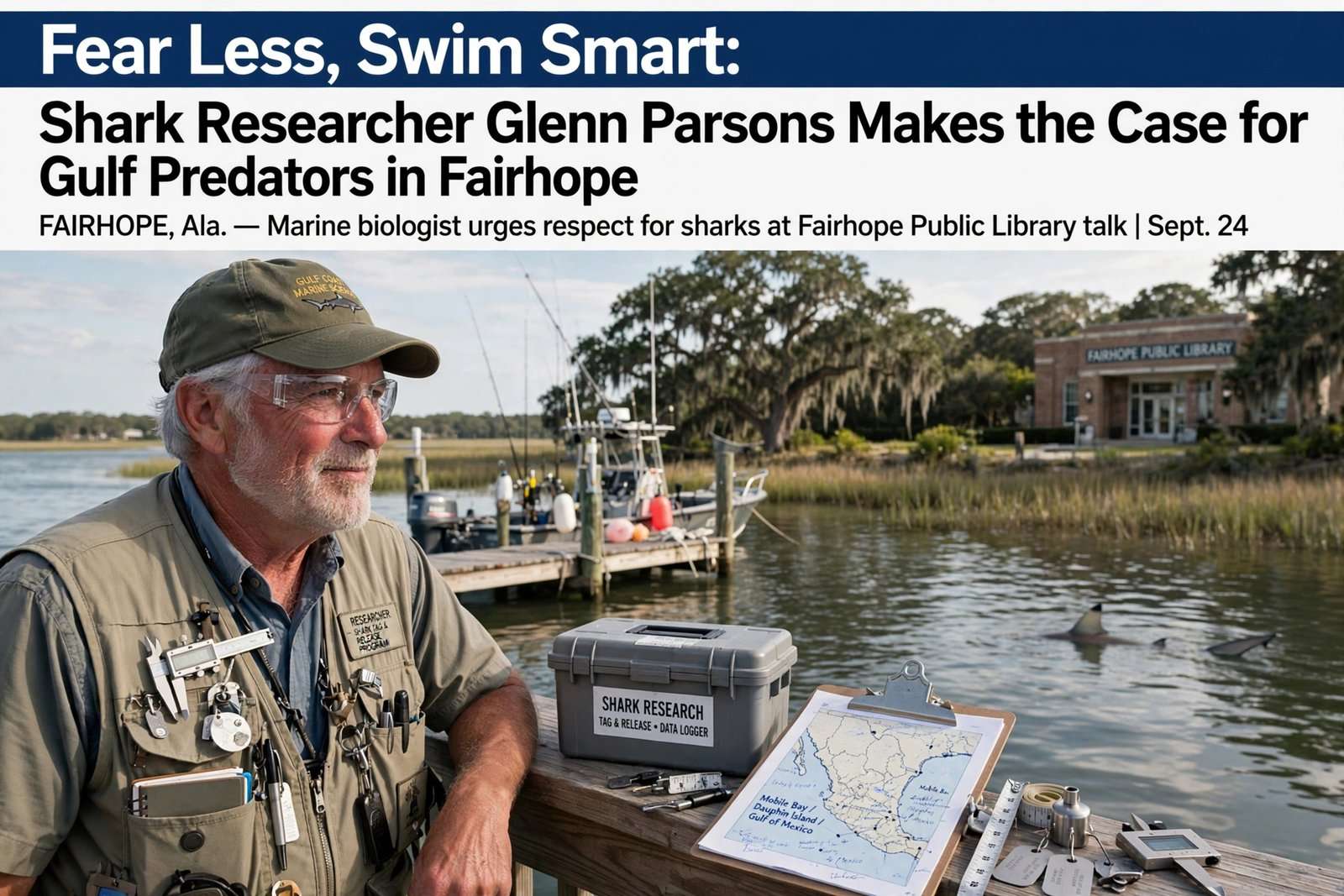
FAIRHOPE, Ala. — Sharks may star in summer blockbusters and beach-season headlines, but the scientist who spent decades catching, tagging and studying them in the waters off Alabama told a Fairhope audience that the animals deserve far more respect than fear.
Glenn R. Parsons, a retired University of Mississippi biology professor, delivered an all-ages shark talk at the Fairhope Public Library on Thursday, Sept. 24. Drawing on research in the Atlantic Ocean, the Gulf and the waters around Dauphin Island and Mobile Bay, Parsons made the case that sharks are essential to healthy oceans, that some species live right off the local coast, and that they pose very little danger to the millions of people who swim in the Gulf each year.
“Sharks are a valuable resource to human beings,” Parsons said.
A career spent with sharks
Parsons retired in 2022 after 36 years teaching biology at the University of Mississippi. He has deep academic ties to the region: he earned degrees from the University of Alabama and the University of South Alabama before completing his doctorate at the University of South Florida. Shark biology was the core of his research, and he is the author of “Sharks, Skates, and Rays of the Gulf of Mexico: A Field Guide,” published by the University Press of Mississippi.
Over his career, Parsons has seen more sharks up close than most beachgoers ever will. Working with his students, he used longlines and gill nets to catch sharks, attach identification tags and release them, building records that help scientists understand where sharks travel, how fast they grow and how their populations change over time.
Why sharks matter
Parsons walked the audience through the many ways sharks matter to people. In some cultures, sharks are an important source of protein. Researchers have explored their potential in medical research. Shark-watching and diving draw tourists in many parts of the world, making sharks valuable to ecotourism economies. And as predators near the top of the food chain, sharks help keep marine ecosystems in balance.
“If you remove predators like sharks from the ocean, you can negatively alter the numbers of more desirable species,” he said.
That point reflects a well-documented principle in ecology. Top predators influence not only how many prey animals survive but also where they feed and how they behave. When predators disappear, the effects can cascade down through the food web, sometimes in ways that harm the very fish and shellfish people most want to catch.
Saving sharks from fishing lines
Parsons’ research also took aim at bycatch, the accidental capture of sharks by fishermen targeting other species. Sharks frequently take baited hooks set for tuna and swordfish, and many die before they can be released.
Part of his work focused on developing what he called “entangling leaders,” specialized fishing line designed to let sharks free themselves before they are hauled to the boat. When a shark bites the bait, its sharp teeth catch in loops built near the hook, which causes the leader to break and lets the shark swim away. Tuna and swordfish, whose teeth are different, are less likely to break the line, so fishermen can still land the fish they are after.
The approach reflects a broader push in fisheries science to design gear that reduces the unintended catch of sharks, sea turtles and other protected or vulnerable species without putting commercial fishermen out of business.
Who lives in the Gulf
Much of the talk focused on species found in the Gulf, including blacktip sharks, hammerheads and bull sharks. Blacktips are among the most commonly seen sharks along the Alabama coast; last month, beachgoers filmed a group of them in the shallows near the Gulf State Park Pier over Labor Day weekend. Bull sharks are notable for tolerating fresh and brackish water and are known to move up into Mobile Bay and the rivers that feed it.
The Gulf is also home to sharks people rarely associate with the region. Parsons described the whale shark, the largest fish in the ocean, which filters plankton and small fish from the water and is regularly sighted in the northern Gulf. He talked about the cookie-cutter shark, a small species whose unusual bite lets it gouge neat, round plugs of flesh from much larger fish and marine mammals. And he described small bioluminescent sharks that produce their own light in the deep sea.
The hammerhead’s sixth sense
Parsons also explained the adaptations that make sharks such effective hunters. Hammerheads, for instance, carry sensory organs that detect the weak electrical fields given off by living animals. The wide, flattened head spreads those sensors across a broad area, helping the shark find prey hidden in the sand.
“They can detect them by that electric sense,” Parsons said of buried prey. “Every time their heart beats, they throw an electric signal, electromagnetic signal, out into the water.”
Those sensory organs, called the ampullae of Lorenzini, are found in sharks and their relatives, the skates and rays, and are sensitive enough to pick up the tiny electrical activity of a buried fish’s muscles and heart.
Putting shark bites in perspective
For all their hunting skill, Parsons said, sharks do not treat people as regular prey. Despite the attention shark bites receive, they are rare. His research on shark attacks in Florida, the state that consistently records the most unprovoked shark bites in the country, found roughly 35 bites in a very high year, with most years seeing about half that number. Fatal attacks were rarer still.
“To deprive yourself of one of the really great pleasures in life of swimming in the ocean because you fear shark attack — you’re a lot more likely to be injured in a car accident driving to the beach than being in the water,” Parsons said.
Common-sense precautions
Parsons said swimmers can lower their already small risk even further by following a few simple rules:
- Don’t swim alone.
- Avoid the water early in the morning, late in the evening and after dark, when sharks can be more active.
- Stay out of the water if you have an open wound.
- Avoid murky, low-visibility water, especially where sharks are known to be present.
- Don’t swim where sharks are visibly gathering.
“Just common sense stuff,” Parsons said.
Lifeguards along the Alabama coast offer similar advice, and beach flag systems in Gulf Shores and Orange Beach use a purple flag to warn of dangerous marine life, which can include jellyfish, stingrays or sharks.
A library program with local stakes
The talk was one of the Fairhope Public Library’s September programs, offered free and open to all ages. For an audience living along Mobile Bay and a short drive from Gulf beaches, the subject was anything but abstract. The researcher at the front of the room had spent years studying the same waters where many in attendance swim, fish and boat.
His closing message was a simple one: understand sharks, take sensible precautions, and enjoy the water.