

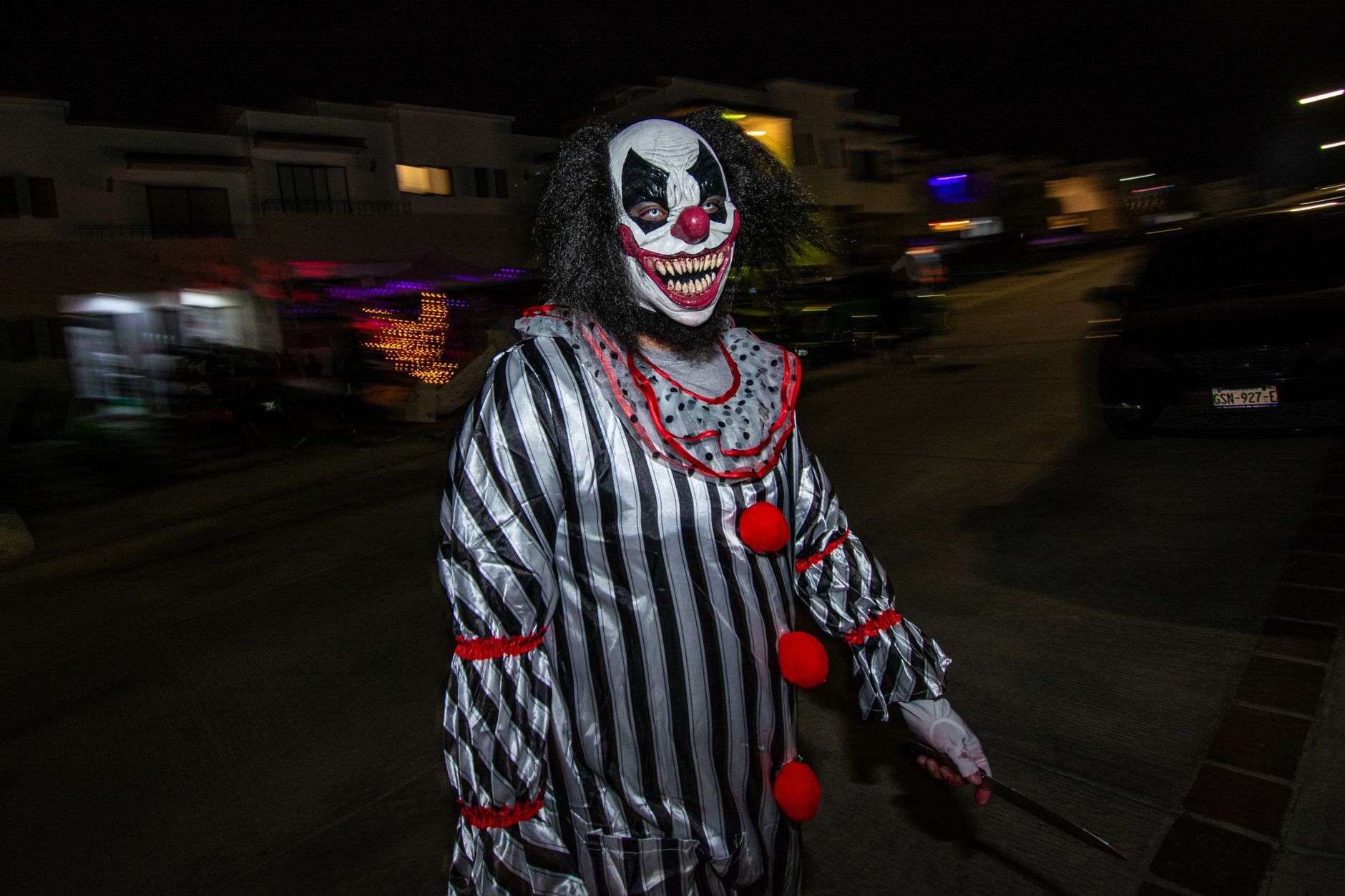
FLOMATON, Ala. — Ten years after a wave of creepy clown sightings sent schools into lockdown and set social media ablaze across the country, a new streaming release, the Clown Panic documentary, is set to take viewers back to the strange autumn of 2016. For people in Flomaton, where a “Flomo Klown” scare disrupted classes and led to arrests, the trip back may feel especially close to home.
The film is scheduled to premiere Oct. 12 on Hulu, and it will also be available through Hulu on Disney+. It is part of the streaming service’s monthlong Halloween programming. A trailer released this week offers a first look, and at least one frame carries a clear reference to Flomo Klown.
A Scare That Seems Hard to Believe Now
Looking back, it can be difficult to believe it really happened. But it did. In the fall of 2016, people across the United States became genuinely worried that costumed clowns were lurking in wooded areas and on the edges of neighborhoods, waiting to lure children away or threatening violence at schools. Police departments fielded calls, school officials tightened security and parents traded warnings online.
Exactly where the craze began is still debated. The documentary’s official description starts in a small South Carolina community where children reported seeing clowns hiding in the woods, while others have pointed to early incidents in Wisconsin or North Carolina. Wherever it started, the fear moved quickly from town to town and state to state, amplified by social media posts that were often impossible to verify.
Some of the sightings had a tidy explanation. Stealth marketing for a found-footage horror movie called “Gags the Clown” was behind at least some of the early reports. That promotional stunt, however, could not account for the flood of sightings, threats and hoaxes that followed across the country in the weeks after.
The timing also fed the anxiety. The panic swelled in the run-up to Halloween and ahead of the release of the first film in the newer “It” movie series, based on the Stephen King novel featuring the menacing clown Pennywise. Clowns were very much on the public mind, and not in a cheerful way.
Flomaton at the Center of Alabama’s Clown Fears
Alabama had more than its share of the frenzy, and the state-line town of Flomaton in Escambia County became the state’s hot spot. Cryptic social media posts about a “Flomo Klown,” sometimes written as “FlomoKlown,” spread through the community in September 2016 and triggered campus lockdowns and increased security at area schools.
A Facebook page using the “Flomo Klowns” name featured unsettling images and messages. Among the phrases later cited in court were “I kill people for a living” and “it’s going down tonight.” Other messages reportedly told a recipient the sender was “coming for you” and would “see you at school.”
Schools that stepped up security during the scare included Flomaton High School, Flomaton Elementary School, Huxford Elementary School north of Atmore and Escambia County High School in Atmore. For families in a small town, the combination of vague threats, school lockdowns and a heavy police presence made for tense days.
Arrests, a Guilty Plea and Probation
The Flomo Klown episode did not end as a harmless prank. Authorities made arrests, and the case moved through the Escambia County court system for more than a year.
A 22-year-old Flomaton woman was charged in connection with the posts. In January 2018 she pleaded guilty to one count of making a terroristic threat. A second charge, disruption of school activities, was dropped as part of the plea agreement.
She received a 120-month sentence that was suspended, and she was placed on five years of probation instead. As a condition of that probation, she was barred from using social media. Had she violated the terms, she could have been ordered to serve the 10-year sentence. Several juveniles were also accused in connection with the posts, though their cases were handled separately.
Under Alabama law, making a terroristic threat is a felony that covers threats to commit a crime of violence or damage property with the intent to cause fear, cause an evacuation or otherwise disrupt schools, businesses or public services. The charge is often used in school threat cases, where even a threat that turns out to be a hoax can shut down campuses and pull law enforcement away from other duties.
Lockdowns and Police Responses Around the State
Flomaton was not alone. Reports in September 2016 described lockdowns, police responses or both in Fairhope, Rainbow City, Etowah County, Calhoun County, Irondale and Montgomery. From the Gulf Coast to north Alabama, police officers, educators and parents were all trying to sort out what was real and what was rumor.
What the clowns were supposedly up to was never entirely clear. In some cases, children said clowns had tried to lure them into the woods. In others, people said they had received vulgar or threatening messages from social media accounts claiming to be clowns. Many reports could not be confirmed, and the uncertainty only added to the unease.
Professional clowns, the kind who make balloon animals at birthday parties and entertain at hospitals and community events, were among the most frustrated people in the country that fall. The people who make a living bringing smiles to children suddenly found their profession associated with menace, and they were as troubled by the scare as anyone.
What the Trailer Shows
The “Clown Panic” trailer released this week manages to be alternately eerie and funny, capturing both the genuine fear of the moment and the absurdity of the whole episode.
One perturbed professional clown in the trailer makes a point that is hard to argue with: there is no sense in a clown threatening to kill children, because “that’s your customers.”
Many of the people speaking in the trailer have Southern accents, which makes it hard to tell from the preview alone how much of the finished film focuses on Alabama. But at least one distinct visual reference to Flomo Klown appears, suggesting the Escambia County episode is part of the story.
According to Hulu’s description, the documentary follows how, after children in a small South Carolina community reported seeing clowns in the woods, “few believe them. But as sightings spread across the country, panic escalates into school lockdowns, police investigations, and a nationwide media frenzy.” The film is billed as an examination of how “a bizarre urban legend spiraled into a global moral panic that has echoes that resonate today,” told through archival footage, viral internet videos and interviews with witnesses, law enforcement officers, clowns and cultural commentators.
An Award-Winning Director Behind the Camera
Beyond the premiere date and the trailer, the streaming service has not released many details about the project. The film is directed by Ed Perkins, an experienced documentary filmmaker whose work has drawn major awards attention.
Perkins’ 2019 documentary “Tell Me Who I Am,” made for Netflix, told the story of twin brothers Alex and Marcus Lewis. After a motorcycle accident in 1982, when he was 18, Alex lost his memories of his childhood, and Marcus was the only person he recognized when he woke from a coma. It premiered at the Telluride Film Festival and was nominated for a British Independent Film Award.
Perkins’ other work includes:
- “Black Sheep” (2018), a short documentary that was nominated for Best Documentary Short Subject at the 91st Academy Awards;
- “The Princess” (2022), a documentary about Diana, Princess of Wales, that premiered at the Sundance Film Festival;
- “Garnet’s Gold” (2014), which earned him the Grierson Award for Best Newcomer.
He was also named a BAFTA Breakthrough Brit in 2015. His track record suggests “Clown Panic” will aim to be more than a simple nostalgia trip, using the 2016 frenzy to look at how fear spreads online and in communities.
Why the Story Still Resonates
Sociologists use the term “moral panic” to describe a surge of public fear over a perceived threat that is out of proportion to the actual danger. The 2016 clown scare fits the pattern: a handful of real incidents and pranks, a few genuine threats, and a great deal of rumor, all magnified by social media platforms that let unconfirmed reports travel faster than anyone could check them.
That dynamic is familiar a decade later, which is why the documentary’s makers describe the episode as having echoes today. Viral hoaxes, anonymous threats against schools and online rumors that prompt real police responses remain a challenge for law enforcement and school systems, including those in south Alabama.
For Flomaton, the Flomo Klown affair is a strange chapter in local history: a time when a small town on the Florida line found itself caught up in a national phenomenon, complete with lockdowns, arrests and a court case that stretched into 2018. Residents who remember it will get a chance to see how the rest of the country experienced the same fall when “Clown Panic” arrives on Oct. 12.
How to Watch
- Title: “Clown Panic”
- Premiere: Monday, Oct. 12
- Where: Hulu, and Hulu on Disney+
- Director: Ed Perkins
- Programming: Part of the service’s monthlong Halloween lineup