

A Georgia man has sued the city of Orange Beach, alleging he was run over by a truck driven by a city lifeguard while he sat on the beach with his wife in 2024.
Mark Kelemen filed the complaint July 7 in Baldwin County Circuit Court, naming the city and Orange Beach Lifeguard Erik Nathaniel Mason as defendants.
According to the lawsuit, Mason struck Kelemen with a city-owned Ford F-150 on July 20, 2024, at about 3:30 p.m., while Kelemen sat in a beach chair beside his wife, Christine.
Kelemen is asking Circuit Judge Byron Brackin to award more than $1 million in damages, covering physical and emotional injuries and medical expenses.
A civil complaint contains only one side’s allegations and marks the opening of a case rather than a legal finding. The claims have not been proven in court, and as of Thursday, attorneys for the defendants had not filed a formal response.
That caution applies with full force to a case like this one. A complaint is a set of allegations drafted by a plaintiff’s lawyer to state a legal claim; every fact in it must still survive the defendants’ answer, discovery, and possible motions before a jury ever weighs it. Cities routinely contest such claims, and municipal insurance carriers — not just city attorneys — typically shape the defense.
What the complaint alleges
According to the complaint, Mason got into the city-issued truck “without checking his surroundings” and turned it in a way that struck Kelemen.
“The front of the City’s vehicle hit Kelemen, and the front tire ran over the top of Kelemen’s hips, low back, abdomen, and arm, severely injuring him,” the complaint states.
The lawsuit contends Orange Beach is liable for Mason’s actions and that he violated the city’s procedures for operating beach vehicles.
“Mason failed to follow the City’s beach vehicle operation policies and procedures of walking around and looking around his vehicle prior to operating it, and his negligent conduct is a proximate cause of Plaintiffs’ personal injuries and damages,” the complaint reads.
The allegation about procedures is the crux of the case against the city. When an employer’s own written rules require a driver to walk around and check around a vehicle before operating it, and an incident occurs in the apparent absence of those steps, the written rule becomes evidence of the standard of care the city itself set. In Alabama negligence law, a defendant’s violation of its own internal safety policy is not automatically negligence, but it is the kind of fact plaintiffs use to argue that the conduct fell below what a reasonable operator following company rules would have done.
Liability against the city itself rests on the doctrine that an employer answers for negligent acts its employees commit within the scope of their duties — in legal terms, respondeat superior. A lifeguard driving a city truck on city sand, on duty, plainly fits the framework the complaint invokes.
Beach vehicles on a crowded strand
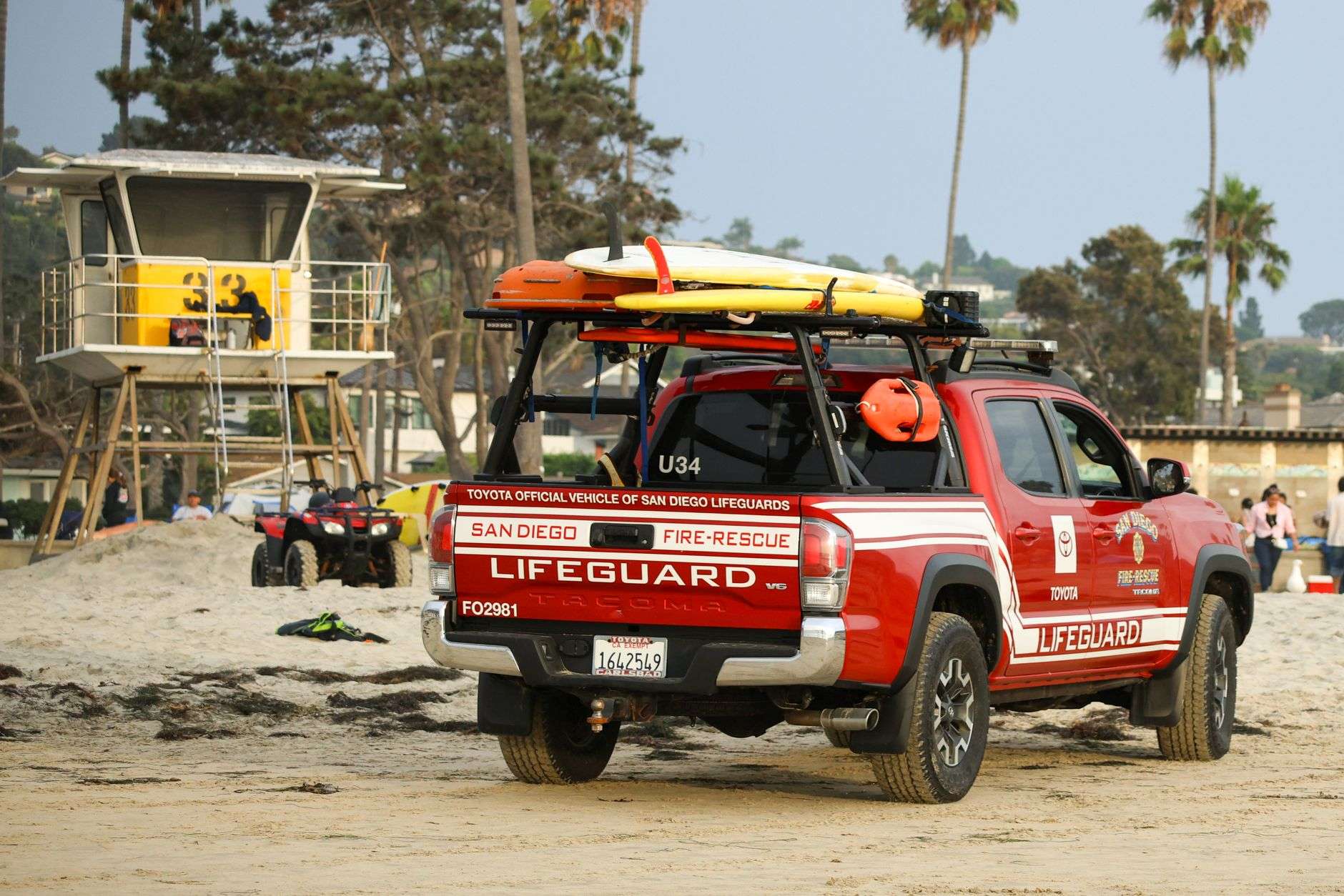
Beach patrol trucks are commonly used by lifeguard services along the Gulf Coast to reach swimmers in distress and monitor crowded stretches of sand, though their use near seated beachgoers also carries risk if drivers do not take precautions.
Orange Beach, like Gulf Shores, staffs a seasonal beach safety operation through the height of tourist season, when the city’s public beaches draw some of the heaviest crowds on the Alabama coast. Lifeguards patrol on foot and in vehicles, post flags warning of surf conditions, and respond to swimmers in trouble far faster in a truck than anyone could on foot along a mile of soft sand.
The trade-off is built into the tool itself. A truck that can cross the strand at speed is also a machine operating in the middle of a crowd of people who are lying down, facing the water, wearing headphones and children. Standard practice — and the city’s own policy, as the complaint quotes it — is to walk around the vehicle, check the blind spots behind and beside it, and move slowly in areas where beachgoers are seated.
Afternoon, when the alleged incident occurred, is also when Gulf Coast beaches are at their fullest, with umbrella lines and chairs densest between the dune line and the water.
The spouse’s claims
Christine Kelemen is also named as a plaintiff in the suit, seeking damages for what the complaint describes as the shock of witnessing her husband’s injuries, along with her own losses.
“Plaintiff Christine Kelemen is entitled to recover for the shock and apprehension of seeing her husband injured in this matter, for her own personal injuries, and for loss of consortium for the services of her husband as provided by Alabama law,” the complaint states.
Alabama recognizes both bystander claims — for the emotional shock of witnessing a family member’s injury — and loss of consortium, the recognized value of a spouse’s companionship, care and services lost to an injury. Both are standard features of serious-injury litigation, and their inclusion signals that the plaintiffs view the harm as extending beyond the physical injuries themselves.
The insurance angle
The Kelemens’ auto insurance provider, Chubb National Insurance Company, is also named as a defendant.
The complaint argues Mason qualifies as an “underinsured motorist” under the city’s liability coverage, meaning Chubb could be required to pay out under the couple’s own policy if the city’s insurance proves insufficient to cover the alleged damages.
“Plaintiffs aver their damages far exceed the amount of liability insurance coverage available under any and all policies covering Erik Mason, making him an underinsured motorist under Alabama law,” the complaint reads. “Defendant Chubb stands in the shoes of Erik Mason and is liable to the Plaintiffs for the damages caused as provided under the uninsured/underinsured motorist provisions of the insurance policy between Plaintiffs and Chubb.”
The structure is a common one in serious-injury cases. Alabama law requires insurers to offer uninsured and underinsured motorist coverage with auto policies, and it allows an injured party to pursue that coverage when the at-fault driver’s available liability limits cannot cover the loss. Naming the insurer from the outset — rather than waiting to see whether a verdict exceeds the city’s coverage — keeps every potential source of recovery in the case from day one.
For the defendants, the stacking of claims — a city, an employee, and a national insurer — means coordination among separate defense teams, and raises the usual early questions: whether the city’s coverage applies to off-road beach operations, whether the employee was acting within the scope of duty, and how the couple’s own policy language treats an incident involving a government vehicle.
The city’s response
As of Thursday, attorneys representing the city of Orange Beach and Chubb had not responded to the complaint, and no hearing date has been set in Baldwin County Circuit Court.
Orange Beach City Administrator Ford Handley said the city’s attorneys are reviewing the complaint but declined to discuss specifics.
“Because this is pending litigation, we are unable to comment on the specifics,” Handley said in a statement. “We look forward to resolving the matter through the appropriate channels.”
The statement is the standard posture for a municipality facing a damage suit: no admissions, no characterizations of the incident, and a deference to the litigation process. Under Alabama’s tort claims framework, suits against municipalities carry procedural requirements and damage considerations distinct from ordinary civil cases, which is one reason city governments rarely comment in the weeks after a complaint is filed.
The timeline ahead is familiar to Baldwin County litigants. After an answer is filed, the case moves into discovery — written questions, document requests, depositions of the lifeguard, the city’s safety officers and the plaintiffs’ treating physicians — a phase that in a case of this size commonly runs a year or more before trial setting.
The wider docket
Update (Aug. 1, 2026): Court filings show Christine Kelemen has now joined her husband, Mark Kelemen, as a plaintiff in the case, with the couple together seeking more than $2 million in damages.
In addition to compensation for lost wages, Mark Kelemen is seeking $1 million for his injuries, $50,000 in special damages for medical expenses and $500,000 for future medical expenses.
Christine Kelemen is separately seeking $500,000 “for her past, present and future consortium damages arising out of her husband’s physical injuries and permanent limitations,” along with compensation for her own personal injuries from the incident.
The amended demand reflects the direction such cases take as medical records accumulate: a permanent-injury framing, with future care costs projected, converts a damage claim from a snapshot into a lifetime accounting.
The suit is one of several lawsuits currently facing the city of Orange Beach, according to the filing, which also points to a federal lawsuit over bodycam footage tied to an alleged domestic violence incident reportedly involving Mayor Tony Kennon on Labor Day 2024 — an allegation he has denied — as well as a separate suit against the Orange Beach school system filed by a former Blue Angels pilot after his out-of-district children were told they could no longer attend city schools.
For a city of Orange Beach’s size, the cluster of cases is unusual in its variety — a beach-safety injury claim, a dispute over police bodycam records, and a school-enrollment fight — and each will draw its own line through the city’s operations. The beach case, though, is the one most likely to produce lasting operational change: whatever the litigation settles, the written procedures for driving on crowded sand will be re-read, re-taught and, in all likelihood, revised.
No hearing date had been set as of Thursday, and the court file remains open to the public through the Baldwin County Circuit Clerk.