Gulf Shores Police K9 Dies After Being Left in Hot Patrol Car
K9 Officer Mason, a three-year-old community engagement dog, died of heat-related causes after being left inside a Gulf Shores patrol vehicle.
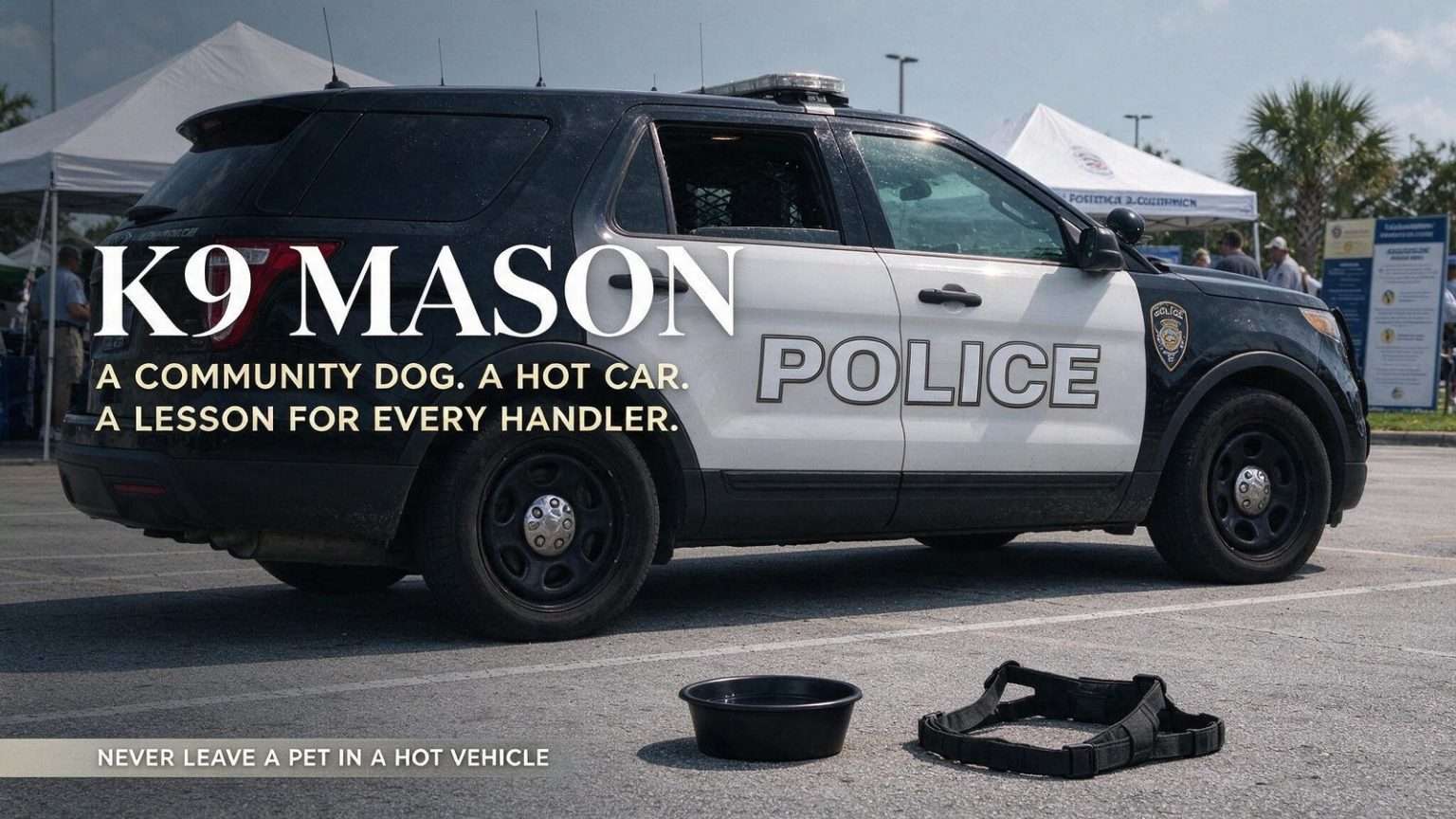
A Gulf Shores Police Department K9 has died after being left inside a hot patrol car, according to the department, which said no criminal charges will be filed but that internal action has been taken against the officer involved. The death of K9 Officer Mason — a dog whose job was to meet the public, not confront it — has struck the department and the community it serves with a force unusual even for a line-of-duty animal loss.
K9 Officer Mason, a three-year-old dog who served as the department’s community engagement officer, was left in the back seat of a patrol vehicle on Thursday, June 18, while his handler, Cpl. Josh Coleman, worked a hurricane preparedness expo in Gulf Shores. According to a department statement, Coleman forgot Mason was still in the car and, upon realizing the dog was missing, found him inside the vehicle.
Mason was rushed to a veterinarian but died the following day, June 19, of heat-related causes. The department’s account of the timeline — a working event, a forgotten dog, an hours-long search that ended at the patrol car — traces the shape of an accident that unfolded in minutes but ended a life two days later.
Department spokesman Sgt. Jason Woodruff explained that Mason’s role set him apart from the department’s enforcement K9s, whose patrol vehicles are outfitted with remote heat alarms, water bowls and other safeguards because those dogs spend long stretches of time in their handlers’ cars. Because Mason’s community engagement duties rarely required him to be left in a vehicle for extended periods, his handler’s car was not equipped with the same protective measures.
That distinction — between a working enforcement dog’s vehicle and a community dog’s vehicle — is now the central fact of the case. The safeguards that might have saved Mason’s life existed in the department’s fleet, but not in the car he happened to be riding in that day, and no alarm sounded when the interior began to heat.
A different kind of police dog
Enforcement K9s are selected and trained for apprehension, drug detection or tracking, and their public role is limited by design. Community engagement dogs occupy the opposite end of the spectrum: they appear at schools, festivals and public events, and their value lies in being approachable. Mason’s work in Gulf Shores made him a familiar face at community gatherings, the kind of dog children are invited to pet rather than warned away from.
Gulf Shores itself is a city built on tourism, where the police department’s public presence — on the beach, at events, in season — is a core part of its mission. A community engagement K9 fits naturally into that setting, and Mason’s appearances at public gatherings made him part of the city’s welcome. His death during an event devoted to public safety has given the department’s outreach a somber new context heading into the height of the summer season.
The department had celebrated Mason’s birthday only recently before his death, a detail that captures how deeply embedded the dog had become in the department’s life. Three years old is young for a working dog — the prime of a career that, in a community engagement role, could have run another seven or eight years of school visits and public events.
Woodruff described the loss as devastating for Coleman and his family, as well as for the department as a whole, calling it a tragic occurrence that left the whole organization mourning. The statement acknowledged what police agencies have learned through similar losses: the handler who lives with the mistake carries it for a career, and the department’s response — discipline without criminal charges, mourning without scapegoating — reflects the difference between negligence that endangers the public and a lapse that destroyed the officer’s own partner.
The department’s decision that no criminal charges will be filed, with internal action taken instead, follows the pattern of how such cases are typically resolved. Prosecutors generally reserve criminal charges for conduct showing reckless disregard beyond an oversight, while police agencies handle the rest internally — an administrative outcome that can still end careers, but that stops short of the courtroom.
The expo where Coleman was working when Mason was left in the car was a hurricane preparedness event, the kind of community gathering that fills the Gulf Coast calendar in the opening weeks of the Atlantic hurricane season. June 1 marks the season’s start, and coastal cities like Gulf Shores spend the early summer hosting events that connect residents with emergency information — and, as at most such events, police departments bring displays, officers and often their K9s.
The heat that killed him
June on the Alabama coast is among the most dangerous months of the year for animals and children left in vehicles. Gulf Shores in late June combines high humidity with afternoon temperatures that routinely climb into the 90s, and a parked car in those conditions becomes an oven within minutes even when the air outside feels merely warm. Windows cracked or not, an enclosed vehicle’s interior can exceed the outdoor temperature by tens of degrees in a short span, and a dog’s ability to cool itself — primarily by panting — fails quickly in that environment.
Veterinarians warn that heatstroke in dogs progresses fast: distress and heavy panting first, then collapse and organ damage as body temperature keeps climbing, with death possible within an hour in severe conditions. Emergency treatment can save some dogs, and Mason was rushed to a veterinarian immediately after being found, but the time he had already spent in the heating car was more than his body could survive.
Woodruff also used the incident to issue a broader caution to the public about the dangers of hot vehicles, noting how quickly heat can affect anyone left inside a parked car, particularly children, pets and elderly people who are especially vulnerable to high temperatures. The warning came as South Alabama moved into the peak of summer heat during the opening weeks of hurricane season, when the combination of long daylight, high humidity and a sun-heavy parking lot makes every unattended vehicle a hazard.
The message was aimed beyond Gulf Shores. Heat deaths of children left in cars occur across the country every summer, and police departments along the Gulf Coast treat the season’s first heat wave as the traditional moment for public reminders: never leave a child or animal in a parked car, even briefly, and call 911 immediately upon seeing one.
Mason’s death drew attention statewide as an example of how quickly a momentary lapse can turn fatal, even for an experienced handler, and the coverage reached audiences far beyond Baldwin County. K9 deaths in hot vehicles have prompted legislation, policy changes and equipment mandates in states across the country, and each new case revives the question of whether heat alarms should be standard in every police vehicle that carries a dog, regardless of that dog’s assignment.
For police departments, the practical lessons are direct. Enforcement K9s ride in vehicles equipped with remote heat alarms, water bowls and other safeguards precisely because those dogs live in their handlers’ cars for entire shifts; the assumption that a community engagement dog will never be left behind is the kind of assumption this case has now retired. Agencies that read the Gulf Shores statement will find the lesson stated plainly by the department itself: the protective equipment existed, in the same fleet, one car away.
The loss also lands on a department that had built Mason into its public identity. Community engagement K9s appear in school programs, parades and social media posts, and the public grieving that followed Mason’s death reflected the connections those appearances create. The department’s transparency about the circumstances — naming the handler, explaining the timeline, detailing the equipment distinction — stands as part of Mason’s legacy, offering other agencies an honest accounting of how a routine day became a fatal one.
In the days after the death, the questions the case leaves are the ones police agencies and dog handlers everywhere already know: never assume the dog is out of the car, check the back seat on every exit, and equip every vehicle that carries an animal with the alarms that turn a moment’s forgetting into a rescue rather than a loss. Gulf Shores learned those lessons at the cost of a three-year-old dog the whole department had recently gathered to celebrate.
Mason’s death closed a career that was, by design, entirely about public trust — a dog whose job was to be approached, petted and enjoyed. The department’s mourning, and its decision to speak plainly about what happened, extended that work one last time: turning a handler’s worst day into a public warning that may save other dogs, children and elderly people from the same heat that took him.