
Gulf Shores Says Sally Stripped 410,000 Cubic Yards of Sand, Leaving Beach Boulevard Exposed
Gulf Shores lost about 410,000 cubic yards of sand in Hurricane Sally, and the city is pressing FEMA for dredging money to rebuild its storm-protecting.
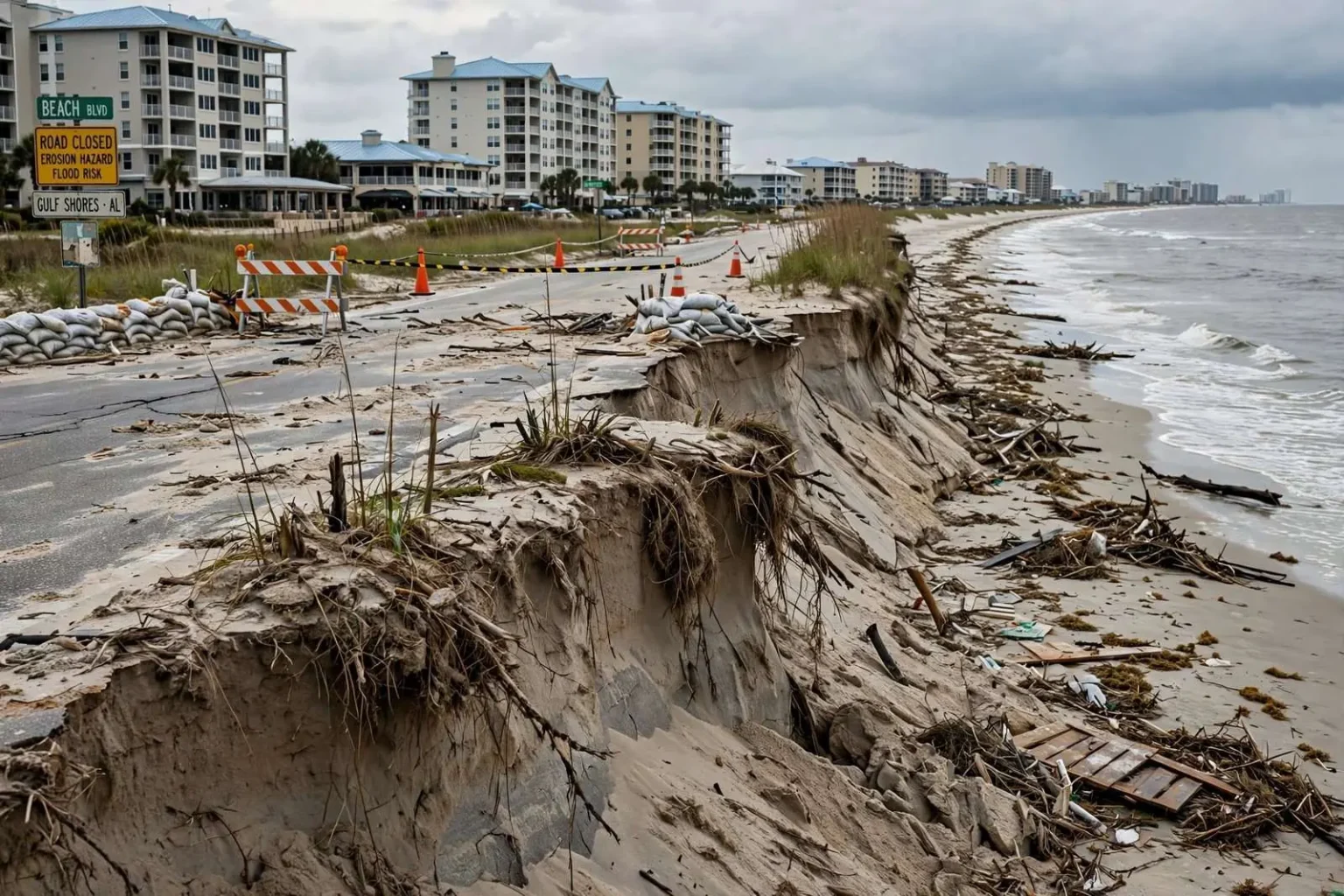
Three storms in three years have carved away the sand dunes that shield Gulf Shores from the Gulf of Mexico, and city officials say the damage is now serious enough to threaten roads and buildings along the beachfront. City Engineer Mark Acreman said erosion that began with Hurricane Nate worsened during Hurricane Laura and then accelerated sharply when Hurricane Sally came ashore. The sequence has left the city’s beach profile in some of the weakest condition residents and visitors have seen in years, with the natural buffer between the Gulf and the built environment substantially depleted.
“We lost about 410,000 cubic yards of sand in Sally,” he said. “Took a big toll on our sand dune system.” The figure counts only the sand that Hurricane Sally took, and it came on top of the losses from the two storms that preceded it. To put the number in perspective, 410,000 cubic yards is enough sand to fill a convoy of dump trucks stretching for miles, and replacing it requires either large-scale trucking of material or dredging sand from offshore or nearby inlets — projects measured in millions of dollars.
Why the dunes matter, according to Acreman, the dunes function as the beach’s first line of defense. “It acts as a guardrail, the waves come in and hit the sand and dune system first,” he said, explaining that the sand absorbs and dissipates wave energy. Sand is lost in the process, but the structures behind the dunes are spared. That exchange is the entire logic of a healthy beach system: dunes are designed by nature to be sacrificed, absorbing the punch of storm waves so that streets, utilities and homes behind them do not have to.
West of West Sixth Street, he said, the dunes have been almost entirely flattened. That leaves Beach Boulevard and nearby property vulnerable to storm surge that in past years would have stopped short of the roadway. Beach Boulevard runs directly along the Gulf in the heart of the city’s tourist district, fronting condos, restaurants and public beach accesses, and it serves as the main coastal drive through town. With the dune line flattened, even routine tropical weather could push water and debris onto the road.
City pressing FEMA for dredging money. Acreman said the city is asking FEMA to approve funding for a dredging project that would rebuild the beach profile and restore the dune system. He described the work as essential not only to protecting public infrastructure but to the tourism economy that depends on the beach itself. Until sand is replaced, city officials say even a moderate tropical system could reach roads, utilities and buildings that the dunes previously kept out of reach.
A String of Storms the Coast Never Recovered From
Hurricane Nate made landfall near the mouth of the Mississippi River in October 2017 and pushed its effects east across the northern Gulf Coast, sending surge and waves into Baldwin County beaches. While Nate was a comparatively modest system, it moved quickly and arrived at a time when Gulf Shores’ beaches had not yet fully rebuilt from earlier hits, and the city’s dune line absorbed its first significant losses of the period.
Hurricane Laura then came ashore in southwestern Louisiana in August 2020 as a major hurricane, but its large circulation spread high surf and elevated water levels across the entire northern Gulf, chewing away at Alabama beaches even from hundreds of miles away. Coastal engineers often note that a beach does not need a direct hit to suffer; sustained onshore winds and swell from a distant hurricane can strip away as much sand as a weaker storm arriving overhead.
Hurricane Sally delivered the decisive blow in September 2020, making landfall near Gulf Shores as a slow-moving Category 2 storm. Sally’s crawl across the coast — moving at a pace that parked its most damaging winds and surge over the region for hours — produced record flooding in Pensacola and severe damage throughout Baldwin County. The storm’s winds flattened what remained of dunes west of West Sixth Street, pushed sand onto roads and private property, and left behind debris fields that took months to clear. For the city’s beach, it was the third punch in three years, and the knockout.
What a Beach Nourishment and Dune Project Looks Like
The dredging project the city is seeking FEMA funding for would follow a playbook familiar across Florida and Alabama. A dredge vessel pumps a slurry of sand from an offshore borrow site through a pipeline to the beach, where crews shape it into a designed profile with a wider berm and a rebuilt dune line. Native dune vegetation — sea oats, panic grass and other salt-tolerant species — is then planted to trap wind-blown sand and help the dunes grow back naturally between storms.
Dune plantings and sand fencing, while inexpensive on their own, cannot rebuild an eroded system on the scale Gulf Shores has lost. Engineering studies for nourishment projects typically evaluate wave climate, sediment compatibility and expected project life, because a rebuilt beach is not permanent: storms will take sand again, and communities usually plan periodic renourishment intervals. The difference a restored profile makes in the meantime is measured in avoided damage — fewer flooded streets, less destroyed utilities and faster reopening after a storm.
The Stakes for a Tourism Economy
Gulf Shores’ identity and budget both rest on its beaches. The city, together with neighboring Orange Beach and the Gulf State Park, draws millions of visitors a year to the sugar-white sand of the Alabama coast, and lodging, restaurant and retail businesses across the area depend on the summer season. A beach that is visibly narrowed, with a scarped dune line and exposed sandbags where a natural berm should be, does not merely look worse — it changes visitor behavior, and city officials are explicit that the economy rides on the sand.
The city’s beach nourishment history stretches back years, with earlier projects rebuilding the shoreline after previous hurricane seasons. Alabama’s beaches were heavily damaged by Hurricane Ivan in 2004 and Hurricane Katrina in 2005, and large restoration efforts followed. Each project required years of planning, environmental review and federal-state funding negotiation, which is why city officials began pressing for FEMA approval quickly rather than waiting for the next storm season.
FEMA funding for such work generally flows through the agency’s public assistance and hazard mitigation programs, which can cover the repair of disaster-damaged facilities and projects that reduce future risk. The city’s argument rests on both: the dune system and beach are infrastructure, in effect, and rebuilding them protects far more valuable assets behind them. Approval processes can be lengthy, involving benefit-cost analysis and environmental coordination with state and federal agencies that oversee coastal resources and protected species habitat.
In the meantime, the city is left managing risk with a diminished buffer. Officials have said that until sand is replaced, even a moderate tropical system could reach roads, utilities and buildings that the dunes previously kept out of reach — a warning that applies not just to a major hurricane but to the kind of strong tropical storm that strikes the northern Gulf Coast in most years. Beach Boulevard, condos and public facilities sit directly in the exposure zone.
The erosion episode is also a case study in cumulative storm damage. Any one of the three storms, taken alone, would have been an ordinary coastal event; in succession, they stripped away the system’s capacity to recover between hits. Coastal managers call this the recovery interval problem — beaches need calm years to rebuild naturally, and Gulf Shores has not had one. The FEMA decision the city is awaiting will determine whether the dunes return by design, or whether the city gambles that the Gulf stays quiet until it can afford to rebuild them itself.
Living With an Eroding Shoreline
The Gulf Shores situation reflects a challenge facing beach communities across the northern Gulf, where barrier-linked shorelines naturally shift with storms and currents. Along the Alabama coast, the beach and dune system in front of developed property has always been managed — renourished, replanted, and in places armored — because the shoreline’s natural tendency is to move landward over time. Sea-level rise and more frequent intense storms have shortened the recovery intervals coastal managers plan around, turning what was once a cyclical problem into a persistent one.
Residents along West Beach and the neighborhoods west of West Sixth Street have watched the change directly. Where dunes once stood high enough to block the view of the water from ground floors, Gulf-facing lots now sit with little more than a scarp and a fringe of dead vegetation between their foundations and normal high tide. After Sally, sand deposited by storm surge had to be scraped off streets and returned to the beach where possible, but storm-scattered sand cannot recreate a dune’s engineered height and volume.
Public safety officials also weigh the erosion in their storm planning. Evacuation routes in south Baldwin County, including the bridges and causeways that connect the island communities to the mainland, depend on roads that remain passable before and after storms. Beach Boulevard and the beachfront streets that feed it are part of that calculus, and a storm that floods them complicates both evacuation and re-entry after an event.
The city has, in the past, supplemented large nourishment projects with smaller measures: dune restoration volunteers planting sea oats, sand fencing to catch blowing sand, and targeted repairs after minor storms. Those efforts work best maintaining a healthy system rather than rebuilding a collapsed one, which is why the missing 410,000 cubic yards from Sally — and the losses from Nate and Laura before it — cannot be addressed by volunteers alone. The scale of the deficit requires a dredge, a pipeline and a federal funding decision.
For now, city officials continue to press their case with FEMA while monitoring the beach through the current hurricane season. Acreman’s message has been consistent: the dunes were the city’s guardrail, they are gone where they are needed most, and the window to rebuild them affordably — with the damage documented and federal disaster channels open — is exactly the window the city is working to use before the next storm tests an unprotected shoreline.