

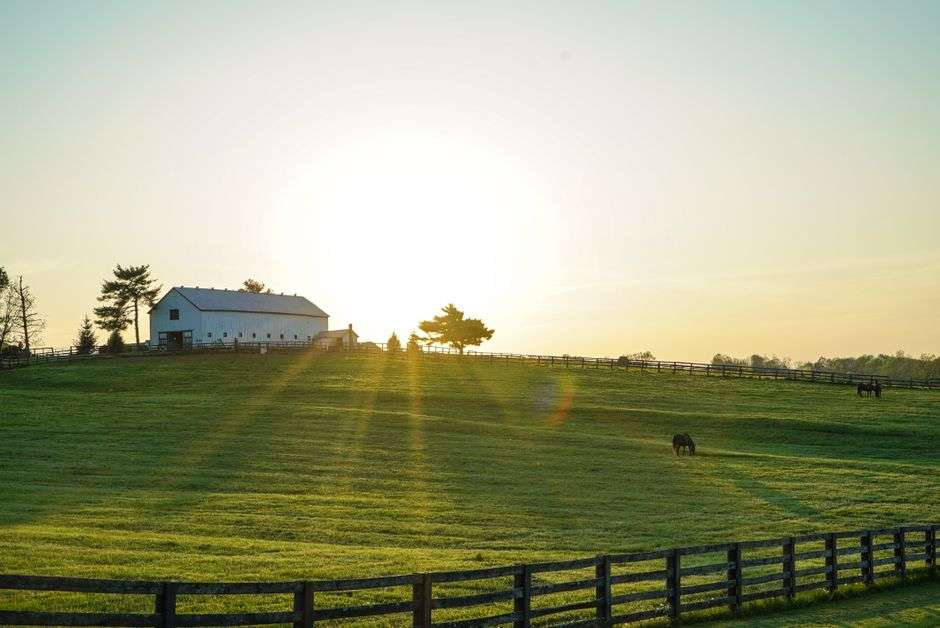
Five acres of pastoral calm in the middle of a subdivision: that is the first surprise at Jordan Beech Farms and Venue in the Belforest area of Daphne. The second is that the place was nearly a ruin when its owners found it. Today, less than two years after opening, the farm on Austin Road — just east of Highway 181 — is a working horse farm, a riding school, and one of the area’s most unusual event venues, all run by an equestrian who never planned to run either.
A Diamond in the Rough on Austin Road
Donna Beech has been an equestrian most of her life, but she wasn’t looking for a horse farm, much less a place where people gather for weddings and birthday parties. Then a listing appeared in her own neighborhood: a two-story property with a barn, past its prime and photographed accordingly. “If you go back and look at the pictures online, it was a dump,” she says — “but it had been beautiful back in its day.”
She drove over anyway. “I pulled in the driveway and it immediately felt like home,” she says. What she bought — without knowing its history until after the purchase — had been the old polo pony stables and a breeding facility, a piece of Baldwin County’s equestrian past hiding on Austin Road. The main structure pairs a spacious family residence with a barn of 12 horse stalls.
After a long stretch of sprucing up, the farm opened as Jordan Beech Farms and Venue, co-owned with Buzz Jordan. The setting does half the marketing: a riding arena and trails, a picturesque pond, stately oaks — and, in the distance, the steady traffic of the four-lane highway. “It’s conveniently located enough to be easily accessible,” Donna says, “but it still gives that sense of peacefulness that people are looking for away from the hustle and bustle.”
Growing Up Horse
Donna’s credentials were earned early. She grew up in Grand Bay, where her parents ran a farm and weekends revolved around horses. “We started in the mornings with halter shows and western pleasure and we ended the night running barrels and bending poles,” she says. Her teenage years were spent in Mendenhall, Mississippi, training under cutting-horse trainer Ralph Little, learning to ride cutting horses — the quick-footed discipline where horse and rider separate a single cow from a herd.
That background now gets passed along daily. Riding instructor Alyssa Lowtharp hit the rodeo circuit as a girl in Arkansas and went through her first-ever stretch without horses recently — an absence she describes bluntly. “I was miserable. It actually made me depressed. So I looked up boarding places and training places, and that’s how I found Donna. I just had to be around horses and ride again because it’s such a passion.”
The therapeutic side of the barn is part of the offer. The staff welcomes riders of all ages, including home-school students who visit a couple of days each week, and the teaching approach is deliberately broader than riding.
“Horse Lessons,” Not “Riding Lessons”
“Instead of ‘riding lessons,’ we call them ‘horse lessons’ because there is so much to learn about these amazing animals,” Donna says. Students learn grooming, feeding, and care — plus anatomy — “and they don’t leave until they clean a stall, because they need to understand what all it entails.” The philosophy produces riders who understand what a horse costs in labor, not just in money, and it has made the farm a favorite of parents looking for more than an hour of entertainment.
The staff behind it is close-knit and, in Donna’s telling, essential. “I really think of us all as collaborators,” she says. “I would never want to give the impression that I do or could do all of this alone. There are so many others — like Johnny, Ms. Paula, Alyssa, Kayla, Westin, and Shelby — that all work hard to make it what it is.”
Weddings, Barns, and a Business With Its Own Momentum
The venue side grew out of the setting. Jordan Beech Farms now hosts weddings, birthday parties, baby showers, retirement receptions, and company retreats — an event calendar that takes advantage of the oaks, the pond, and a barn that photographs like a magazine spread. For Baldwin County families planning celebrations, a working horse farm five minutes from Highway 181 is a venue category that barely existed in the area a few years ago.
Half a year into the enterprise, the demand had already outrun the business plan. “It’s developed a life of its own,” Donna says. “At first, I was thinking that some kids might be interested in coming out to ride and I might do five or six lessons a week and maybe make enough to cover my food bills. It’s turned out to be a lot more than that.”
The farm also offers boarding, which fills the barn’s twelve stalls with a community of horse owners who, in the way of boarding barns everywhere, become part of the operation’s daily life. Between boarders, students, and event guests, the property that was once a “dump” in listing photos now hums most days of the week.
A Piece of Baldwin County’s Equestrian Past, Working Again
Baldwin County has deep equestrian roots — from the polo-era estates of the early 20th century to the trail-riding culture that still fills the county’s state lands on weekends — but subdividing farmland has steadily erased the barns. Jordan Beech Farms is a counterexample: a historic equestrian property restored to working use, in a neighborhood that grew up around it.
For visitors, the formula is simple. Come for a horse lesson and leave knowing how to groom, feed, and clean up after an animal twice your weight. Book the venue and hold your celebration under oaks older than the subdivision. Either way, the polo ponies’ old home is back in business — and, if its owners have their way, it will be teaching Baldwin County to ride for a long time to come.
Why Belforest Became Horse Country’s Suburb
The farm’s location tells its own story about eastern Baldwin County. Belforest — the unincorporated community between Daphne and Malbis — spent decades as farm country before subdivision development transformed it, and Highway 181 became one of the county’s busiest north-south corridors. The old equestrian properties that survived the transition are now anomalies: acreage with barns inside neighborhoods of newer homes. Jordan Beech Farms sits exactly in that seam, close enough to Fairhope, Daphne, and Spanish Fort for after-school lessons, far enough out to keep the oaks and the quiet.
That geography is also the business plan. Boarding barns need customers within a 20-minute drive; riding programs need families; venues need guests who won’t drive an hour. Belforest delivers all three, which is why the farm’s first six months outperformed its owner’s five-lessons-a-week projection. The county’s growth, usually the enemy of horse properties, here provided the customer base.
What a Visit Looks Like
New students start with the basics — haltering, leading, grooming — before they ever mount. Lessons cover English and western basics, groundwork, and the anatomy and feeding routines that keep a horse sound. Home-school groups use weekday mornings for multi-week blocks. Boarders’ horses get daily turnout, and the arena hosts lessons most afternoons. Event guests see a different side of the property: string lights, the pond at golden hour, and a barn aisle that doubles as the best photo location for miles.
Donna’s team will tell you the two halves feed each other. Families come for a birthday party, the kids meet the horses, and a riding lesson gets booked. A boarder hosts a baby shower in the venue. On a working five-acre farm, the marketing is the product.