Belforest Water Utility Sues Daphne and Developer in Federal Court Over Prospect Park Service Fight
Belforest Water System has sued Daphne, its Industrial Development Board and developer 68 Ventures in federal court, alleging a scheme to reroute water service for the Prospect Park development.
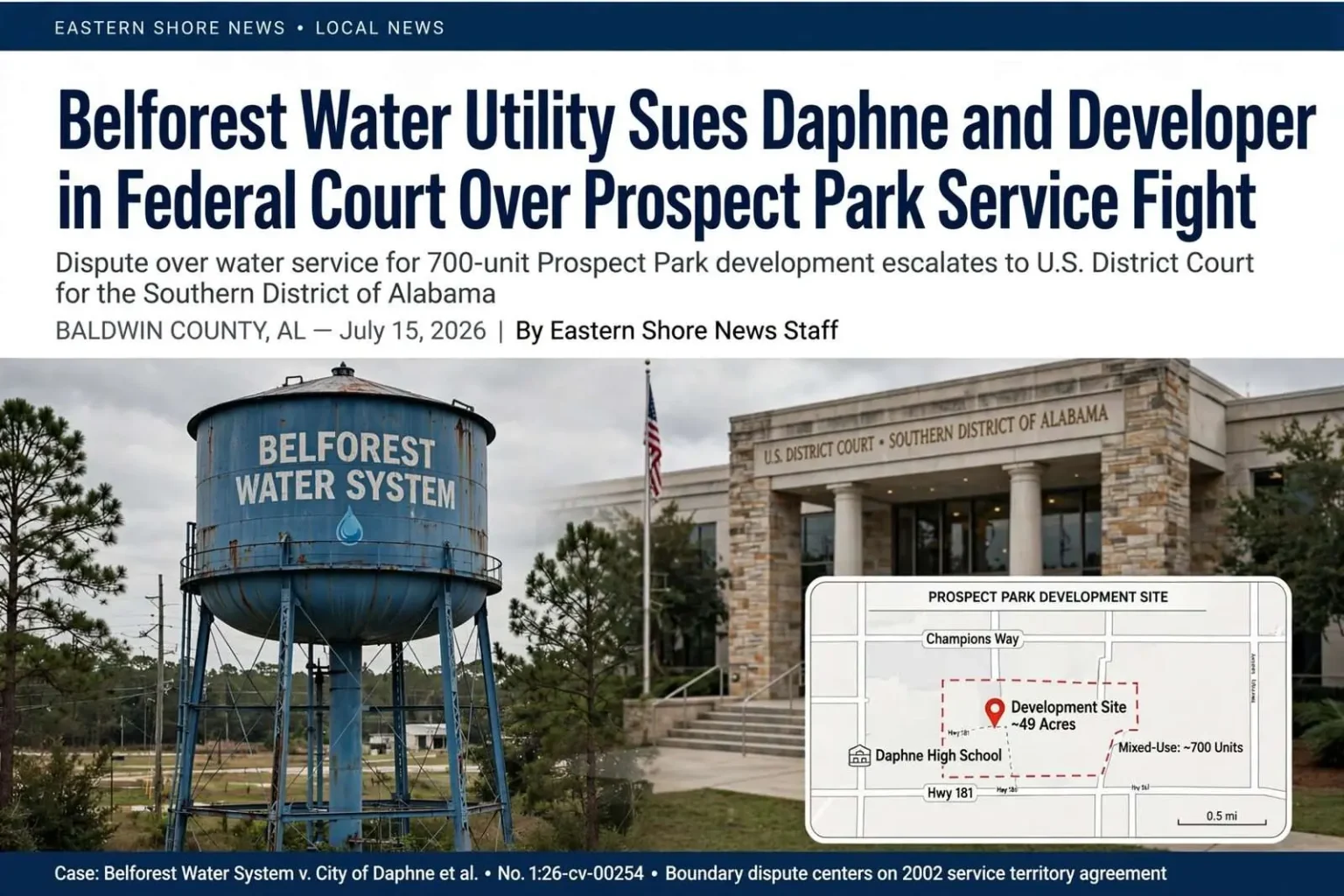
A long-running dispute over who gets to provide water service to a major Daphne development has escalated into federal court, with Belforest Water System (BWS) accusing the city of Daphne, its Industrial Development Board (IDB) and developer 68 Ventures of conspiring to push the utility out of its own service territory.
BWS filed suit on July 15 in the U.S. District Court for the Southern District of Alabama, naming the city, the IDB and 68 Ventures as defendants. The complaint centers on Prospect Park, a roughly 49-acre mixed-use development planned between Champions Way and Highway 181, behind Daphne High School, that is expected to include around 700 residential units along with office space. The case, Belforest Water System v. The City of Daphne et al., is docketed as No. 1:26-cv-00254, and U.S. District Judge Kristi DuBose has been assigned to preside.
According to the complaint, BWS alleges the defendants worked together to steer water service for the development to Daphne Utilities instead, in an effort to get around a 2002 settlement agreement that divides service territory between BWS and Daphne Utilities. That agreement, along with federal and state water utility protections, generally requires a utility to either provide service in its territory or formally decline to do so before another provider can step in.
BWS attorney George Irvine wrote in the complaint that the city, the IDB and 68 Ventures “entered into a common scheme, combination and conspiracy to unlawfully curtail the services of BWS in its service territory” in an attempt to force the utility into declining service and consenting, in writing, to let Daphne Utilities take over.
“The city, IDB and 68 Ventures desired to obtain exclusive water service from (Daphne Utilities) rather than from BWS, but this desire was frustrated by the existence of the 2002 Settlement Agreement and the provisions of both 7 U.S.C. §1926(b) and Ala. Code §11-501.1 (1975),” Irvine wrote. The complaint also accuses the defendants of seeking to “facilitate the duplication of BWS’s water service” by Daphne Utilities.
The suit also claims Daphne is violating federal law by considering franchise ordinances and permit fees on BWS within city limits while the city holds federal loan funding tied to water infrastructure.
Why the Territory Fight Matters
Water service areas along the Eastern Shore of Mobile Bay are not abstractions — they decide who lays pipe, who bills the customer, and who carries the debt for decades of infrastructure investment. Belforest Water System serves an unincorporated stretch of Baldwin County east of Daphne, and its service territory has been fixed in relation to Daphne Utilities since the 2002 settlement. When a large development lands near the boundary line, the question of who serves it can be worth millions of dollars in tap fees, monthly revenue and bond capacity.
Prospect Park is exactly the kind of project that turns that question acute. A mix of several hundred homes and commercial office space on 49 acres represents years of construction activity and, once built out, a permanent base of water customers. Whichever utility signs the service agreement collects those customers for the life of the development. That is why disputes like this one rarely stay technical: the parties understand that a single boundary determination can shift the economics of an entire utility district.
The 2002 settlement and how service areas work
The 2002 agreement between BWS and Daphne Utilities is the governing document for this fight, and its logic is common across Baldwin County, where municipal and rural water systems have historically overlapped. Settlement agreements of this type divide a growing area into defined service territories so that two systems do not race each other to lay competing lines down the same corridor — a pattern that in other places has produced redundant infrastructure, stranded debt and higher rates for everyone.
Under the standard framework that BWS invokes, a utility holding a service territory must either extend service when a customer inside that territory asks for it or formally decline in writing, at which point another provider may step in. The protection exists to prevent the more common abuse: a developer or municipality arranging for a rival system to poach customers from a rural utility that has already invested in the area. Federal and state law layer additional safeguards on top, in part because rural water systems often carry federal loan funding whose terms assume the utility will keep the customers that justify the investment.
The two statutes BWS cites are specific. The federal provision, 7 U.S.C. §1926(b), bars other providers from serving new customers inside a system’s territory in a way that would impair its ability to repay outstanding federal loans while those loans remain unpaid. The state statute requires one water provider to obtain written consent from another before serving properties inside that provider’s certified territory. Under the 2002 agreement, properties along the boundary can be served by the other utility only if the first refuses to or cannot reasonably provide service.
BWS argues that what happened with Prospect Park inverted that process. Instead of BWS being asked to serve or decline, the complaint says, the city, its IDB and the developer worked in combination to make service impossible or unattractive — through the machinery of annexation-adjacent incentives, board approvals and development agreements — so that BWS would be maneuvered into a written consent it never wanted to give.
The Federal Law Claims
The second half of the complaint reaches beyond the settlement agreement into federal statutes that govern water infrastructure funding. BWS contends that Daphne’s consideration of franchise ordinances and permit fees applying to BWS inside city limits violates federal law precisely because the city holds federal loan funding tied to water infrastructure. The argument reflects a broader principle: utilities that have accepted federal money for water projects operate under conditions designed to protect their service areas and their ratepayers, and municipal actions that undermine those conditions can draw a federal court’s attention.
Franchise ordinances matter because they are the mechanism by which a city asserts control over a utility’s presence within its boundaries — the right-of-way access, the fees, the conditions of operation. For a rural water system like BWS, a franchise burden inside Daphne’s limits can function as a toll on the utility’s own territory, particularly as annexation and development push city boundaries toward BWS’s customer base. The complaint frames the fee discussion not as routine municipal housekeeping but as part of the pressure campaign alleged against the utility.
The federal court venue matters as well. The Southern District of Alabama, seated in Mobile, is where Eastern Shore development disputes of this magnitude end up when state-court remedies and negotiated settlements have failed. A federal filing also signals that BWS believes federal statutory claims — not merely the contract dispute over the 2002 agreement — are in play.
How the Fight Started
The federal case is the latest chapter in a fight that began last year, when 68 Ventures and the city of Daphne sued BWS, arguing the utility was blocking Prospect Park from moving forward by refusing to let Daphne Utilities serve the site. That earlier suit, filed in Baldwin County Circuit Court, framed BWS’s resistance as an obstacle to a major development the city wanted — jobs, tax base and housing growth hanging on a water line — and said the standoff was keeping land deals between the developer, the city and the IDB from closing. The land is owned by the IDB and the city and was in the process of being purchased by 68 Ventures; roads have already been paved through the site and much of the underground infrastructure is in place.
According to the federal complaint, 68 Ventures first asked Daphne Utilities to serve the project area in 2024, then discovered the property sat within BWS territory. BWS says the “will service” letter it later provided related to a completely different project — a six-building plan the IDB proposed in 2016, when the site was slated for a science park — and that the IDB had a service agreement tied to those earlier plans under which it would have remained responsible for water infrastructure upgrades through 2026. The complaint also alleges 68 Ventures hired a consulting firm for “due diligence” work that, in BWS’s telling, was aimed at making it harder for BWS to claim it could reasonably serve the site.
At its core the dispute is about money. BWS says the developer would have to pay for the infrastructure improvements needed to serve the project; 68 Ventures CEO Drew Dolan has said those upgrades would cost his company roughly $10 million, while Daphne Utilities offered service to the site for $2 million. When first proposed in 2024, Prospect Park was pitched on about 60 acres as a village combining single-family and multifamily housing, retail and corporate office space, including a training center tied to the Novelis aluminum plant under construction in the county.
The state case has already produced a ruling against BWS. Baldwin County Circuit Judge Ashley Siebert granted partial summary judgment for the plaintiffs on counts one and two of their complaint — a ruling that, if it holds, may establish that BWS effectively declined to provide sufficient water service and could let Daphne Utilities serve the property. Siebert did not explain the decision but invited attorneys to submit a proposed order with more detail; she had not acted on it when the federal suit was filed. BWS appealed in late June, and the Alabama Supreme Court has not yet scheduled a hearing.
From the developer’s vantage, the issue is schedule. Projects of Prospect Park’s scale are built against financing deadlines, and a water-service impasse can stall site work indefinitely. From BWS’s vantage, the issue is survival: a rural water system that loses a 700-unit development inside its own territory loses not only the revenue but the precedent, because the next boundary dispute will cite this one.
The escalation from state court to federal court suggests neither side believes the dispute can be managed locally anymore. The earlier litigation posed the question as whether BWS was obstructing growth; the new complaint recasts the same events as an organized effort to strip a small utility of its territory through coordinated municipal and private action. Those are incompatible narratives, and the federal court will now have to sort out which one the record supports.
What residents should watch
For Daphne-area residents, the case has three practical dimensions. The first is rates: whoever serves Prospect Park will carry infrastructure costs that eventually flow into a rate base, and the boundary outcome will shape what customers on both sides of the line pay. The second is service reliability — rural systems like BWS exist because municipal utilities historically did not extend into unincorporated Baldwin County, and their viability depends on keeping enough territory to justify their debt. The third is the development itself: Prospect Park’s housing and office plans are real economic activity for the Highway 181 corridor, and the water dispute is now the principal variable determining its timeline.
The Industrial Development Board’s role deserves particular attention, because IDBs exist to issue tax-exempt financing and facilitate development incentives on a city’s behalf. When a development board becomes a defendant in an antitrust-style conspiracy claim alongside the city and a private developer, the complaint is alleging that public-purpose machinery was enlisted in a private commercial contest — a serious allegation that goes beyond a routine boundary quarrel.
Baldwin County’s Water Landscape
The dispute is easier to understand against the backdrop of Baldwin County’s growth, which has been among the fastest in Alabama for two decades. Daphne, Fairhope, Spanish Fort and the unincorporated communities around them — including the Belforest area — have absorbed thousands of new households, and every subdivision raises the same underlying question: whose lines, whose meters, whose debt. Water systems in the county range from large municipal departments to small rural districts that were organized generations ago by residents who needed service the cities did not offer.
Highway 181, which anchors the Prospect Park site along with Champions Way, runs through one of the county’s principal growth corridors, connecting Daphne’s eastern edge toward Spanish Fort and the growing communities to the north. Corridors like this one are where boundary questions are sharpest, because developers assemble large tracts that often straddle the informal edges of municipal and rural service areas. A 49-acre mixed-use tract with roughly 700 units is precisely the scale at which those edges stop being academic.
Small water systems also carry institutional weight beyond their size. They are governed by boards answerable to their own customers, they maintain their own wells, tanks and mains, and they often hold federal or state loan obligations whose terms assume a stable service territory. When a dispute like BWS’s reaches federal court, the underlying stakes include the viability of that whole model of utility governance in fast-growing counties — whether rural systems can hold their ground as municipalities expand, or whether growth inevitably redraws the map in the cities’ favor.
What comes next
The federal complaint asks the court to declare the city’s franchise ordinances and permit fees unlawful, to bar the defendants from facilitating service by Daphne Utilities inside BWS’s protected territory, and to award damages for the alleged conspiracy. BWS is represented by George R. Irvine III of Stone Crosby, P.C., in Daphne. Mayor Robin LeJeune declined to comment on the lawsuit, and Dolan and 68 Ventures founder Nathan Cox did not respond to requests for comment. At Daphne Utilities’ July 29 board meeting, the board’s attorney acknowledged the new lawsuit and said a dismissal was being pursued.
Litigation of this kind unfolds slowly. The defendants will answer the complaint, likely moving to dismiss some or all of the federal claims; discovery will follow, and with a development agreement, board minutes and years of correspondence at issue, the documentary record will be extensive. Settlement negotiations remain possible at any point — boundary disputes are frequently resolved by amended agreements that redraw lines or compensate the displaced utility — but both sides have now invested enough in public positions that a negotiated exit is harder to engineer.
For the 2002 settlement itself, the case is a stress test. Agreements like it work when all parties honor the serve-or-decline discipline that gives them meaning. BWS’s core allegation is that the discipline was engineered away rather than honored. If the court agrees, the remedy could reshape not only Prospect Park’s water service but the terms under which Daphne and the county’s other utilities negotiate future boundary questions.
Until the case resolves, the practical reality on the Highway 181 corridor is uncertainty: a major development waiting on its water answer, a city and a rural utility locked in a fight neither can afford to lose, and a federal court in Mobile holding the map that Baldwin County’s fastest-growing corner will live by.