

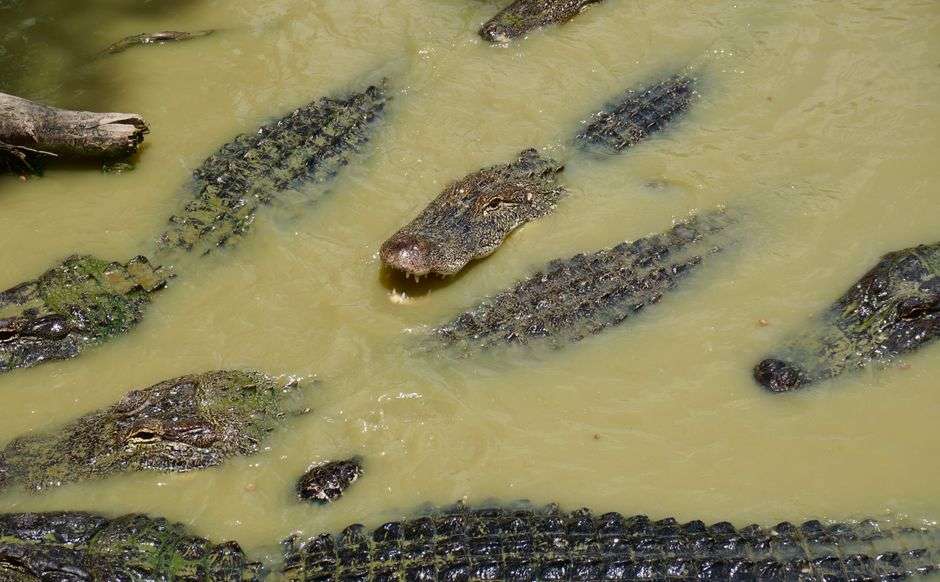
Anyone who has lived along the Alabama coast for more than a season has a gator story. The one basking beside the 14th green. The one sunning on the causeway shoulder like it owns the lane. The one that made the neighborhood group chat before the school bus arrived. Alligators are not a novelty here — they are a neighbor, a sometimes-startling one, and understanding how they live is the difference between coexistence and trouble.
Where You’ll See Them — and When to Be Careful
American alligators favor warm weather and are most visible when they haul out to bask. Along the coast they turn up along the Causeway, on creek banks, throughout the Mobile-Tensaw River Delta, and on golf courses across the region. As the human population grows and seasonal tourism swells, encounters between people and alligators naturally increase. Alligators are naturally shy of humans, but they can become aggressive if harassed, provoked, or fed — and fed is the dangerous one, because an alligator that learns to associate people with food loses the wariness that keeps everyone safe. They also grow more territorial during mating season, which generally runs April through May, when both adults and hatchlings are on the move.
Pets deserve particular attention. Leashes in coastal parks are not just courtesy — a dog at the water’s edge is the single most common trigger for a close encounter.Keeping pets on a leash at parks and preserves near water is the single easiest safety step a coastal resident can take.
The Nesting Season Wild Card
Spring brings a specific hazard most visitors never think about: nests. Alligator breeding occurs in open water, and after conception the female builds a mound nest of vegetation and mud, where she lays 30 to 70 eggs. The nests are well hidden and fiercely defended. In alligator country, that means watching where you walk and where you swim — a conveniently overgrown pond bank in May may be somebody’s nursery.
Feeding behavior is worth understanding too. Alligators are carnivores that eat fish, birds, snakes, turtles and small mammals, hunting mostly at night by lying in wait and drowning their catch. Large prey gets dragged underwater and wedged beneath logs or stumps until it drowns. They must surface to swallow — they cannot do it underwater — and they cannot chew, taking meals whole or in large chunks. None of this makes them malicious; it makes them ambush predators, and ambush predators are best appreciated from a distance.
The Comeback Story Behind Every Sighting
Every gator on a Baldwin County golf course is a descendant of one of the great conservation recoveries in American history. Unregulated harvest across the South in the early 1900s pushed the American alligator toward extinction. Alabama led the rescue: in 1938 it became the first state to protect alligators, and other states followed. In 1967 the U.S. Fish and Wildlife Service listed the species as endangered; by 1987 the alligator had recovered enough to be removed from the endangered list, though it remains federally protected.
The recovery was so complete that Alabama now runs a regulated hunting season, with permits issued by lottery. The state record testifies to how large the species can grow here: the biggest alligator ever legally taken in Alabama measured 15 feet and weighed more than 1,000 pounds. Few wildlife stories in the state — from sea turtles to brown pelicans — have bent the curve back from the brink as decisively.
Where to See One Safely
For the genuinely curious, the coast offers plenty of low-risk ways to see alligators up close. The Gator Boardwalk on U.S. Highway 98 in Daphne and the neighboring Village Point Park Preserve put observers on boardwalks over prime gator habitat. The Hugh S. Branyon Backcountry Trail in Orange Beach winds through freshwater marshes where alligators are commonly seen from the path. Alligator Alley in Summerdale offers a dedicated alligator sanctuary experience. And the restaurants along the Causeway — several with decks over the water — are an underrated gator-watching venue, particularly in warm weather when the animals bask on the banks below.
For the full immersion, tour operators run boat trips into the Mobile-Tensaw Delta, the 260,000-acre wetland system where alligators live at the top of the food chain exactly as they have for millions of years.
The Rules That Keep Everyone Alive
The practical rules reduce to a short list. Never feed an alligator — it is illegal and it converts a shy animal into a bold one. Keep pets leashed near water. Swim only in designated areas, and never at dawn or dusk when alligators feed. Keep a respectful distance from nests, and never try to move a hatchling. Report nuisance alligators to state wildlife officials rather than handling the situation personally.
Alligators have patrolled Alabama’s wetlands for a very long time, and the coast would simply not be the same without them. They are an essential part of the ecology of the state’s wetlands — and like the best neighbors, they ask only for a little space and a little respect. Give them both, and the gator stories stay the harmless kind.