USA Health Marks Overdose Awareness Day With Warning Signs Every Bystander Should Know
USA Health's Spiritual Health and Counseling department joined the national observance of International Overdose Awareness Day on Aug. 31, highlighting how to recognize an opioid overdose and why naloxone and a 911 call both matter. Alabama's opioid prescribing rate remains among the highest in the country.
MOBILE, Ala. — USA Health’s Spiritual Health and Counseling department joined communities across the country in marking International Overdose Awareness Day on Aug. 31, an annual observance intended to raise awareness of opioid overdoses and to acknowledge the effect substance use has on individuals, families and communities.
The observance carries two purposes at once. One is remembrance — recognizing the people who have died and the families who continue to live with that loss. The other is practical: teaching people to recognize an overdose when it is happening in front of them and to respond in the minutes that matter.
Through its participation, Spiritual Health and Counseling emphasized the importance of compassion, education and support for those affected by substance use. The department provides emotional and spiritual support to patients and families as part of USA Health’s commitment to whole-person care.
Knowing what an overdose looks like
The single most useful piece of information in an observance like this one is also the simplest: what an overdose actually looks like to someone standing nearby.
According to the information shared by USA Health, signs of an overdose can include:
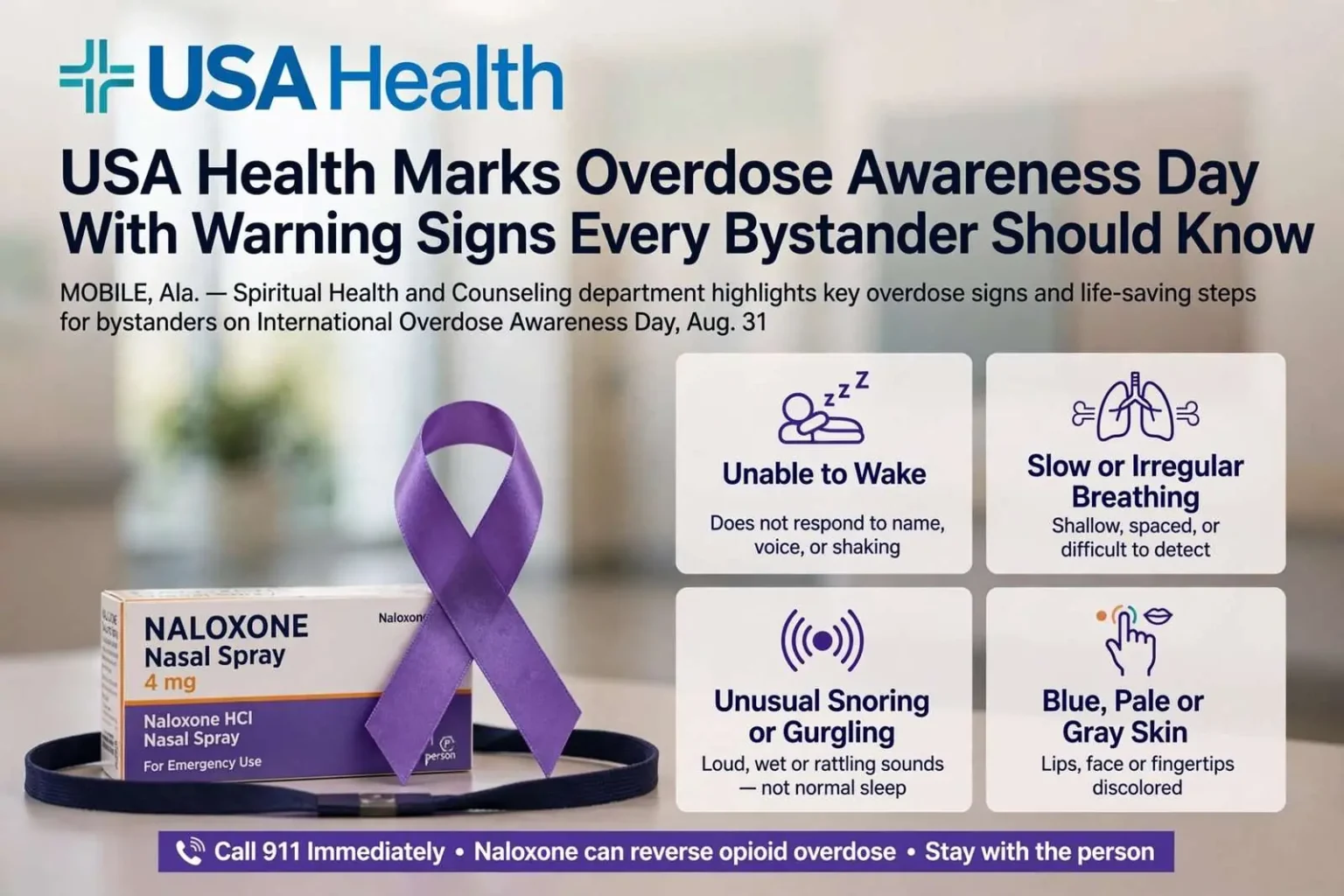
- An inability to wake the person. They do not respond to their name, to being spoken to loudly, or to being shaken.
- Slow or irregular breathing. Breaths may be shallow, widely spaced or difficult to detect.
- Unusual snoring or gurgling sounds. These noises are frequently mistaken for ordinary heavy sleep.
- Blue, pale or gray lips or fingertips. A change in color at the lips, face or fingertips can indicate that the body is not getting enough oxygen.
Immediate action, including administering naloxone and calling 911, can save a life.
The snoring detail is worth dwelling on, because it is the one most often misread. A person who appears to be sleeping heavily and making loud, wet or rattling noises may not be asleep at all. Friends and family members who later describe an overdose frequently say the same thing: they assumed the person had simply passed out and would sleep it off. The distinction between deep sleep and an overdose can be as small as whether the person can be roused — which is precisely why the guidance emphasizes trying to wake them and treating a failure to respond as an emergency rather than as a reason to leave someone alone.
Why breathing is at the center of it
The reason those particular warning signs appear together is a matter of basic physiology. Opioids act on receptors in the brain that, among other functions, regulate the automatic drive to breathe. In an overdose, that drive is suppressed. Breathing slows and becomes shallow or irregular, the airway may partially close — producing the snoring or gurgling sound — and as oxygen levels fall, the lips, face and fingertips can take on a blue, gray or unusually pale color. Loss of consciousness follows from the same underlying process.
This is also why time matters so much. Every one of the listed warning signs is a symptom of insufficient oxygen, and the damage from oxygen deprivation accumulates. That places the burden of the first response on whoever happens to be present, not on the emergency medical crew that arrives later.
What naloxone is and what it does
Naloxone is a medication that reverses the effects of an opioid overdose. It works as an opioid antagonist: it attaches to the same receptors in the brain that opioids act on and displaces them, which can restore normal breathing in a person whose respiration has been suppressed.
Several characteristics of naloxone are worth understanding as general public safety information.
It is designed for use by people without medical training. Naloxone is widely distributed in a nasal spray form intended specifically for bystanders — family members, friends, coworkers, roommates.
It does not work on overdoses that are not opioid-related, and it has no opioid effect of its own. That is why the guidance in a public awareness context is generally to use it when an overdose is suspected: if opioids are not involved, naloxone is not the answer, but administering it does not create a new problem.
Its effect is temporary. Naloxone can wear off before the opioids in a person’s system do, which means someone who initially responds may deteriorate again. That single fact is the reason 911 is not an optional second step. Calling emergency services is part of the response, not an alternative to it. Professional responders can continue treatment, monitor for the return of symptoms and transport the person for further care.
Naloxone also cannot substitute for the other basic elements of emergency response — staying with the person, keeping their airway clear and following the instructions of the 911 dispatcher, who is trained to guide callers through exactly this situation.
What Alabama’s prescribing rate does and does not tell us
The need for opioid awareness remains significant. According to the Centers for Disease Control, Alabama had 68.5 opioid prescriptions dispensed per 100 people in 2024, among the highest rates in the nation.
That number benefits from careful reading. A rate of 68.5 prescriptions per 100 people does not mean that 68.5 percent of Alabamians received an opioid prescription in 2024. It is a count of prescriptions dispensed measured against the size of the population — a single patient with a chronic condition may account for several prescriptions over the course of a year, while most residents account for none. The measure is a way of comparing prescribing volume across states on a common scale, not a headcount of individuals.
What the figure does establish is that opioid medications remain broadly present in Alabama relative to other states. Prescribing volume is one of the standard indicators public health agencies track because prescribed opioids circulate: they sit in medicine cabinets after a surgery or an injury, they are sometimes shared, and they are sometimes retained long after the condition that prompted them has resolved.
What the figure does not establish is any direct claim about overdose deaths, about the share of overdoses involving prescribed as opposed to illicitly obtained substances, or about trends over time. The source material cites the prescribing rate as evidence that awareness efforts remain warranted, and that is the appropriate weight to give it. It is a measure of exposure and context, not a measure of outcomes.
For readers in Mobile and Baldwin counties, the practical implication of a high statewide prescribing rate is straightforward: opioid medications are present in a great many households, including households where no one considers substance use to be an issue. That is part of why awareness campaigns direct their warning-sign information at the general public rather than at any particular group.
The role of a spiritual health and counseling department
That the observance at USA Health was led by Spiritual Health and Counseling says something about how the health system is framing the issue.
Spiritual health departments — often staffed by chaplains and counselors — are a standard part of hospital operations, though their work is less visible to the public than clinical care. They provide emotional and spiritual support to patients and to families, frequently at the hardest moments of a hospital stay: a difficult diagnosis, a long intensive care admission, an unexpected death. Their support is generally offered to people of any faith background and to those of none.
Overdose sits squarely within that scope. Families affected by substance use often carry not only grief but a particular kind of isolation, because the circumstances of the loss are still widely stigmatized. Stigma has a measurable practical cost in this context: it discourages people from seeking treatment, discourages families from talking openly about a relative’s situation, and discourages people from carrying naloxone or asking questions about it. A department whose stated emphasis is compassion, education and support is addressing that isolation directly.
The phrase USA Health uses — whole-person care — describes an approach that treats a patient’s emotional and spiritual needs as part of their care rather than as something separate from it. In practice, it means recognizing that a person admitted to a hospital arrives with a family, a history and a set of fears, and that the outcome of their care is bound up with all of it.
Why bystander awareness is the point
International Overdose Awareness Day is observed on Aug. 31 each year, and health systems, community organizations and public health agencies across the country participate. The reason this kind of observance focuses so heavily on recognition and response is that overdoses rarely happen in the presence of medical professionals. They happen in homes, in vehicles, at workplaces and in public restrooms, and the person best positioned to intervene is almost always someone with no clinical training at all.
That reframes the goal of an awareness campaign. It is not primarily about persuasion; it is about distributing a small amount of specific knowledge as widely as possible — the four warning signs, the existence of naloxone, and the instruction to call 911 — so that the person who happens to be in the room knows what they are looking at and what to do.
What to take from the observance
The information USA Health highlighted is compact enough to remember and general enough to apply anywhere:
- An overdose may look like heavy sleep. If a person cannot be woken, treat it as an emergency.
- Slow or irregular breathing, unusual snoring or gurgling, and blue, pale or gray lips or fingertips are warning signs.
- Naloxone can reverse an opioid overdose, and it is intended to be usable by ordinary bystanders.
- Call 911. Naloxone’s effect can wear off, and professional care is part of the response, not a fallback.
Questions about naloxone — how to obtain it, how to store it, how it is used, and what local resources exist for someone concerned about their own substance use or a family member’s — are best directed to a physician, a pharmacist or a local public health agency, all of which can address individual circumstances that a general article cannot.
What USA Health’s Spiritual Health and Counseling department contributed to the observance is the part that no clinical protocol supplies: the reminder that the people affected by substance use, including those grieving a death, deserve compassion and support rather than judgment. That posture is not incidental to the public health goal. People are more likely to seek help, ask questions and carry naloxone in communities where doing so does not carry shame.