Mobile Developer Matt Walker Set for Arraignment on Theft Counts
Mobile entrepreneur and real estate developer Matt Walker was scheduled for arraignment on four counts of receiving stolen property, in a case involving antiques allegedly taken from upscale homes whose owners were away.
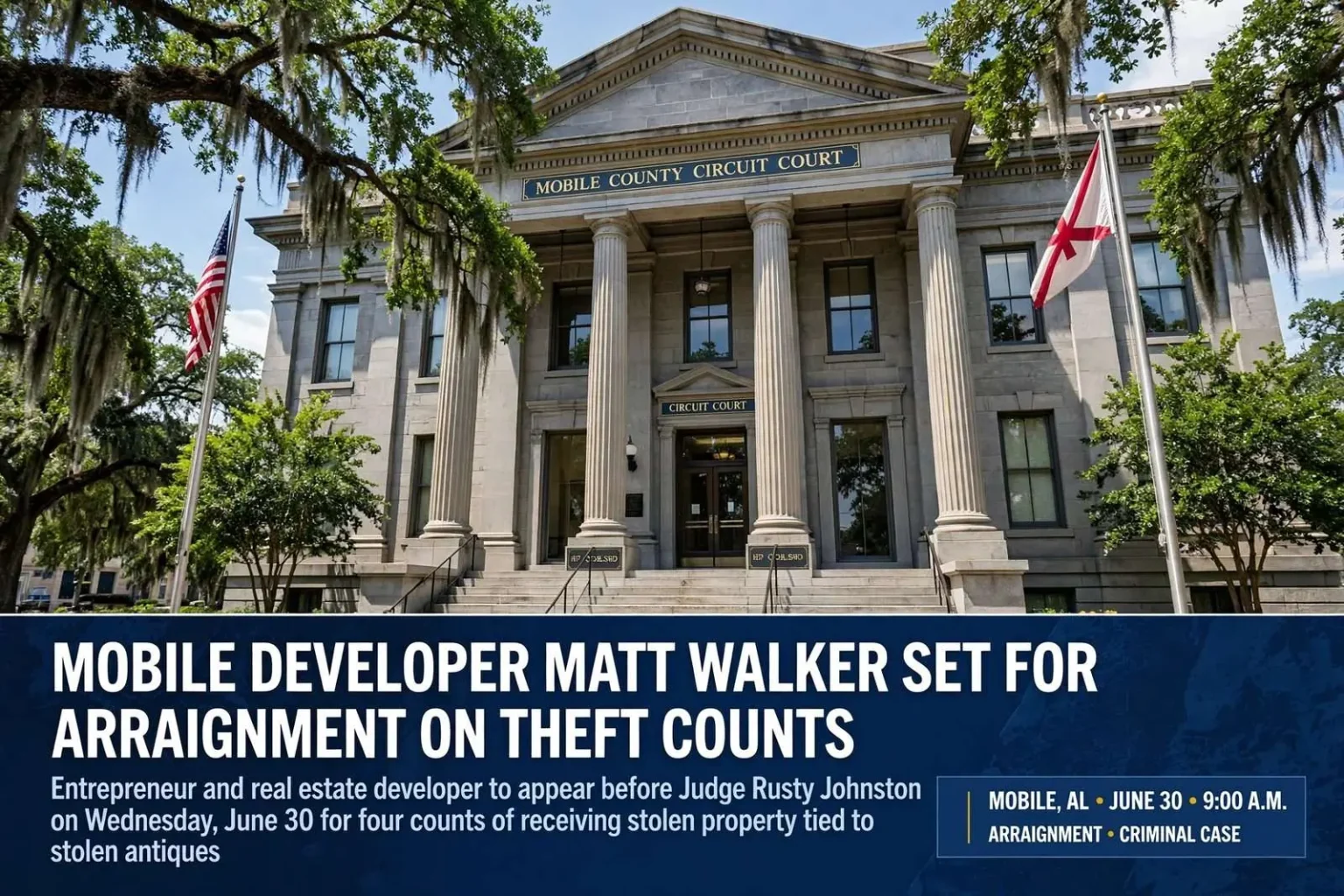
Mobile entrepreneur and real estate developer Matt Walker was scheduled to be arraigned later this month on criminal charges tied to a collection of stolen antiques, court officials confirmed. The arraignment was set for 9 a.m. on Wednesday, June 30, in the courtroom of Mobile County Circuit Judge Rusty Johnston. Walker faced four counts of receiving stolen property, allegations that grew out of antiques taken from upscale homes whose owners were away at the time the thefts occurred.
According to the allegations, Walker came to possess antiques that had been stolen from residences whose owners were absent when the items were taken. The case drew attention in Mobile not only because of the nature of the property involved, but because of Walker’s standing in the city’s business and development circles, where he had built a reputation as an active entrepreneur.
What an arraignment involves
An arraignment is an early and largely procedural step in a felony case. It is the point at which a defendant is formally advised of the charges against him and enters a plea, and at which the court can address matters such as bond conditions and the schedule for the proceedings to come. It is not a trial, and it does not determine guilt or innocence.
In practice, the hearing is usually brief. A defendant appears before the judge, the charges are read or summarized, and a plea of guilty or not guilty is entered. In felony cases in Alabama, arraignment follows indictment by a grand jury, which determines that there is probable cause to believe a crime was committed and that the accused committed it. Once a not guilty plea is entered, the case moves into a pretrial phase in which both sides exchange evidence and file motions.
The appearance before Judge Rusty Johnston would also have given the court an opportunity to confirm that Walker had counsel, to revisit the conditions of his bond, and to set deadlines for the discovery process and future hearings. Scheduling decisions made at arraignment often shape the pace of a case for months, determining when suppression motions are heard, when trial dates are considered, and how quickly evidence moves between prosecutors and the defense.
What the counts mean
In Alabama, receiving stolen property is a charge distinct from theft itself. The law reaches people who knowingly buy, receive, retain or dispose of property belonging to another, knowing or having reasonable grounds to believe it was stolen. Prosecutors do not have to prove that the defendant personally carried out the original theft, only that he knowingly handled the stolen goods after the fact.
The seriousness of the offense generally rises with the value of the property involved. Theft and receiving stolen property offenses in Alabama are graded in large part by dollar amounts, with higher-value property carrying felony exposure and lower-value items typically charged as misdemeanors. Antiques, which can carry appraised values far above what their appearance might suggest, frequently push such cases into the felony range.
Multiple counts can reflect items connected to separate homes or separate incidents. Four counts in this case pointed to distinct pieces of property or distinct episodes alleged in the indictment, each of which would be weighed separately if the case went to trial. Separate counts also give prosecutors flexibility in plea negotiations and give juries a clearer picture of the alleged pattern of conduct.
The allegation that the antiques came from upscale residences whose owners were away pointed to a pattern that, as described, targeted valuable furnishings and heirlooms at times when the homes were unoccupied. Burglars and theft rings have long favored unoccupied properties because they allow more time to search for and remove items without interruption, and antiques are attractive targets because they are portable, hard to trace and easy to sell through secondary markets.
The specifics of how the items were said to have changed hands, and how they came into Walker’s possession, were matters expected to be laid out as the case moved forward. Prosecutors would be required to present evidence connecting Walker to each item named in the indictment and to show that he knew, or had reasonable grounds to know, that the goods were stolen when he received or retained them.
Why antique theft cases are complicated
Stolen property cases involving antiques present particular challenges for investigators and prosecutors. Unlike automobiles or electronics, antiques rarely carry serial numbers, and ownership must often be established through photographs, appraisals, insurance records and family documentation. Victims in burglary cases are frequently asked to provide inventories of what was taken, and matching recovered items to specific victims can take weeks of work.
Once items are recovered, establishing the chain of possession becomes the central task. Investigators typically trace the goods backward from where they were found, documenting each transfer, sale or storage arrangement along the way. Witness statements, receipts, shipping records and storage facility records can all become evidence, and each link in the chain must be documented for the state to prove knowing possession of stolen property.
Receiving stolen property statutes exist in part because the market for stolen goods drives the burglary and theft that produce them. By criminalizing the knowing receipt and resale of stolen items, the law aims to close the loop between the person who takes property and the person who profits from it. Prosecutors across Alabama regularly use the charge against fences, resale shops and collectors when evidence shows the buyer should have been suspicious of the goods’ origins.
Reasonable grounds to believe property is stolen can be inferred from circumstances. Items offered far below their market value, goods sold out of the back of a vehicle or a storage unit, sellers unwilling to provide documentation, and cash-only transactions with strangers are among the warning signs courts have said can support an inference of knowledge. Defense counsel, in turn, often argue that their clients were themselves deceived by the person who sold them the goods.
A prominent name in local business
Walker was known in Mobile as an entrepreneur and real estate developer, a profile that lent the case added local notice. Figures active in the city’s business and development circles tend to draw attention when they appear on a criminal docket, and Walker’s scheduled appearance in a circuit courtroom was followed by residents who knew his name from commercial projects and business dealings around the city.
Mobile’s real estate and development community is a close-knit one, with a relatively small number of active players involved in the restoration of historic properties, commercial development and the ongoing revitalization of neighborhoods downtown and midtown. Cases involving figures from that community tend to ripple through it, both because of personal connections and because of the professional stakes involved for anyone whose business depends on reputation and credit.
For a defendant with business interests, a pending felony case carries consequences well beyond the courtroom. Banks and lenders scrutinize borrowers facing criminal charges, partners may reevaluate joint ventures, and the time demands of litigation can pull attention away from active projects. Bond conditions can also restrict travel or business activities, complicating the operation of companies while a case is pending.
At the same time, a charge is not a conviction. The presumption of innocence applies at every stage, and the state bears the burden of proving each element of each count beyond a reasonable doubt. Defendants routinely contest receiving stolen property cases by disputing knowledge of the goods’ origins, challenging the valuation of the items or attacking the chain of custody of the evidence.
The road ahead in the case
After arraignment, a felony case in Mobile County Circuit Court typically moves through a period of pretrial activity. The defense receives the state’s evidence through discovery, which includes police reports, witness statements and physical evidence. Either side may file motions, including motions to suppress evidence gathered during searches, motions to sever counts or motions seeking dismissal of particular charges.
Plea negotiations frequently run in parallel with that preparation. In multi-count cases, defendants sometimes resolve the case by pleading to a reduced number of counts or to lesser offenses, while others choose to take their chances before a jury. Cases that do go to trial are decided by juries that must unanimously agree on guilt for each count submitted to them.
Sentencing, if a conviction occurs, would take into account the value of the property involved, the defendant’s prior record and a range of other factors under Alabama’s sentencing framework. Restitution to the victims is also a common component in property cases, with courts ordering defendants to compensate owners for items that were not recovered or that were damaged.
For the homeowners whose antiques were taken, the criminal case represented only one part of the process. Recovered property can be held as evidence until the case concludes, and insurance claims, appraisals and disputes over ownership often continue independently of the prosecution. Victims in cases like this one are frequently most concerned not with the courtroom outcome but with the return of family pieces that may have been passed down for generations.
What the case illustrates for local residents
The case served as a reminder of the risks that accompany extended absences from home. Law enforcement agencies across the Gulf Coast routinely advise residents traveling for extended periods to stop mail delivery, arrange for lights to be switched on timers, ask neighbors to watch the property and avoid posting travel plans publicly, since unoccupied homes are the most attractive targets for burglars.
Residents who own antiques or other high-value items are also encouraged to keep inventories, including photographs and appraisals, and to record any distinguishing marks or provenance documents. Such records make insurance claims smoother and dramatically improve the odds that stolen property can be identified and returned if it is ever recovered in a case like this one.
For now, the case stood at its beginning. The June 30 arraignment before Judge Rusty Johnston would formally open the chapter in Mobile County Circuit Court, and the weeks and months that followed would determine whether the four counts ended in a trial, a plea or a dismissal. Court officials said the schedule of subsequent hearings would be set once the arraignment was complete.