

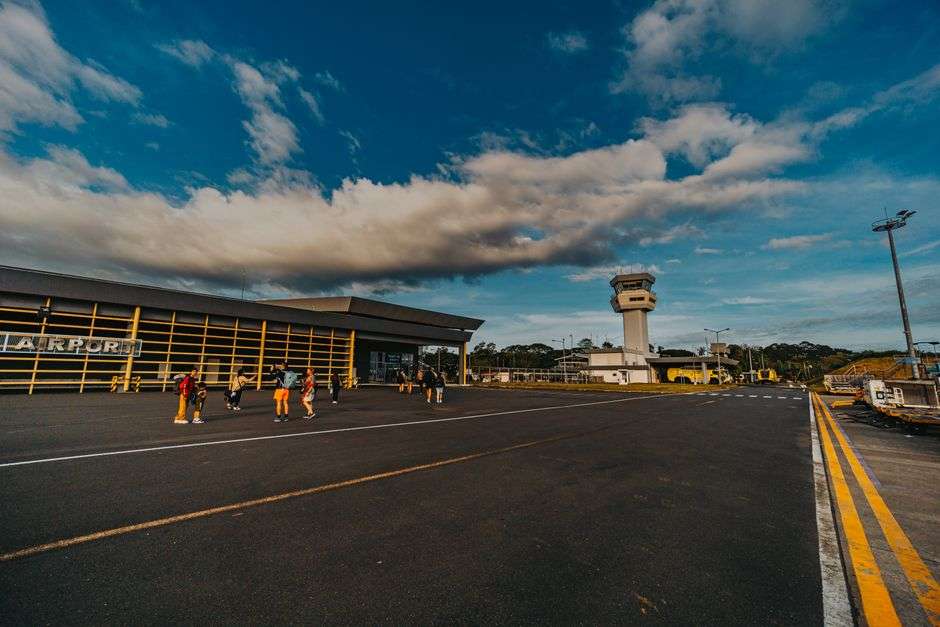
The Mobile Airport Authority is moving ahead with construction plans for a new commercial terminal at the Mobile Aeroplex at Brookley, and officials are still targeting a spring 2019 opening for the facility designed to serve low-cost carriers. The project marks a decisive step in the city’s long-debated effort to move commercial air service from Mobile Regional Airport in west Mobile to the Aeroplex, the sprawling industrial aviation complex just south of downtown.
Authority President Chris Curry said the board of directors recently authorized construction activity tied to the renovation of an existing building at Brookley that will be converted into the airport’s first commercial terminal. The authorization sets in motion the physical work of turning a warehouse-style structure into a functioning passenger facility, a process that will unfold over roughly the next year.
The move follows months of planning work that began with the hiring of Birmingham-based architectural firm KPS Group to guide the authority through the selection of a construction team. The choice of an outside architect to shepherd the procurement reflected the authority’s desire to run a disciplined, competitive process rather than improvising the conversion of an industrial building into an aviation facility.
“When we started this, we hired KPS to move us through the process to select a construction manager,” Curry said.
Assembling the Project Team
Through a competitive request-for-proposals process, the authority selected Jesco Construction Co. to serve as construction manager for the project. The construction manager model allows the builder to be brought in early, working alongside designers to refine cost estimates and sequencing before heavy construction begins, an approach often favored for renovation projects where existing conditions can carry surprises.
Michael Baker International was brought on as the engineering firm overseeing the terminal’s design and build-out. The firm’s role places it at the center of the technical challenges inherent in the conversion: reworking utilities, access roads, aircraft parking aprons, security screening areas and passenger circulation within a building never intended to handle travelers.
The building slated for conversion is a roughly 50,000-square-foot structure that has served as a logistics facility for Airbus, which currently uses it as a foreign trade zone as part of its nearby aircraft manufacturing operations. Airbus’s Final Assembly Line at Brookley, where the company builds A320-family aircraft for the U.S. market, made the Aeroplex an international logistics site, and the terminal project effectively recycles a piece of that industrial footprint for public aviation use.
Curry said the airport authority will continue sharing space with Airbus for several more months before taking full control of the structure. The overlap gives the aircraft manufacturer time to relocate its trade zone operations while allowing terminal design work to proceed in parallel.
“We’re going to share it with Airbus for another six months,” Curry said. “Then we’ll take over the building.”
Terminal 1 and a Phased Vision
Once renovated, the facility will be designated Terminal 1 and will primarily serve low-cost carriers while the authority works through a broader master planning process for the Brookley site. The Terminal 1 designation signals that officials view the renovated building as the first phase of a long-term aviation campus rather than a one-off conversion, with room for additional facilities as demand grows.
Officials expect the terminal to open by April 30, 2019, at a total renovation cost of about $3.2 million. That figure is modest by airport construction standards, and it is one of the central arguments for the Brookley approach: adapting an existing, well-located building costs far less than building a new terminal from the ground up.
Curry said Via Airlines is expected to be the first commercial carrier to operate out of the new terminal once it opens. The airline currently flies out of Mobile Regional Airport, offering four flights a week between Mobile and Orlando-Sanford on 50-seat Embraer regional jets.
“Via has expressed a desire to move to the terminal as soon as it’s open,” Curry said. “We continue to talk to other carriers that don’t have service out of Mobile today.”
Via’s presence at the new terminal would give Mobile its first dedicated low-cost carrier facility, the kind of operation that has reshaped air travel markets across the country. Budget carriers built their business models around lean terminals and low landing fees, and a facility tailored to their needs gives airport officials a selling point when courting airlines that have never served the city.
Curry’s comment about conversations with other carriers points to the broader commercial logic of the project. Airlines evaluate potential new markets constantly, and a modern, inexpensive terminal located closer to the region’s population center changes the arithmetic of whether a route can be profitable from Mobile.
Planning for the Whole Site
Beyond the immediate terminal project, the authority is also soliciting bids for a broader master plan governing future development at Brookley. The master plan will map out how the site accommodates aviation growth over decades, balancing passenger terminal needs, cargo operations, general aviation and the industrial tenants — most prominently Airbus — that already anchor the Aeroplex.
Curry said officials expect to narrow the field of firms competing for that contract by the end of the year, with the planning process itself expected to take a year to a year and a half to complete. The timeline means decisions about the site’s long-range layout will be taking shape even as the first terminal is being fitted out inside the former Airbus logistics building.
Looking further ahead, Curry said that once low-cost carriers are established at the new terminal, the authority may pursue construction of a second terminal designed to accommodate larger, more traditional carriers as commercial service at Brookley grows. That staged approach — budget carriers first, mainline carriers later — mirrors how a number of secondary airports around the country have built volume before pursuing bigger aircraft and bigger airlines.
Why Brookley
The push to shift commercial air service to Brookley follows a study released earlier this year that found relocating flights from Mobile Regional Airport to the downtown Brookley site was feasible and, in several respects, advantageous. The question of where Mobile’s commercial airport belongs has surfaced repeatedly over the decades, and the new study gave proponents of the move a data-driven foundation.
The Mobile Metropolitan Airport System Study concluded it would be more cost-effective to consolidate commercial service at the Mobile Aeroplex at Brookley than to fund the infrastructure upgrades that would be needed to expand capacity at Bates Field, the formal name of the Mobile Regional Airport site in west Mobile. Runway extensions, terminal expansion and land acquisition at an established airport carry heavy price tags, while the Aeroplex already possesses an airfield, hangars and support infrastructure from its military and industrial history.
The study also cited Brookley’s location as a competitive advantage, noting the site is “geographically better positioned to attract additional air service due to its proximity to downtown and ability to attract a larger share of the airport’s catchment area.”
The catchment area — the pool of travelers within convenient driving distance of an airport — is where the financial case for Brookley becomes most concrete. Currently, Mobile’s airport captures only about half of its potential regional travelers, with many area residents instead driving to airports in Pensacola or Gulfport for flights. Every traveler who begins a trip at another airport takes ticket revenue, parking revenue and economic activity across state lines.
Study authors suggested that a move to a more centrally located, downtown facility could help the region capture a share of the roughly 138,000 additional potential passengers currently flying out of neighboring markets. For a market of Mobile’s size, that volume of recaptured passengers would represent meaningful growth, and it is the number airport officials will cite when making the case to airlines considering new Mobile routes.
Brookley’s proximity to downtown places the future terminal minutes from the city’s hotels, restaurants and business districts, a convenience factor that matters to both business travelers and leisure visitors. It also positions the airport adjacent to the Alabama State Port Authority’s operations and the growing cluster of aviation employers along the waterfront, reinforcing the corridor’s identity as the city’s industrial and logistics center.
What It Means for Travelers
For Mobile-area residents, the practical stakes of the project come down to fare competition and convenience. Low-cost carriers have repeatedly demonstrated that their entry into a market forces incumbent airlines to lower fares across the board, a dynamic that benefits travelers whether or not they fly the budget airline itself. A $3.2 million terminal that attracts even one additional carrier could reshape fare levels at both the new facility and any remaining service in the market.
The transition itself will take patience. The authority will share the building with Airbus for roughly six more months, renovation will follow, and the master planning process will extend well beyond the terminal’s opening. Passengers who fly out of Mobile in the meantime will continue using the existing facilities at Mobile Regional Airport until the new terminal is ready.
By the time the first Via flight departs from the renovated building, the authority expects to have both a functioning Terminal 1 and a master plan under way that will sketch the rest of the campus. Whether the second terminal envisioned by Curry is ultimately built will depend on ridership, airline interest and the willingness of carriers to serve a downtown airport — but the board’s recent authorization of construction activity ensures the first step of that sequence is now moving from planning documents into physical work at Brookley.