Mobile Airport Leaders Sought More Local Passengers in 2009
Mobile Airport Authority leaders met with business and community representatives in 2009 to discuss fares, service and ways to draw more passengers to Mobile Regional.
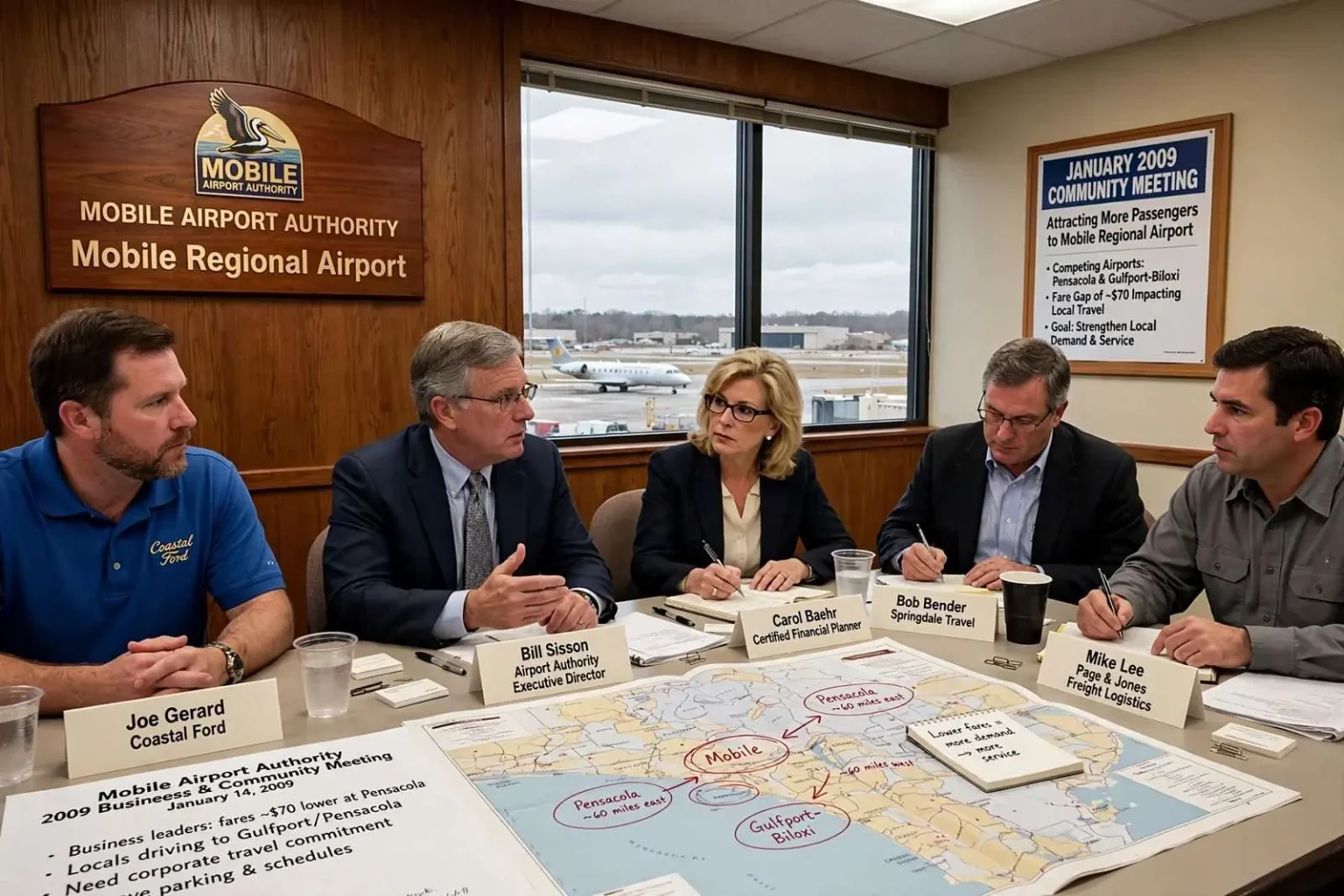
Mobile Airport Authority leaders met with business and community representatives in 2009 to discuss how Mobile Regional Airport could attract more passengers and strengthen local air service. The discussion centered on a common concern: many travelers were choosing airports in Pensacola or Gulfport because they found lower fares. The meeting brought together airport officials and representatives of the local business community to examine why Mobile-area flyers were driving out of the market and what could be done to win them back.
Business representatives said the price gap could influence where companies and their employees chose to fly. For corporations weighing Mobile against competing cities for expansions and relocations, the convenience and cost of air service rank among the practical factors that get examined alongside taxes, labor and infrastructure. Every passenger who drives to Pensacola or Gulfport is, in effect, a vote for another region’s air service — and business leaders in Mobile understood the arithmetic.
Fares and flight choices Joe Gerard of Coastal Ford said his company’s employees often considered nearby airports because of ticket prices. Bob Bender of Springdale Travel estimated that Pensacola fares averaged about $70 less than comparable flights from Mobile. Airport Authority Executive Director Bill Sisson said lower fares were central to drawing passengers back to Mobile. His view was that stronger local demand could encourage airlines to add service and compete more aggressively on prices.
The dynamics the participants described were familiar across small and mid-sized airline markets. Carriers price routes based on competition and demand, and an airport without low-fare carriers or with thin schedules often shows a fare premium that grows self-reinforcing: higher fares drive locals to neighboring airports, which weakens demand, which discourages airlines from adding seats. Breaking that cycle was the goal Sisson and the authority set for themselves in the discussions.
Airport experience and business recruitment. Participants also discussed ground transportation, terminal access and parking. Carol Baehr, a certified financial planner, pointed to the experience of solo travelers moving luggage through the parking area. Mike Lee of Page & Jones freight logistics said scheduling could be as important as price for business travelers. Bender said air service mattered beyond individual trips. Companies considering a move to Mobile would look at flight availability and prices alongside factors such as schools and other local infrastructure.
The 2009 meeting captured a continuing regional challenge: how Mobile Regional could retain passengers when nearby airports offered different combinations of fares, schedules and service. The conversation linked passenger decisions to broader economic-development goals for the Mobile area.
The Airport and Its Market
Mobile Regional Airport, operated by the Mobile Airport Authority, serves as the commercial airport for the city of Mobile and the surrounding Gulf Coast region, with a terminal surrounded by woodlands in western Mobile County. The airport grew out of the region’s decision generations ago to move commercial aviation from the cramped downtown Bates Field to a modern facility with room to expand, and by 2009 it offered nonstop service on the major trunk routes — Atlanta, Dallas, Houston, Charlotte and other hubs — through the carriers of the day.
The market challenge the 2009 meeting addressed was geographic. Mobile sits within a two-hour drive of multiple commercial airports: Pensacola to the east, Gulfport-Biloxi to the west, and the New Orleans metro not much farther. Travelers in the central Gulf Coast have always been able to shop among several airports, and low-fare carriers’ presence at neighboring fields gave Mobile’s catchment area alternatives that weaker markets never faced. A family of four flying on vacation could save hundreds of dollars by driving an hour or two, and corporate travel departments noticed the same math.
Gulfport-Biloxi, benefiting from the casino-driven growth of the Mississippi Gulf Coast, had attracted low-fare service that siphoned price-sensitive travelers from across the region, while Pensacola’s beach market supported strong tourist traffic that sustained competitive fares. Mobile Regional’s passenger counts reflected the drain — locals who would have filled Mobile flights were boarding at other terminals, along with the parking and rental car revenue that follows them.
Why Local Demand Matters to Airlines
Sisson’s argument — that stronger local demand would encourage airlines to add service and compete on price — reflects how airline route planning actually works. Carriers assign aircraft where load factors justify them, and an airport whose residents consistently fill its seats becomes a candidate for additional frequencies, larger aircraft and new destinations. An airport whose passengers drive elsewhere sends the opposite signal, and airlines have historically removed service from markets that underperform, deepening the original problem.
That is why the authority courted the business community rather than simply marketing to travelers. Employers can direct corporate travel, choose to book from Mobile as a condition of their travel policies, and lobby carriers directly as high-volume customers. The participants at the 2009 meeting — a Ford dealership, a travel agency, a freight forwarder, a financial planner — represented exactly the types of enterprises whose daily operations depend on air service and whose choices tip the market.
The scheduling issue Mike Lee raised matters as much to logistics firms as to passengers. Freight that misses a same-day connection costs shippers real money, and the era’s hub-and-spoke system meant that early departures and late arrivals carried a premium for business travelers who needed a full day at their destination. An airport’s schedule, not just its fares, determined whether a business traveler could fly out and back in a day — a capability Mobile companies used routinely for trips to Atlanta and Texas.
The Passenger Experience Question
Baehr’s observation about solo travelers wrestling luggage through the parking area pointed to a dimension of the competition that fares alone could not explain: convenience. Mobile Regional’s parking configuration at the time required many travelers to haul bags from distant spaces to the terminal, an experience that contrasted with newer terminals elsewhere where garages adjoin the ticket counters. Small frictions accumulate into passenger decisions, and airport administrators who track where their local travelers go consistently find that parking, security wait times and terminal navigation weigh heavily in the choice.
The authority had already invested in terminal improvements and would continue to refine the passenger experience in the years after the 2009 discussions, but the meeting’s participants made clear that the airport’s product had to compete on every dimension — price, schedule and ease — not just one. A $70 average fare gap could not be waved away by friendlier parking, but neither could lower fares alone win back travelers who found the total experience wanting.
The conversation also reflected the economic moment. The 2009 meeting took place during a punishing recession for the airline industry, when carriers were cutting capacity nationwide and small markets were losing routes. Airlines that year parked aircraft, dropped unprofitable cities and merged in waves, and airports like Mobile Regional had to defend the service they had before dreaming of expansion. Against that backdrop, community support for the airport was not just desirable but essential to preserving what remained.
The Broader Economic Development Connection
Bender’s point about corporate recruitment captured the meeting’s highest stakes. Site selection consultants who evaluate cities for corporate projects score air service as a component of quality of life and business logistics; a metro with thin schedules and expensive fares loses points in those evaluations, particularly for companies whose executives travel frequently. Mobile, then in the midst of courting major industrial projects along its riverfront and at the aeroplex at Brookley, had a direct interest in the strength of its air service.
The connection ran both ways. Economic development success feeds air service, since a growing employment base produces more business travel, and the region’s later industrial wins — including the transformation of Brookley into an aerospace manufacturing campus that drew international attention to Mobile — would eventually reshape the conversation about the region’s aviation infrastructure that the 2009 participants had begun.
The airport authority itself has long been one of Mobile’s key economic development players, controlling thousands of acres around its facilities and marketing sites to aviation-related businesses. Its leaders understood the passenger conversation as part of a larger strategy: an airport that anchors a thriving aviation employment base, serves a growing region and offers competitive air service reinforces every other economic development effort the community makes.
The 2009 meeting ended without dramatic announcements, but its themes — fares, schedules, passenger experience and corporate support — have remained the levers Gulf Coast communities pull in the airline market ever since. For Mobile, winning back the travelers who drove to Pensacola and Gulfport required sustained community commitment, and the business leaders who sat down with authority officials that year committed their companies to making the case: fly Mobile first.