Southern Living Named Fairhope Among the South’s Best Small Towns in 2009
Southern Living ranked Fairhope No. 2 among the South’s best small towns in 2009, citing its charm, hospitality, scenery and recreation.
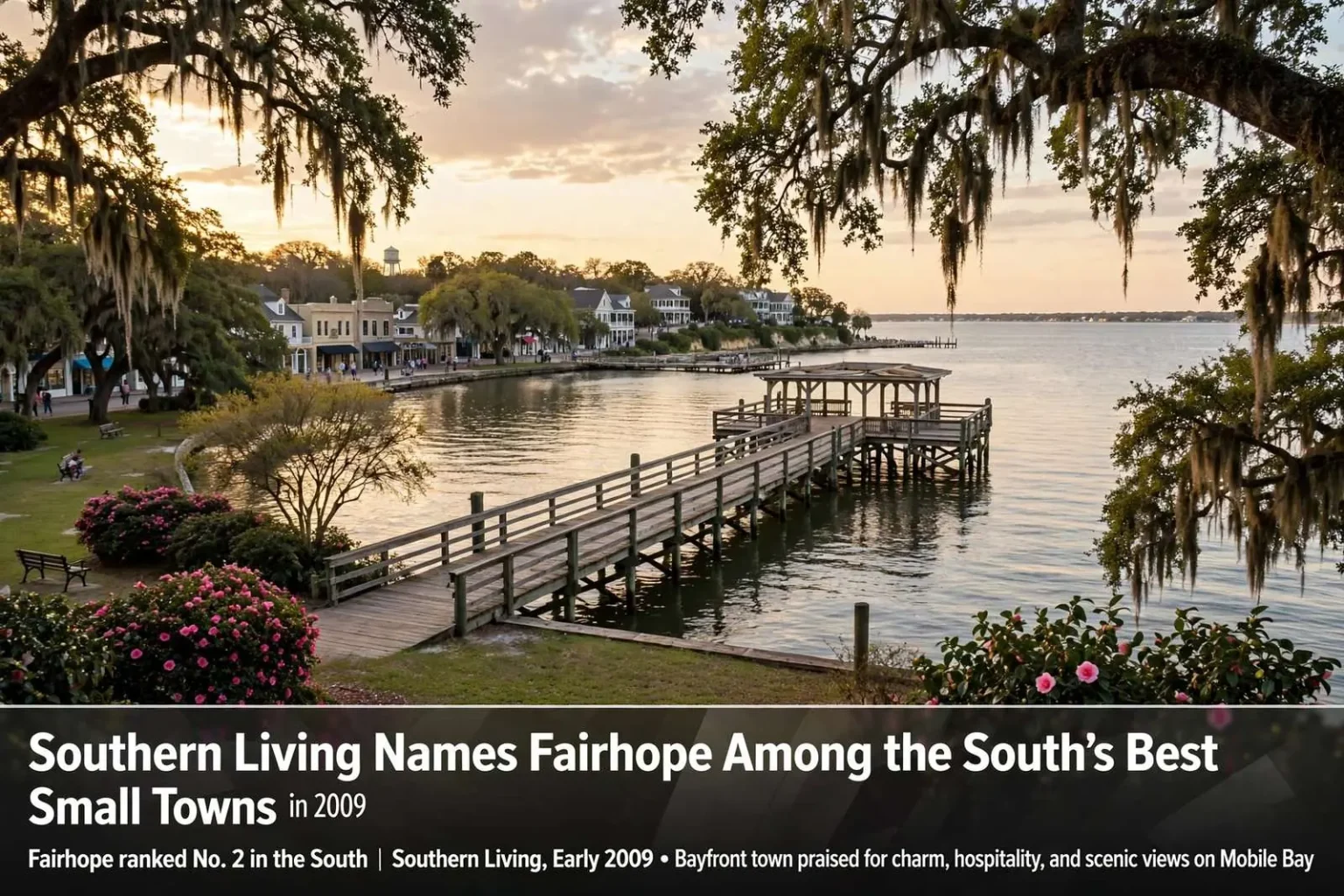
Southern Living magazine named Fairhope one of the South’s best small towns in early 2009, ranking the Eastern Shore community second in its list. The publication cited Fairhope’s Southern charm, hospitality, scenic appeal and recreational opportunities — a combination that has long made the Baldwin County city a destination for travelers across the Gulf Coast and beyond.
The recognition gave residents and visitors another reason to celebrate a city already known for its bayfront setting, downtown shops and distinctive neighborhoods. For a community of roughly 15,000 people perched on the bluffs above Mobile Bay, a second-place ranking in the South’s most widely read regional magazine was both an honor and a reflection of something residents had long taken for granted: that Fairhope’s mix of walkability, natural beauty and civic pride stands out even in a region crowded with picturesque towns.
Southern Living’s editors have built much of the magazine’s identity around the search for authentic Southern places, and its small-town rankings carry real weight in travel circles. Towns that appear on the list tend to see the effect quickly — in bed-and-breakfast bookings, in weekend traffic on Main Street, and in the steady drumbeat of inquiries from visitors planning Gulf Coast trips. Fairhope’s ranking put it in the company of the region’s best-known small-town travel destinations, places whose names function as shorthand for a certain idea of the South.
Recognition for Fairhope and Point Clear
Visitors described Fairhope’s cottages, views of Mobile Bay and atmosphere as a contrast to more heavily built coastal destinations. Where high-rise condominium rows define much of the Gulf’s shoreline, Fairhope’s waterfront is a municipal pier and park, shaded streets of historic homes, and a downtown of independent bookstores, galleries and restaurants. The city was founded in 1894 as a utopian single-tax colony, and that unusual origin left a legacy of public spaces and civic institutions that shaped the town’s character long before travel magazines came calling.
The magazine’s reach extended down the shore. Southern Living also included the Grand Hotel Marriott Resort, Golf Club and Spa in nearby Point Clear among the best hotels in the South. The Grand, a resort whose history stretches back to 1847, sits on its own peninsula of live oaks and formal gardens along Weeks Bay’s edge, and it has anchored the Eastern Shore’s reputation as a retreat destination for more than a century and a half.
General Manager David Clark said the recognition was significant because the hotel appeared alongside prominent resorts from across the region. For a property that markets itself as the flagship of the Eastern Shore, inclusion in the magazine’s national-field ranking was a mark of standing measured not against local competitors but against the finest resort addresses from the Carolinas to Texas.
Other Gulf Coast Honors
The magazine’s listings also recognized other nearby destinations, a reminder that the 2009 honors belonged to the whole upper Gulf Coast rather than a single town. Gulf Shores and Orange Beach were included among the South’s beach and family destinations, the twin resort cities at the end of Alabama’s 32 miles of shoreline whose sugar-white sand beaches draw millions of visitors a year. The National Shrimp Festival in Gulf Shores appeared among notable festivals and fairs — the October tradition that fills the boardwalk at the Gulf State Park Pavilion with shrimp boiled, fried, and served a dozen ways, along with music and arts vendors.
Bellingrath Gardens received recognition among public gardens. The 65-acre estate in Theodore, just across the Mobile County line, began as the private garden of Coca-Cola bottler Walter Bellingrath and his wife Bessie in the 1930s and has since become one of the Gulf Coast’s signature attractions, famous for its azaleas in spring and its Magic Christmas in Lights display each holiday season.
Taken together, the listings sketched a travel region with unusual range: a literary bayfront town, a grand Victorian resort, family beach cities, a working waterfront festival, and a world-class garden, all within roughly an hour of one another. South Alabama’s tourism promoters have long argued that combination is the area’s chief selling point — the ability to base a vacation on the Eastern Shore or the beach and reach the others without ever leaving the region.
Tourism’s Place in the Local Economy
The 2009 rankings highlighted how Fairhope and the surrounding Gulf Coast communities used hospitality, recreation and distinctive local character to compete for visitor attention. Tourism is a pillar of the Baldwin County economy, supporting restaurants, shops, marinas, golf courses and the short-term rental market that seasons the area’s real estate values. Recognition from a magazine with Southern Living’s circulation translates directly into the kind of visitor who stays longer and spends more — travelers who come for a town’s character rather than simply its beach access.
The timing carried its own weight. In early 2009, the national recession had squeezed discretionary travel across the country, and destinations that stayed visible in print were better positioned when families began planning trips again. Fairhope’s appearance in the ranking arrived as a signal that the town’s appeal was durable enough to market through a downturn.
For local businesses, the honor functioned as advertising no budget could buy. Downtown shop owners reported visitors who arrived carrying the magazine’s list, treating it as an itinerary. The city’s bed-and-breakfasts and its waterfront restaurants alike benefited from the heightened profile, and civic leaders cited the ranking in the ongoing conversation about how Fairhope could grow without eroding the charm that earned it.
A Lasting Mark on the Eastern Shore
More than a decade later, the 2009 list remains a touchstone in how Fairhope tells its own story. The city has since collected similar honors from other publications, but the Southern Living ranking was an early national seal on what locals already believed — that the bluff-top views of Mobile Bay, the flower-lined streets of the downtown, and the century-old tradition of the Fairhope Single Tax Colony’s public parks add up to something rare.
The ranking also captured the Eastern Shore at a moment of transition. Baldwin County was among Alabama’s fastest-growing counties through the 2000s and 2010s, and the growth that followed — new neighborhoods, expanded schools, busy segments of Highway 98 — has kept the question of preserving small-town character at the center of local politics. Honors like Southern Living’s cut both ways: they validate a community’s identity while raising the stakes of keeping it.
This account records the magazine’s rankings and the local response at the time — a snapshot of the moment when the travel press confirmed what generations of Mobilians and Eastern Shore residents had long held: that Fairhope, with its pier, its pubs and its view across the bay, belongs on any honest list of the South’s best small towns.
The Fairhope Story Behind the Ranking
Fairhope’s appeal to a magazine like Southern Living rests on foundations laid more than a century earlier. The city was established in 1894 by a group of Midwestern reformers who founded a single-tax colony inspired by the economist Henry George, giving the new settlement both its name — settlers believed the site had a “fair hope” of success — and its unusual civic DNA. The Single Tax Corporation’s legacy endures in the city’s public parks, its waterfront access, and a downtown planned for pedestrians rather than automobiles.
That heritage produced the physical traits the magazine praised. The Fairhope Pier and park anchor a bayfront where residents watch sunsets across Mobile Bay toward the Mobile skyline. Knobby cypress and live oaks shade streets lined with cottages in a range of Southern styles. The downtown’s independent shops, the Fairhope Museum of History, and the city’s long-standing arts colony — drawn to the area in part by its climate and views — give visitors an afternoon’s itinerary without ever touching a chain storefront.
Writers have long been part of the town’s self-image. Sherwood Anderson and Upton Sinclair were among the figures who spent time in the colony’s early years, and Fairhope’s bookshops and libraries still trade on that literary inheritance. It is the kind of accumulated character that cannot be built quickly, which is precisely what small-town rankings exist to find.
The Grand Hotel and Point Clear
Point Clear, the quiet resort community just south of Fairhope along the bay, owes its place on the regional map largely to the Grand Hotel. Opened in 1847 as a two-story boarding house for vacationers escaping Mobile’s summers, the Grand grew into a 213-room resort surrounded by live oaks, camellia gardens and the Lakewood Golf Club’s courses. Its Monday night fireworks over Mobile Bay became a tradition for generations of Gulf Coast families, and its reunion of World War II veterans in later decades drew national attention.
By 2009 the property operated as part of Marriott’s upscale Renaissance portfolio while retaining the Grand name, and its inclusion among the South’s best hotels confirmed what the regional market already knew: the Eastern Shore could compete for the destination-resort traveler, not just the weekend visitor. The resort’s presence supports hundreds of local jobs and feeds business into Fairhope’s shops and restaurants, tying the two communities’ visitor economies together.
How Rankings Shape a Town
Lists like Southern Living’s do more than flatter. They shape expectations — of visitors who arrive looking for the charm described in print, and of residents who weigh growth against the identity that drew the praise. Fairhope’s subsequent decade tested that balance repeatedly, as Baldwin County’s growth brought new rooftops and traffic to a city whose plan governance, including its longtime reliance on the single-tax land holdings, has wrestled with how to absorb change without losing character.
The 2009 recognition arrived, in that sense, as both a celebration and a warning worth rereading: the qualities that make a small town worth ranking are the same ones most easily loved to death. For now, the magazine’s verdict stood as the Eastern Shore’s most visible trophy of the era — second-best small town in the South, according to the publication that wrote the book on the subject.