

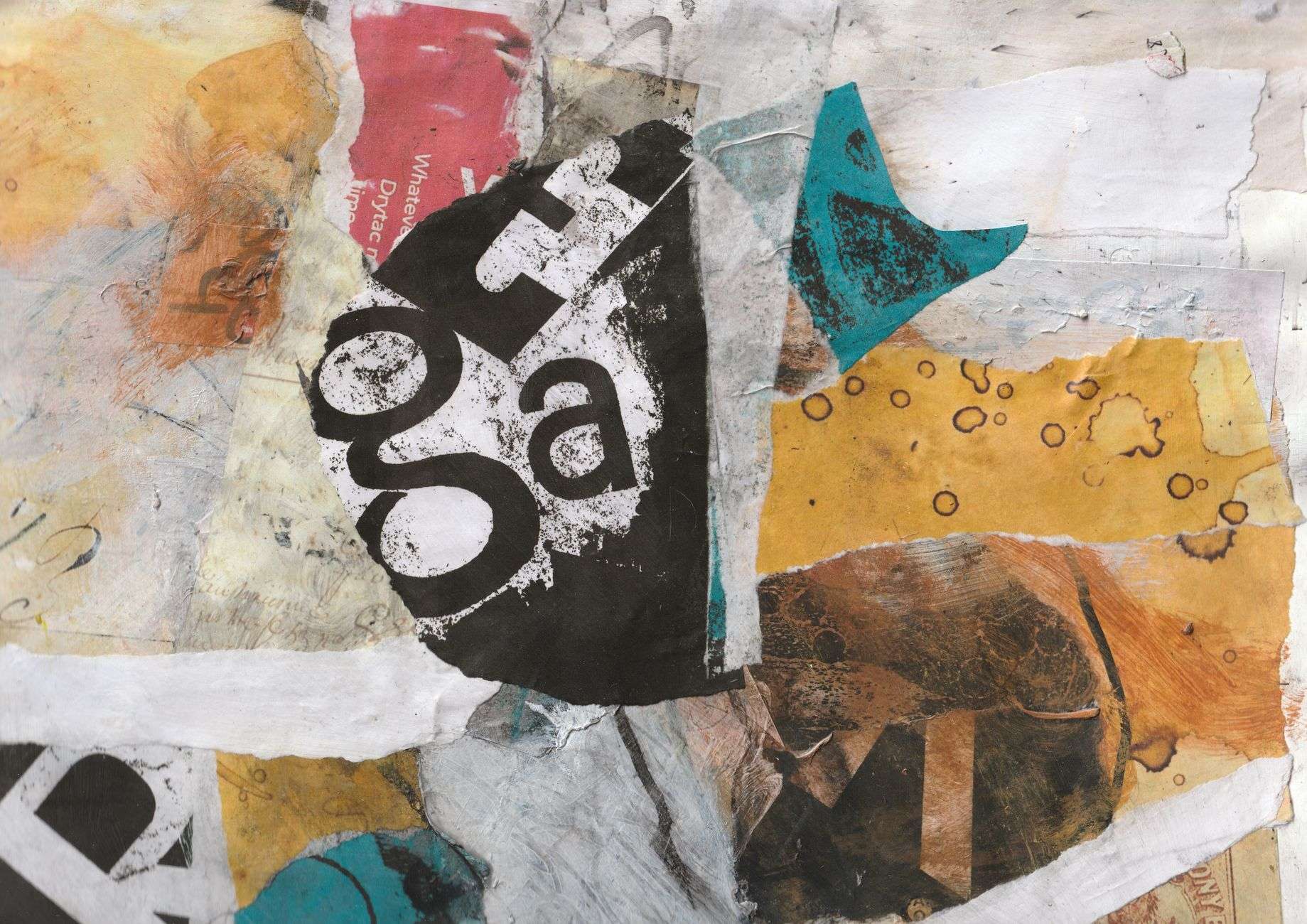
In the fall of 2009, downtown Mobile’s arts scene was in the middle of a quiet but noticeable expansion, with new galleries, coffee-shop art nights and the monthly LoDa ArtWalk drawing a growing circle of local painters, printmakers and mixed-media artists into public view. Among the busiest of that group was Ryan Jetten, a Mobile-based collage artist and cartoonist whose work that year had appeared everywhere from downtown restaurant walls to the cover of a published poetry collection.
Jetten sat down that September for an interview about his art, his long-running comic strip and his plans for the months ahead — a conversation that captured a snapshot of a working artist deeply embedded in Mobile’s do-it-yourself creative community.
From Comic Strips to Collage
Jetten’s move into fine-art collage came by way of a suggestion from a fellow Mobile artist. He said Nikki Burkett, whom he described as one of the best artists in the city, encouraged him to try his hand at collage work. He began in earnest on January 1, 2007, and within a few years had built out an entire body of work under the name the MakeWorldGooder Factory Tour.
That series had, by the time of the interview, been the focus of three solo shows around Mobile: one at Liquid Sushi Lounge in June 2009, another at Serda’s Coffee Co. in July 2009, and a third that August at the Mobile Arts Council’s Skinny Gallery, where Jetten said he hung 120 individual pieces. He also said his collages had been featured in four separate shows at Satori Coffee — three curated by Sarah Parvadeh and one by Ashleah Pinquite — and that his art was hanging, at the time, at both the Blind Mule Restaurant and the Crescent Theater, two well-known gathering spots in the downtown core. He also curated a June ArtWalk show at the Blind Mule.
Jetten described himself as a member of the Mobile Arts Council, the nonprofit organization that has served for decades as one of the primary hubs connecting the city’s visual and performing artists with exhibition space, funding opportunities and public programming. He said one of his collages, titled “Puppeteer and Audience,” was selected for the cover of Lisa Samuels’ poetry collection “The Invention of Culture.”
Community and Education Work
Beyond his own exhibitions, Jetten described a range of community-facing projects. He said he participated in a visiting artist program at Pillans Middle School, spending two days teaching students how to make collages and two more days guiding them through building animal sculptures out of scavenged garbage materials. The resulting student artwork, along with pieces from other visiting artists and from students at Dunbar Middle School, was later displayed together at the Mobile Arts Council’s Skinny Gallery.
School-based visiting artist programs of this kind are a common tool used by arts councils and school systems around the country to expose students to working artists and hands-on creative techniques that may not otherwise fit into a standard classroom curriculum. They are typically funded through a mix of grants, local arts council budgets and school enrichment funds, and often culminate in a public exhibition of student work, mirroring the format Jetten described.
Jetten also said he spent five days volunteering with the Boys and Girls Club, where he helped build what he called the Living Marina, a community garden project. Community garden initiatives tied to youth organizations were increasingly common along the Gulf Coast in the years following Hurricane Katrina, as neighborhood groups looked for low-cost ways to green vacant lots and give young people hands-on projects during after-school and summer programming.
Collage as a Medium
Collage — the practice of assembling art from cut and pasted paper, fabric, photographs and other found materials — has a long pedigree in modern art, tracing back to early 20th-century artists such as Pablo Picasso, Georges Braque and Kurt Schwitters, who began incorporating newspaper clippings, wallpaper scraps and other everyday materials into their paintings. The technique later became closely associated with Dada and Surrealist artists, and by the mid-20th century had become a staple of pop art and underground zine culture alike, prized for its low material cost and its ability to repurpose mass-produced imagery into something new. Jetten’s description of his own progression — starting with comic-style collages before moving into large-scale gallery pieces built from found materials — fits a well-established arc for self-taught and DIY-oriented collage artists, many of whom move between commercial illustration, zine publishing and gallery exhibition over the course of a career.
Mobile’s own coffee-shop and small-gallery circuit, which by 2009 included venues such as Satori Coffee, Serda’s Coffee Co. and the Mobile Arts Council’s Skinny Gallery, reflected a broader national trend of that decade in which independent coffee shops and small storefronts increasingly doubled as informal art galleries, offering emerging artists low-barrier exhibition space outside of traditional commercial galleries or museums.
The Squares
Alongside his visual art, Jetten has long produced a comic strip called The Squares, which he said originated in Tuscaloosa, Alabama, and had been running since 2000. He described it as a minimalist, single-panel gag strip that had appeared in both print and online formats, and said it could be found at www.squarescomics.com.
By 2009, Jetten said, the strip had been compiled into 50 individual zine booklets, each containing 24 strips. The first five booklets were later gathered into a larger collection titled “The Squares: The Original Comic Strip Soundtrack Recording, Vol. 1,” featuring 120 strips paired with an hour-long compilation CD of local and regional music. Booklets six through ten were similarly compiled into a second volume, which came with its own hour-long regional music compilation. Pairing self-published comics with local music compilations was a distinctive touch that tied Jetten’s work directly into Mobile’s broader independent music and zine culture of the period, when small, DIY print runs and burned CDs were still a common way for local artists and musicians to share work outside of traditional retail channels.
Where His Work Could Be Found
Jetten said he was also producing handmade recycled notepads, using old record album sleeves, VHS boxes and other salvaged materials as covers. At the time of the interview, he said those notepads were available at Satori Coffee, the Crescent Theater and the Paper Wasp — a stationery and art-supply shop located on Dauphin Street at Cathedral Square, in the heart of downtown Mobile’s historic district. He also said he set up a table selling the notepads in front of the Mobile Arts Council building during every ArtWalk.
The LoDa ArtWalk, held on the second Friday of most months in Mobile’s Lower Dauphin Street Historic District, has for years served as one of the city’s central recurring events for local galleries, shops and independent artists to show and sell work to the public. Vendors, live music and open gallery hours are typical features of the monthly event, which is organized in coordination with the Mobile Arts Council and area business owners.
Looking Ahead in 2009
At the time of the interview, Jetten said he was working on a large, door-sized collage that would incorporate contributions from between 60 and 100 local and regional artists — a collaborative approach that reflected the collage medium’s natural fit for combining many small contributions into a single unified piece.
He also said he planned to be heavily involved with the Downtown Creative Wellness Foundation, which he described as a planned multifunctional art and wellness space emphasizing education and community. He named a long list of other Mobile-area artists he said would be involved in the effort, including Zach Depolo, Trey Lane, Will Fawcett, Sarah P., Katie Moody, Jimmy Lee, Nikki Burkett, Ashelea Pinquite, Michelle Brown, Courtney Matthews, Morgan Johnson and April Hopkins. He said the group intended to put on a fashion show on October 2 and a Haunted Hospital fundraiser later that October.
On Mobile’s Arts Scene
Asked what he would like to see change in the Mobile Bay area’s artistic environment, Jetten said he was largely satisfied with the trajectory already underway, noting simply that the local arts scene was growing and that he considered that a good thing. Mobile’s downtown arts and entertainment district has continued to be shaped over the years by organizations such as the Mobile Arts Council and a rotating set of independent galleries and coffee shops that have hosted local exhibitions.
Asked for any spiritual or philosophical advice for fellow Coastal Alabamians, Jetten offered a characteristically brief and wry answer: meditate, and read George Herriman’s “Krazy Kat” comics. Herriman’s “Krazy Kat,” which ran from 1913 to 1944, is widely regarded by comics historians and cartoonists as one of the most influential and artistically ambitious American comic strips ever published, admired for its surreal, shifting desert landscapes and its playful, poetic use of language — a fitting touchstone for a cartoonist and collage artist working in his own minimalist, DIY tradition.
This interview reflects Jetten’s own account of his work and activities as of September 2009. Readers interested in the current state of The Squares or Jetten’s collage work are encouraged to check www.squarescomics.com or contact the Mobile Arts Council directly for up-to-date information on local exhibitions and programming.