Mobile County Investigates After Substance Found in Commissioner Nodine’s County Truck
Mobile County Sheriff Sam Cochran says a county worker found a green, leafy substance in a truck driven by Commissioner Stephen Nodine; investigation.
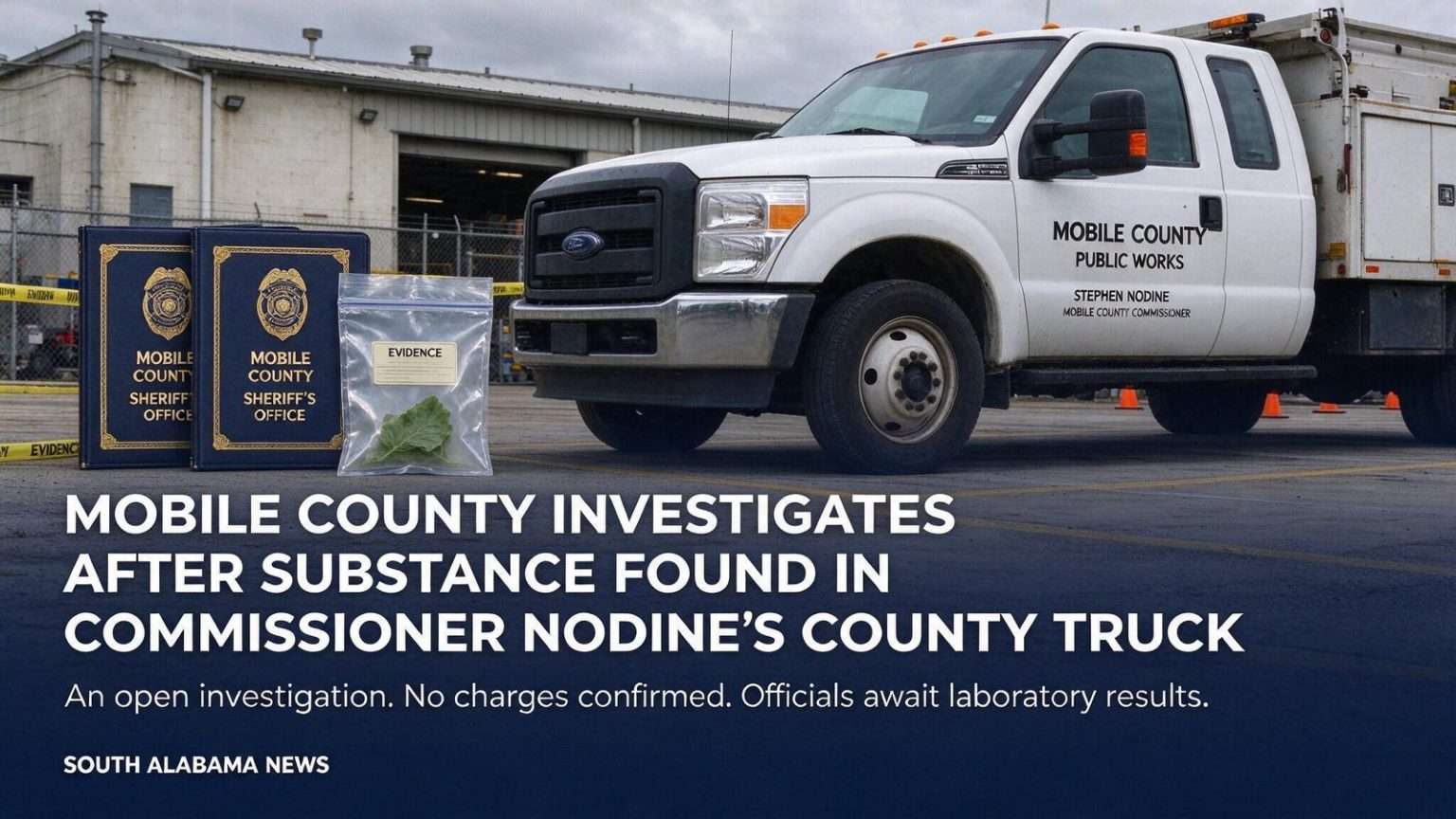
Mobile County officials are investigating after a county employee found what was described as a “green, leafy” substance inside a county truck driven by Mobile County Commissioner Stephen Nodine, according to Mobile County Sheriff Sam Cochran. The disclosure set off one of the more sensitive investigations a county government can face — a question about evidence involving an elected official’s assigned vehicle, handled by the county’s own law enforcement leadership.
The discovery was made by a county worker at a county maintenance facility, Cochran said. The setting matters: county vehicles rotate through maintenance yards routinely for service, and the substance was found not during a traffic stop or a targeted search, but in the ordinary course of a county employee’s work on a county-owned truck. That procedural origin — a routine facility, a routine employee, an extraordinary find — is what pushed the matter from rumor into a documented law-enforcement investigation.
The substance has not been publicly confirmed through lab testing, and officials cautioned that further information is needed before drawing conclusions about what was found or how it got there. The caution was deliberate and, investigators would say, necessary: visual identifications of suspected controlled substances are notoriously unreliable, chain-of-custody and laboratory analysis are required before any finding can support action, and nothing about the truck’s usage patterns was known at the time of the discovery. Public speculation about the substance — or about how it might have come to be in the vehicle — ran well ahead of the evidence the Sheriff’s Office actually possessed.
What Officials Have Said
Sheriff Cochran’s office has not announced any arrest or charges in connection with the discovery, and Nodine has not been charged as of this report. That distinction — between an investigation being public knowledge and any legal conclusion existing — framed the entire story as it developed. An announcement of a discovery is not an accusation; a charging decision requires evidence gathered, reviewed and presented, and as of the reporting, none of that had occurred.
Investigators are continuing to review the matter, and the Sheriff’s Office is expected to release additional details as the investigation proceeds. The pace of such investigations is governed by the work itself: laboratory testing takes time, interviews have to be completed, and the result of any review determines whether a matter is closed, referred to a prosecutor, or pursued further. Until then, officials have released only the minimum facts needed to confirm the investigation exists.
Nodine, an elected Mobile County commissioner, has not issued a public statement responding to the discovery. His silence left the public account of the matter entirely in the hands of the Sheriff’s Office, and it meant the story’s known facts remained limited to what investigators chose to confirm: a county employee, a maintenance facility, a substance inside a county truck, and an open investigation.
Why It Matters
Because the truck in question is a county-owned vehicle, the incident has drawn scrutiny from residents watching how the Sheriff’s Office and county officials handle a matter involving an elected official’s take-home vehicle. County vehicles assigned to commissioners are public property, funded by taxpayers and used for official business, and any question about their use lands squarely in the territory of public accountability. Residents expect the same law-enforcement standards applied to an elected official’s county vehicle as to any other — no more, no less — and both overreaction and underreaction carry political costs.
The structure of Mobile County government sharpens the point. The county is governed by a three-member commission whose members administer both policy and, in the commission form of government, significant operational portfolios — roads, drainage and county facilities among them. A commissioner’s assigned truck is therefore not a perk in the abstract; it is equipment tied to the administration of public works, which makes any evidence found in it a matter of legitimate public record and interest.
The Sheriff’s role in the matter carries its own institutional weight. The Mobile County Sheriff’s Office is an independent, separately elected law-enforcement agency — not a department under the commission’s authority — which means Sheriff Cochran’s office investigates free of the commissioner’s oversight. That structural independence matters in cases touching county leadership: the investigating agency answers to the county’s voters, not to the officials it may be investigating, and the separation is what allows residents to expect an even-handed process.
County-employee discoveries of this kind also raise procedural questions the public rarely sees: who documents the find, how the evidence is preserved, who is notified and when. The account that has emerged — a maintenance facility worker finding the substance and the matter reaching Sheriff Cochran’s office — suggests the standard channel functioned: a county employee reported a finding on public property, and law enforcement took it from there. That orderly handoff is how the system is supposed to work when something unexpected turns up in a public vehicle.
What Comes Next
South Alabama News will continue to follow the investigation and report on any official findings, charges or statements as they become available. Until the Sheriff’s Office releases more — laboratory results, investigative conclusions or a decision about charges — the public record consists of the confirmed discovery, the open investigation and the absence, so far, of any accusation.
For Mobile County residents, the case is a test of process as much as a story about one vehicle. The county’s institutions — an independent sheriff, a commission form of government, a civil-service workforce that documented what it found — are all now part of the same sequence. How each performs will tell residents what to expect the next time a question about a public official’s public property requires an answer from public investigators.
The Take-Home Vehicle Question
Take-home vehicles sit at a recurring intersection of public administration and public trust. Counties assign vehicles to officials and department heads for legitimate operational reasons — emergency response, site inspections, the practical demands of overseeing roads and facilities spread across a county that stretches from the Mississippi line to the Gulf. But each assignment also places public property in private hands around the clock, which is why any question about what happens in or with an assigned vehicle draws outsized attention. The rules that govern use, the logs that track it and the standards officials are held to when something goes wrong are all matters of legitimate public interest.
Nodine’s district includes areas of west Mobile County, and his commission role places him over operational responsibilities that make his county vehicle a working tool rather than a symbolic perk. That context cuts both ways in the public discussion: it explains why the vehicle is assigned to him at all, and it raises the bar for how carefully any evidence found in it should be examined and explained. Residents evaluating the case are, in effect, evaluating whether the county’s systems of vehicle assignment, employee reporting and law-enforcement independence all function as designed.
The sheriff’s public identification of both the substance’s description and the elected official involved — rather than a vague announcement about a county vehicle — reflected the reality that the story was already public knowledge in the county and that transparent confirmation from the investigating agency serves accuracy better than silence. Once a matter involving a public official’s public vehicle is in circulation, the sheriff’s confirmation of basic facts narrows the space for rumor; the laboratory process then determines what those facts mean.
The gap between confirmed facts and public speculation is where cases like this one live for weeks. The confirmed facts here are narrow: a county employee, a maintenance facility, a description of a substance, a commissioner’s assigned truck, an investigation with no charges. Everything beyond that — what the substance is, how it came to be in the truck, what, if anything, follows — belongs to the evidence, and officials have drawn exactly that line in their public statements. The county’s residents, its employees and its elected officials are all waiting on the same thing: the results of the work now underway.
The county maintenance facility where the discovery occurred is one of the yards where Mobile County’s fleet of trucks and heavy equipment is serviced and stored. Fleet workers there see the county’s vehicles come and go daily, and their role in this case — noticing something wrong and reporting it — is the kind of unglamorous public service that accountability actually depends on. A county is only as clean as its willingness to let a line employee’s find become a sheriff’s case file.
As the investigation proceeds, the measurable standards are simple: whether the laboratory work is completed and made known, whether the Sheriff’s Office updates the public when it can, and whether any conclusion — clearing evidence, charges, or an administrative referral — arrives through the proper channels rather than through leaks. Mobile County’s institutions have handled politically sensitive matters before, and the sequence now underway will be measured against that history by a public that has learned, over decades, to watch its county government closely.