Mobile Earned a StormReady Designation From the National Weather Service
The city of Mobile was named StormReady by NOAA's National Weather Service, a certification that a community meets federal standards for warning systems, communication and severe weather planning.
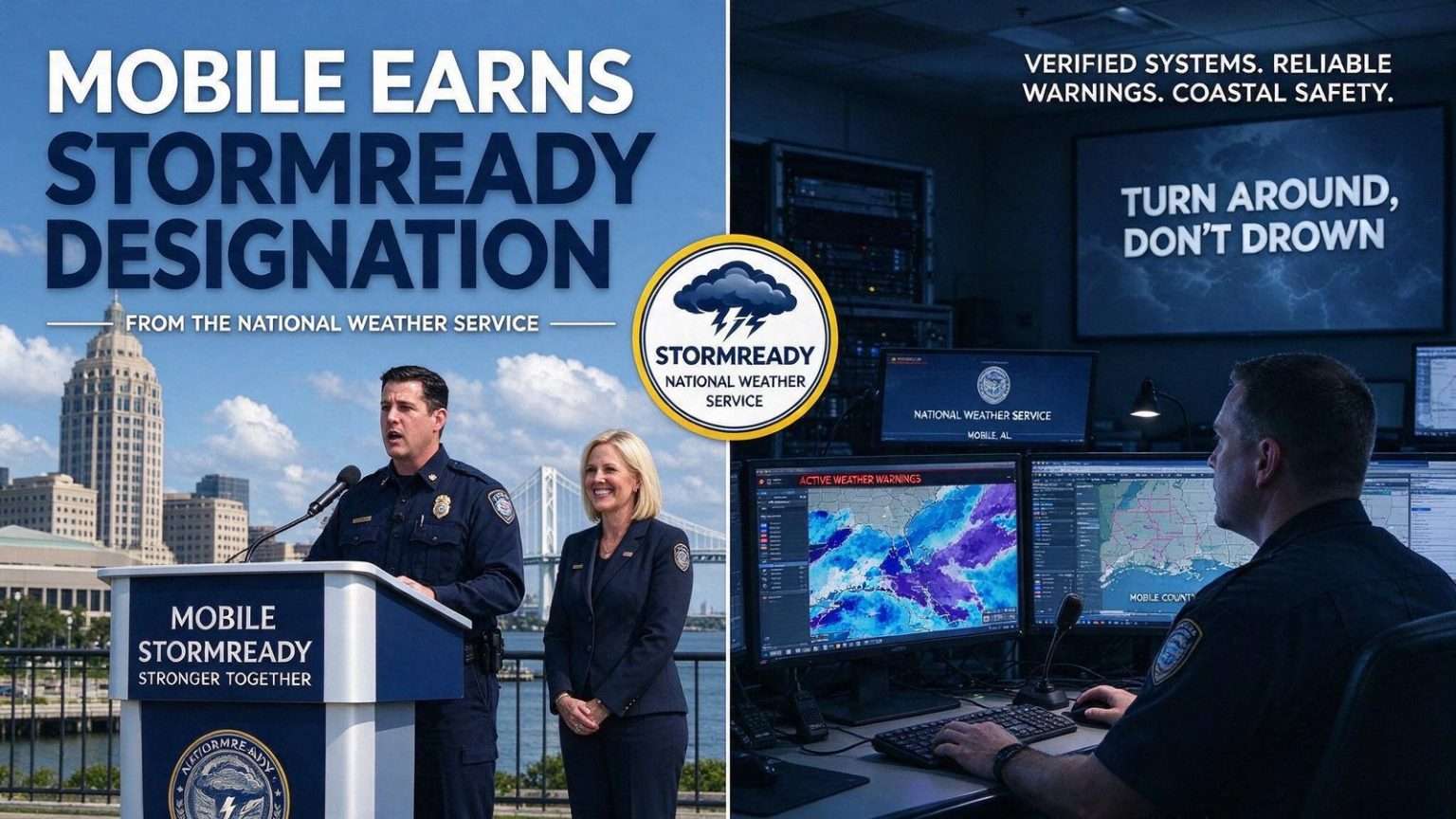
The city of Mobile was named StormReady by the National Oceanic and Atmospheric Administration’s National Weather Service, a designation that certifies a community has the communication and safety systems in place to warn its residents and protect property when severe weather arrives. The recognition landed at the beginning of hurricane season, in a city that needed no reminder of what was at stake.
StormReady is not an award for surviving bad weather — it is a verification that the unglamorous machinery of warning actually works. For a Gulf Coast city, the certification amounts to an outside audit of the systems residents depend on in the hours when a storm is no longer a forecast but a fact.
What StormReady Actually Means
The StormReady program was created to arm American communities with the communication and safety skills they need to save lives and protect property. To earn the designation, a community must meet guidelines established by the National Weather Service in partnership with federal, state and local emergency management professionals. The certification is not ceremonial, and it is not permanent: communities must maintain their systems and renew their recognition on a recurring cycle, which keeps the standards from decaying into wall plaques.
In general terms, the program requires that a community demonstrate: a 24-hour warning point and emergency operations center capable of receiving weather information at any hour; multiple ways to receive National Weather Service warnings and to alert the public; local monitoring capability for severe weather conditions; community preparedness programs, including public education and safety talks; and a formal hazardous weather plan, with exercises and regular contact between local officials and the Weather Service.
In other words, the designation says that when the Weather Service issues a warning at three in the morning, somebody in Mobile is awake to receive it and knows exactly what to do next. That single assurance — staffed, trained, reachable around the clock — is the heart of the program, and it is precisely the link that has failed in disasters elsewhere.
Why This City
No community in Alabama had a more direct education in severe weather than Mobile. Hurricane Frederic in 1979 remade the city’s skyline and its building codes, leveling or damaging thousands of structures and setting in motion the modern era of coastal construction standards on the Gulf Coast. Hurricane Georges came in 1998, flooding neighborhoods and testing the recovery systems Frederic’s aftermath had built. Hurricane Ivan struck in 2004, cutting across the region with destructive winds and knocking out power across the metro area.
Hurricane Katrina, in August 2005, pushed a surge into the Mobile River, flooded downtown streets, tore up the causeway and devastated the fishing communities at the bottom of the county. The storm’s center made landfall west of the city, and Mobile learned the lesson every Gulf Coast community eventually learns: the “weak” side of a hurricane can still destroy a coastline, because water does not care which side of the eye it arrives on.
Beyond the hurricanes, the Gulf Coast contends with a full menu of hazards: tornadoes spun off by tropical systems, severe thunderstorms, flash flooding on flat coastal terrain, and the winter storms that occasionally paralyze a region with almost no equipment to handle ice. Mobile County sits near the top of national rankings for tornado incidence when measured by area, a product of the same warm, unstable air that makes its summers humid and its spring and fall storm seasons dangerous.
The winter hazard deserves its own mention. South Alabama’s infrastructure is built for heat, not cold, and an ice storm that would be a routine event in the Midwest can close an entire metro area here — no sand trucks, few generators for traffic signals, drivers with no experience on glazed roads. A 24-hour warning point matters as much for a January ice event as for a September hurricane.
The Value of the Paperwork
It is easy to be dismissive of a certification program. A plaque does not stop a storm. But the value of StormReady lies in what a city must do to qualify. A community pursuing the designation has to inventory its warning systems, identify the gaps, establish who is responsible at each hour of the day, build relationships with the local Weather Service forecast office, and write down the plan. Much of emergency management is precisely that unglamorous: knowing in advance who calls whom, and on what equipment, when the power is out and the cell towers are overloaded.
The inventory step alone frequently exposes weaknesses no one knew about. Cities pursuing the designation have discovered expired maintenance contracts on sirens, gaps in the chain of phone numbers between the Weather Service and the mayor’s office, and public alert systems that reach some neighborhoods but not others. Correcting those defects before a storm is the entire point; correcting them after one is the subject of after-action reports.
The relationship with the local forecast office is the other quiet dividend. StormReady communities work directly with the meteorologists at the Mobile office of the National Weather Service — briefings before events, direct lines during them — so that local decisions about closing bridges, staging equipment or opening shelters rest on the same information the forecasters are using. Communities without that relationship receive the same public products as everyone else, on the same schedule, with no context.
The communities that fail in a disaster are rarely the ones that lacked courage. They are the ones that had never worked out the details in advance — which is the entire theory behind the StormReady checklist.
What Residents Get Out of It
For the people who live under the designation, StormReady translates into a handful of concrete assurances. There is an emergency operations center that activates for serious weather, staffed by people who have rehearsed doing it. There are redundant channels for receiving warnings — radio, television, sirens where installed, phone-based alerts, and direct feeds from the National Weather Service — so that no single failure silences the city. And there is a public education effort, from school programs to safety talks, aimed at the residents least likely to read an emergency plan on their own.
The designations also matter in ways residents rarely see. When federal disaster declarations, mitigation grants and insurance assessments are made, a community’s documented preparedness is part of the record. Cities that can show training logs, exercise reports and warning system inventories are better positioned for the federal programs that share the cost of recovery and of rebuilding stronger afterward.
A Shared Coastline
Mobile’s designation placed it among a growing number of StormReady communities nationwide. The program had spread from its Gulf Coast origins — it grew out of the Tulsa, Oklahoma warning projects and the lessons of major tornado and hurricane disasters — into a national network of counties, cities, universities and even military installations that have passed the same checklist. Neighboring jurisdictions in Baldwin County and across the state line in Mississippi and Florida had pursued the same recognition, because storms do not stop at municipal boundaries and warning systems work best when every jurisdiction in a storm’s path speaks the same language.
The network effect is a real part of the value. During a hurricane, Mobile’s emergency managers coordinate with Baldwin County, with the state emergency agency in Clanton, and with the counties up the evacuation routes through which Gulf Coast residents will flow. A region in which the major jurisdictions are all StormReady is a region where the plans interlock — the same terminology, the same incident command structure, the same forecast partners on the call. Training exercises increasingly cross those boundaries for the same reason: the jurisdictions that rehearse together are the ones that coordinate instead of improvising when a real storm crosses the lines between them.
Infrastructure Built of Meetings and Radios
The timing of the announcement — the beginning of hurricane season — was no accident, and it served as the annual reminder the season demands. June 1 opens six months in which the Gulf produces nearly all of its hurricanes, and Mobile’s season now opens with the city’s preparedness formally verified by the agency that will be watching the tropics all summer.
For a coastal city where the difference between a well-warned population and a surprised one can be measured in lives, the certification was a modest but genuine piece of infrastructure, the kind built out of meetings, radios and plans rather than concrete. Storms will come to Mobile regardless of what the city does; the StormReady designation records that, for once, the city got there first — that the warning point is staffed, the plan is written, the drills are run, and the three-in-the-morning warning will find someone awake.