


MOBILE, Ala. — A routine court hearing in Mobile County took a dramatic turn this week when Clinton Lee Nelson, a local branch manager for the pest control giant Terminix, was arrested and charged with unauthorized use of a vehicle. The charges stem from an incident in which prosecutors allege Nelson orchestrated the towing and concealment of a marital vehicle belonging to his brother’s estranged partner, an act that directly defied standing court orders and interfered with an ongoing civil divorce.
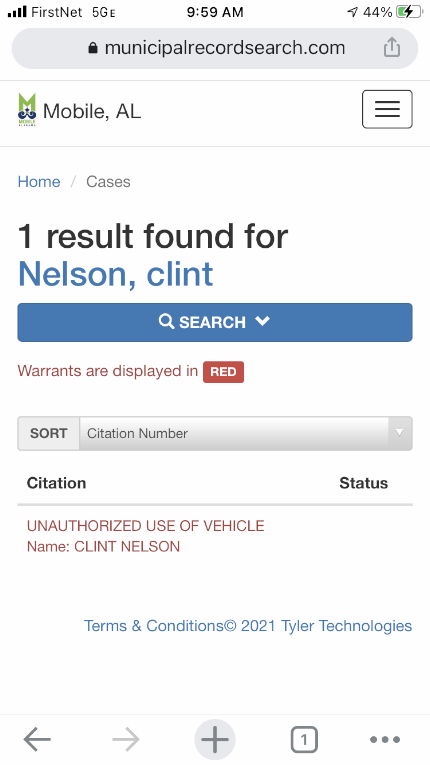
The arrest, recorded in the Mobile County court system under citation number CW2002397, has sent shockwaves through the local community, raising questions about the lengths to which family members will go during contentious separations and the legal boundaries that are crossed when personal grievances collide with judicial mandates. While the charge itself is a Class A misdemeanor under Alabama law, the circumstances surrounding the case paint a complex picture of familial loyalty, property disputes, and the strict enforcement of the rule of law.
The Incident and the Allegations
According to prosecutors and court records, the incident unfolded against the backdrop of a bitter divorce between Nelson’s brother and his partner. During the pendency of the divorce, a status quo order was in place—a standard judicial mechanism designed to preserve marital assets and prevent either party from disposing of or hiding property until a final settlement could be reached. Such orders are a cornerstone of family law in Alabama, intended to maintain the financial status quo and prevent one spouse from gaining an unfair advantage through the dissipation of assets.
Prosecutors allege that Clint Nelson, rather than remaining a neutral bystander, intervened on his brother’s behalf. He is accused of arranging for one of the marital vehicles to be towed from the residence where it was lawfully parked and transporting it to his own backyard, where it was allegedly hidden for several months. This action, prosecutors argue, was a direct violation of the court’s explicit directives and a deliberate attempt to interfere with the divorce proceedings.
The discovery of the vehicle in Nelson’s possession led to his arrest. He was booked into the Mobile County Metro Jail, and his mugshot was processed through the local booking system. The charge, “Unauthorized Use of a Vehicle,” is defined under Alabama Code Section 13A-8-11. The statute states that a person commits the crime of unauthorized use of a vehicle when, “knowing that he does not have the consent of the owner, he takes, operates, exercises control over or otherwise uses a propelled vehicle” . In this case, the “owner” is legally ambiguous due to the marital dispute, but the court’s status quo order effectively rendered any unilateral removal of the vehicle illegal.
The Legal Framework: Unauthorized Use of a Vehicle in Alabama
To understand the gravity of the charge, one must look at how Alabama law treats the unauthorized use of a vehicle. Under Alabama Code § 13A-8-11, unauthorized use of a vehicle is typically classified as a Class A misdemeanor . This classification distinguishes it from grand theft auto or larceny, which involve the intent to permanently deprive the owner of the vehicle. Instead, unauthorized use focuses on the act of taking control of a vehicle without consent, even if the intent is temporary.
While a Class A misdemeanor is the lowest tier of criminal offense in Alabama, it is far from inconsequential. A conviction can result in up to one year in jail and fines of up to $6,000 . For a professional like Clint Nelson, a manager at a prominent national company, even the arrest—let alone a conviction—carries significant professional and reputational risks.
Legal experts note that the statute is designed to cover a broad range of scenarios, from joyriding to disputes over vehicle custody. In the context of a divorce, the “owner” of the vehicle is often the subject of intense litigation. If the vehicle was titled jointly, or if the court had issued a temporary order granting exclusive use to one party, Nelson’s actions would clearly fall outside the bounds of the law. By allegedly taking the vehicle and hiding it, Nelson not only defied the civil court’s authority but also potentially committed a criminal act.
The Divorce Proceedings and the Status Quo Order
The divorce between Nelson’s brother and his partner was not a simple dissolution of marriage; it was a civil dispute that had already drawn the attention of the courts. In Alabama, when a divorce is filed, either party can request a “status quo” order. This order is a temporary injunction that prohibits both parties from “harming, threatening, or destroying or disposing of any marital property” . The purpose is to prevent one party from selling, hiding, or damaging assets before the court can equitably divide them.
Prosecutors allege that Clint Nelson’s decision to tow the vehicle was a deliberate attempt to subvert this order. By hiding the vehicle in his backyard, he effectively removed a marital asset from the reach of the court and the opposing party. This action, according to prosecutors, was not just a civil violation but a criminal one. The distinction is crucial: while violating a divorce court order might result in a contempt of court charge in the civil proceeding, the act of taking the vehicle itself triggered criminal charges under the unauthorized use statute.
The timing of the event is also significant. The vehicle was reportedly hidden for “several months,” meaning that for a substantial period, the opposing party was deprived of the use of a vehicle that was likely rightfully hers, or at least subject to the court’s jurisdiction. This prolonged concealment moves the act from a momentary lapse in judgment to a calculated scheme to deprive the other party of their property.
The Arrest and Booking Process
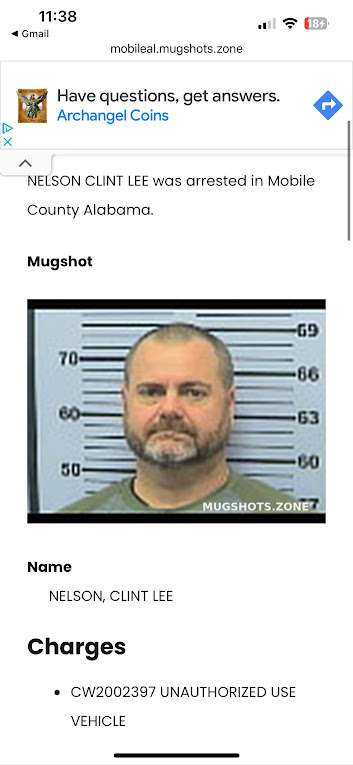
The arrest of Clint Nelson was recorded in the Mobile County booking system, and his mugshot was disseminated through public records websites like Mugshots.zone. The booking information lists his name as “NELSON, CLINT LEE” and provides the citation number CW2002397 for the charge of “UNAUTHORIZED USE VEHICLE.” The mugshot, a stark image showing Nelson with a short, graying beard and a neutral expression, has become a public record of the event.
While the booking details do not specify the exact date of the arrest, the citation number and the charge indicate that the case is proceeding through the Mobile County court system. In Alabama, misdemeanor cases typically begin with an arraignment, where the defendant enters a plea. Following the arraignment, a disposition hearing is usually scheduled, during which the prosecution may offer a settlement or the defendant may request a trial .
For Nelson, the legal process is just beginning. He will need to navigate the criminal justice system while simultaneously facing the fallout from the divorce proceedings, which are likely still ongoing. The fact that his brother’s divorce is still active means that the civil and criminal cases are intertwined, and the outcome of one could influence the other.
The Human Element: Family Loyalty vs. Legal Boundaries
At its core, this case is a story about family loyalty gone awry. Clint Nelson is not accused of stealing a vehicle for personal gain, but of attempting to help his brother in a divorce. This motive, while understandable on a human level, does not excuse the alleged violation of the law. The case serves as a stark reminder that during a divorce, the legal system imposes strict rules on both parties and their associates. Family members who intervene can find themselves facing criminal charges.
The emotional toll of a divorce often leads individuals to take drastic actions. In this instance, the brother’s desire to secure an asset—the vehicle—for himself or to deprive his partner of it, led to a criminal charge for Clint Nelson. The case highlights the dangers of allowing personal animosity to override legal obligations. The court’s status quo order was in place precisely to prevent such unilateral actions, ensuring that the division of property is handled fairly and legally.
Moreover, the involvement of a third party—Clint Nelson—complicates the legal landscape. By allegedly towing the vehicle, he inserted himself into the dispute. If the vehicle was titled solely to the brother, the case might be a civil matter. However, if the vehicle was marital property or titled to the partner, the act becomes a criminal offense. The fact that prosecutors have pursued the charge suggests they believe the evidence supports a criminal violation.
Potential Penalties and Professional Consequences
As a Class A misdemeanor, the charge of unauthorized use of a vehicle carries a maximum penalty of one year in jail and a fine of up to $6,000 . While a jail sentence is not guaranteed, the possibility exists, especially if the court views Nelson’s actions as a willful violation of a court order. Additionally, Nelson could face restitution payments to the victim for the use of the vehicle or any damages incurred during the towing and storage.
Beyond the legal penalties, the professional consequences for Nelson could be severe. As a branch manager for Terminix, a company that prides itself on trust and reliability, a criminal conviction could jeopardize his employment. Companies often have strict policies regarding employees who are charged with crimes, particularly those involving dishonesty or theft. Even if he is acquitted, the publicity surrounding the arrest could damage his reputation in the community.
Terminix, as a national brand, has not released a statement regarding Nelson’s arrest. However, the company’s local branch in Mobile, located on N. University Blvd., is likely aware of the situation. The case serves as a cautionary tale for professionals who might be tempted to use their resources or influence to intervene in personal legal matters.
The Broader Implications for Divorce Proceedings
This case also sheds light on the broader issue of property disputes during divorces. In Alabama, the division of marital property is governed by the principle of “equitable distribution,” which does not necessarily mean a 50/50 split but rather a fair division based on various factors. To prevent one party from gaining an unfair advantage, courts routinely issue status quo orders. Violating these orders can lead to contempt of court charges, which can include fines or even jail time.
However, when a third party—such as a family member—intervenes, the legal consequences can escalate. The unauthorized use of a vehicle charge is a criminal matter, separate from the civil contempt proceedings. This dual-track system means that a person can face both criminal penalties and civil liability for the same act.
For the opposing party in the divorce, the fact that the vehicle was hidden for months likely caused significant inconvenience and financial strain. The vehicle, presumably a necessary asset for transportation, was rendered inaccessible. The court’s intervention, leading to the arrest of Clint Nelson, is a clear message that the judiciary will not tolerate interference with its orders, even from family members.
Conclusion
The arrest of Clint Nelson is a multifaceted story that touches on family dynamics, legal ethics, and the criminal justice system. While the charge of unauthorized use of a vehicle is a misdemeanor, the circumstances—defying a court order to hide a marital asset during a divorce—elevate the seriousness of the offense. As the case moves through the Mobile County courts, it will serve as a reminder that the rule of law applies to everyone, and that personal loyalty cannot justify breaking the law.
For Clint Nelson, the coming months will be a test of his legal resilience and professional standing. For his brother’s divorce proceedings, the incident adds another layer of complexity to an already contentious separation. And for the community of Mobile, Alabama, the case is a stark illustration of how quickly a family dispute can spiral into a criminal matter.
As the legal process unfolds, the key questions will be whether the prosecution can prove that Nelson knowingly took the vehicle without consent, and whether the court will view his actions as a gross deviation from legal norms. Regardless of the outcome, the case has already left an indelible mark on all parties involved, serving as a cautionary tale about the perils of taking the law into one’s own hands.