

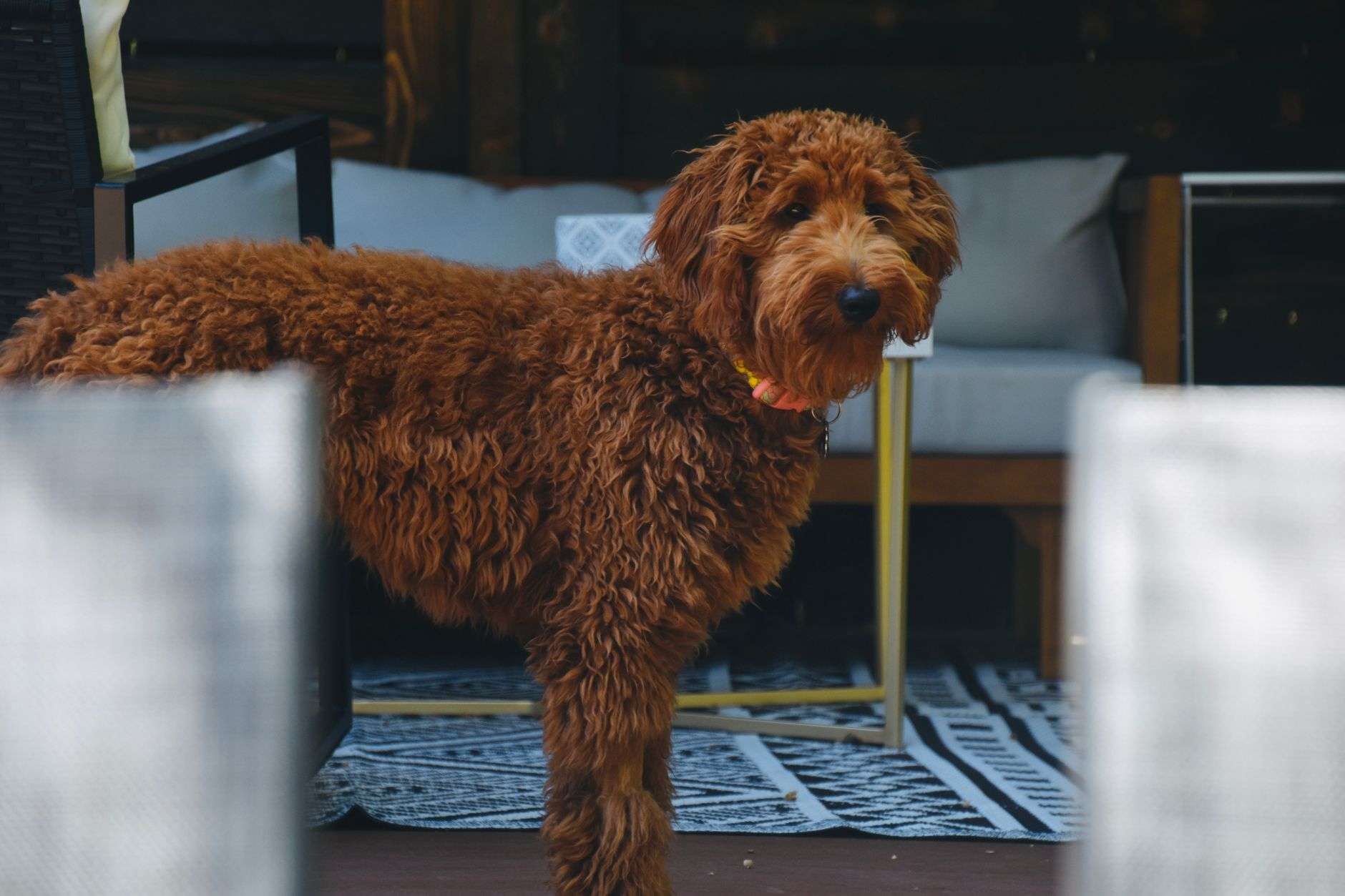
More than a month after her Goldendoodle went missing from her yard, a Mobile woman says a promising microchip alert led not to a reunion, but to weeks of unanswered questions and a legal battle of her own.
The case began as the kind of story every pet owner fears and ended as a tangle of competing accounts, unanswered calls and criminal charges — with a dog at the center of it all still missing. Linnea Tyree’s account of what happened after Olive’s microchip was scanned raises the questions owners ask whenever a microchip fails to do its one job: who is responsible for making the call, and what happens when nobody makes it.
A dog gone from a secured yard
Linnea Tyree says her dog, Olive, disappeared from her yard on May 29. According to Tyree, the dog had been secured to a heavy-duty ground stake he had never previously escaped, and when she discovered he was gone, the entire stake was missing along with him, leading her to believe someone may have removed the dog rather than him breaking free on his own.
The distinction matters both practically and legally. A dog that slips a harness or digs free of a yard is a lost dog; a dog that leaves the premises with its anchor still attached to nothing is a different matter entirely, and Tyree says the missing stake was what convinced her Olive did not leave on his own. The detail has also shaped how she has pursued the search — not as a case of a wandering pet, but as one where a person, somewhere, has him.
The alert that arrived too late to matter
More than a week later, Tyree says she got the notification she had been waiting for. On June 6, Olive’s PetWatch microchip registered a scan during a vaccination clinic at Little Flower Catholic Church. Tyree says the alert reached her phone within minutes of the scan.
“As soon as he was scanned, I got the notification on my phone,” Tyree said. “PetWatch sent me a notification at 10:16 and I called them at 10:18.”
For a family searching for a lost pet, that notification is the moment everything is supposed to change. Microchip registries are built around it: a scan triggers an alert to the owner on file, and the owner’s information gives the person holding the animal a direct path to a reunion. In Tyree’s telling, the system worked exactly as designed for all of two minutes — and then stopped.
Tyree says she immediately contacted Mobile Animal Services, hoping to arrange Olive’s return. She says she was first told staff were working to locate him, then received a follow-up call directing her to the vaccination clinic. By the time she arrived, she says Olive was already gone.
“By the time that I made it there, he was gone,” Tyree said. “They allowed him to leave with the person who brought him… they told me he was going to be allowed to keep him until Monday.”
Instead of a Monday return, Tyree says she was told a different story altogether.
“They told me Olive was not at his house and they were claiming that he had run off again,” Tyree said.
The competing accounts leave the central question unresolved: who had Olive on June 6, and where did he go when he left the clinic? What is not in dispute, according to Tyree, is the sequence — a scan, an alert, a call, a trip to the clinic and a dog that was no longer there. Neither Mobile Animal Services nor the clinic has publicly offered a detailed accounting that reconciles the versions of events.
What the microchip was supposed to do
Tyree believes her contact information should have been available the moment Olive’s microchip was scanned. Microchips are typically registered with a pet owner’s name, phone number, address and email, information intended to allow shelters, clinics and animal control officers to reach an owner quickly.
“My microchip company said… all of my information was available. My name, phone number, address, my email… and they never once tried to contact me,” she said.
Her account describes the failure mode that microchip advocates most fear: not a registry with outdated information, but a scan that never becomes a call. A chip is inert technology — a passive transponder that returns a number when waved over by a reader. Everything that gives the number meaning happens afterward, in the choice of the person holding the scanner to look up the registration and pick up the phone. When that step is skipped, a chip is no better than a collar tag that fell off in the grass.
The system also depends on how organizations handle animals that arrive in someone else’s custody. Shelters and animal control agencies generally scan strays on intake as a matter of policy, and many veterinary clinics scan found animals brought in by the public. Pop-up vaccination clinics, by contrast, exist for preventive care, and scanning is not always a formal part of their workflow — one of the gaps Tyree’s case has exposed for pet owners who assumed it was.
From missing dog to legal trouble
Weeks later, Tyree went to the home of the person she believes last had possession of Olive, hoping to get answers. That confrontation led to legal trouble of her own — court records show she was later charged with harassment and third-degree criminal trespass. Tyree turned herself in on the charges and says the legal fallout has added to the emotional and financial strain of continuing to search for her dog. She has since hired an attorney and started a GoFundMe campaign to help cover legal expenses.
“None of this would’ve happened if they would’ve just scanned this microchip and called me to come pick him up,” she said.
The turn from petitioner to defendant is the part of the story she says she never saw coming. Property disputes over pets occupy awkward ground in the law: animals are legally property, but the emotional stakes — and the speed with which a confrontation can escalate — rarely fit the paperwork. Charges such as harassment and third-degree criminal trespass are typically misdemeanor-level matters, but they carry court costs, attorney fees and records that follow a person, whatever the eventual outcome.
The GoFundMe reflects the accumulating costs of a search that has outlasted the ordinary channels. Legal fees, flyers, gas and time add up for a family pursuing answers through formal channels after informal ones failed, and crowdfunding has become a common recourse for owners caught in exactly this kind of extended dispute.
The search continues
More than a month after Olive disappeared, Tyree says she still has not located him on missing pet pages and believes someone may currently have him.
“I probably only had him for like six months, but I was going through a lot,” she said. “Getting him from the shelter… it made me feel like I had a purpose again… I had a reason to come home… he needed me just as much as I needed him… and now he’s gone. I don’t know if he’s been rehomed or if he’s hurt.”
Her account of adopting Olive from a shelter only months before his disappearance adds a layer to the case’s emotional weight — a rescue dog who had just begun to settle in, an owner who describes the adoption as a turning point in her own life, and a bond of six months severed by a May afternoon. The missing-pet pages she monitors, where owners and finders trade sightings across social media, have become the default search engine for lost pets in the region, but they depend on someone recognizing a dog and reporting it.
“If you see him… let somebody know. I’m not angry. I just want him back,” Tyree said. “I really just want to know what happened.”
What owners should know
Microchipping has become one of the most widely recommended tools for reuniting lost pets with their owners, since collars and tags can fall off or be removed but an implanted chip generally cannot. Veterinarians and animal welfare groups routinely urge pet owners to keep their contact information updated with their chip registry to ensure a scan actually leads back to them.
Chips do have limits owners should understand. They are not GPS trackers and cannot be located remotely; they store only a registration number, and they require a compatible scanner and a cooperative reader. Registration must be kept current — a chip pointing at a former address or disconnected number is a dead end — and many registries charge a small fee for updates. Owners of adopted pets should confirm which registry holds their animal’s chip, since shelters sometimes use systems that differ from a new owner’s assumptions.
The practical lessons from cases like this one are unglamorous but real: photograph a pet from angles that make identification easy, keep registration information current, ask any clinic or organization that scans a found pet to check the registry on the spot, and get a written record of who had the animal and when. If a scan occurs and the finder declines to return the animal, prompt documentation — the scan time, the registry’s records, any communications — matters enormously in any later dispute.
Anyone with information about Olive’s whereabouts is asked to contact Mobile Animal Services or local law enforcement. Tyree’s GoFundMe remains active for those wishing to help with her legal expenses.
For now, the search continues with the same mix of hope and frustration that defines it. Tyree says the questions she asked on June 6 — who has Olive, and why was no one called — have never been answered. Until they are, a Goldendoodle with a registered microchip remains a missing dog, and the system built to bring him home remains, in his owner’s telling, the thing that failed him.