The president of Mobile’s short-term rental owners group agrees with city councilors that the city’s rules for Airbnbs and VRBOs need updating — he just thinks the problem is the rules themselves, not the hosts.
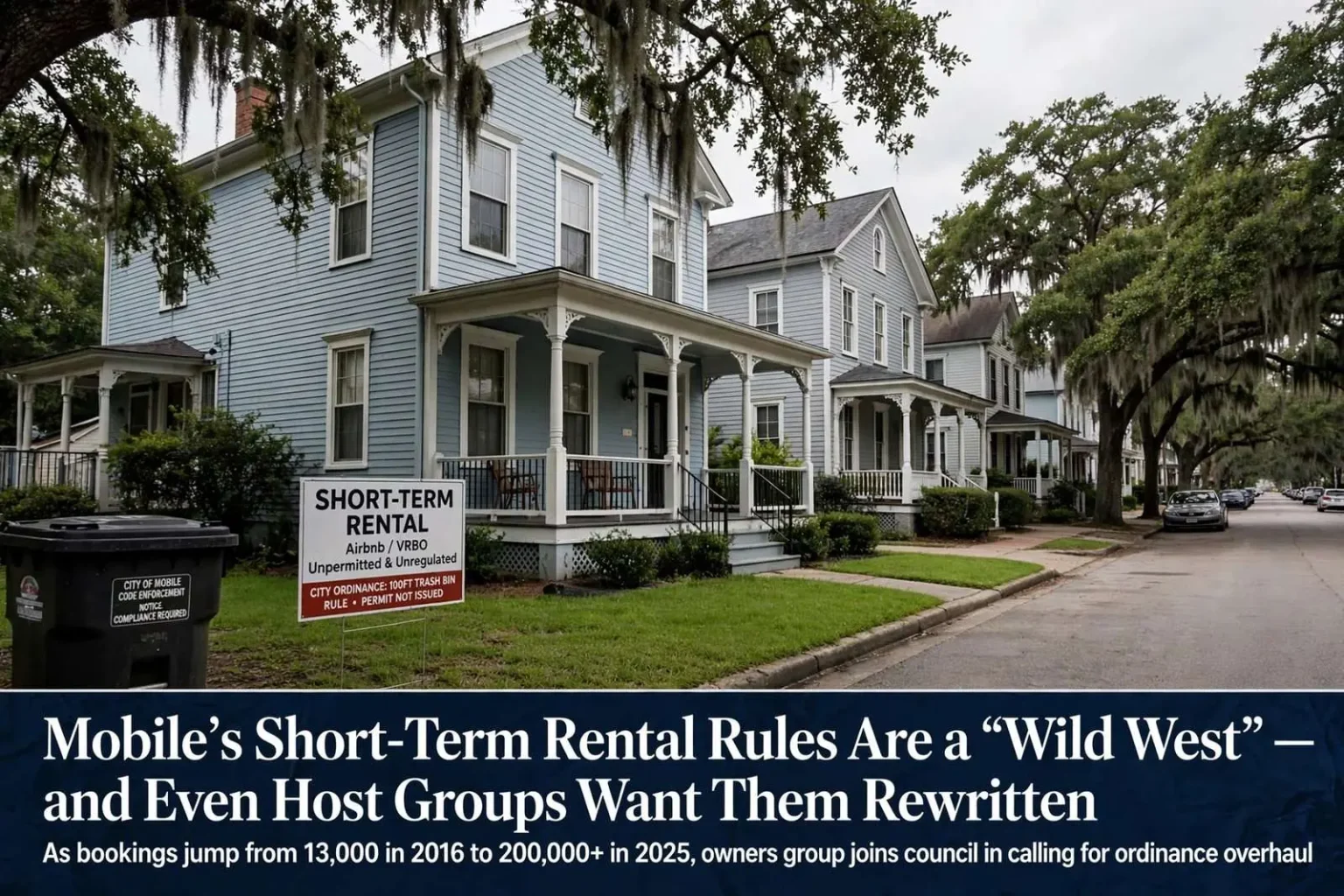
The Mobile City Council decided during a pre-meeting work session on June 30 that the ordinance governing short-term rentals should be updated, after voting to deny a conditional use permit to a rental on Kentucky Street because it did not meet the city’s standards for trash collection. Officials noted that very few property owners hold the permitting required to operate a short-term rental legally, despite an explosion in bookings over the past decade. District 4 Councilman Ben Reynolds described the current scene as the “Wild West.”
Colin Campbell, president of the Mobile Short-Term Rental Alliance, said he shares the council’s view that the ordinance ought to be revised. But in an interview after the work session, he argued the current rules make it nearly impossible for owners to obtain a business license and operate legally in the first place.
Rules that are hard to meet
The ordinance’s strict requirements are the core problem, Campbell said. Under the current rules, a short-term rental’s trash bins cannot be closer than 100 feet to another property or within 20 feet of another property line — a standard that is difficult or impossible to meet on typical city lots. Parking must also be available behind the rental house.
And even after an owner clears every hurdle, the rules still leave discretion with elected officials: Campbell said the City Council can deny a business license application even when a short-term rental meets all the written requirements — which is what happened on Kentucky Street.
He also pushed back on the idea that short-term rentals shortchange the city. It is a “misnomer” that Mobile’s rentals don’t pay local taxes, he said: guests pay local lodging taxes when they book a stay, and property owners pay local taxes on the money they spend maintaining their properties.
Campbell said they are good for the economy and good for the neighborhoods, and that they live here, sleep here, and pay taxes.
Not just tourists
Campbell said short-term rentals serve far more than visiting tourists. In recent months, more than 60 percent of the guests in his own rentals were traveling workers — contractors, nurses and other professionals on temporary assignments — and local families whose homes are under repair also rely on them for temporary housing, he said.
The push to revisit the rules comes as Mobile’s short-term rental market has grown rapidly while the city’s regulatory framework has stayed essentially frozen. Councilors learned during the work session that only a small fraction of operators hold the permits the ordinance requires, leaving the city with little ability to enforce trash, noise or parking standards on the many rentals operating without them.
Optimism at City Hall
Campbell said members of the City Council and Mayor Spiro Cheriogotis’ office have been receptive to suggestions from the alliance, and he is optimistic that a positive change is in the works.
Campbell said the administration is interested in adjusting the rules, making it acceptable for getting a license and driving revenue, as long as there is a central mechanism that can protect neighborhoods and the behaviors of hosts.
Done right, he said, the rewrite could help Mobile’s short-term rental scene grow to the point that the city leads the country in Airbnb “super hosts” per capita — a distinction that would mean more lodging tax revenue flowing into city coffers and more compliant, accountable operators.
The council has not set a timeline for drafting a new ordinance, but the work session consensus signaled that a rewrite is now a legislative priority. Any proposed changes would come back before the council for public hearings before adoption.
How big the gap actually is
Numbers aired during the same work session showed just how far the market has outrun the rules. Visit Mobile President and CEO David Clark said short-term rental bookings in the Port City jumped from 13,000 in 2016 to more than 200,000 by the end of 2025 — the equivalent, he said, of adding eight hotels to the market. There were 550 short-term rentals in Mobile as of last year.
Against that growth, the city’s licensing ledger is nearly empty. Shayla Beaco, the city’s chief of building and planning, told councilors that few property owners have received the business license required to operate a short-term rental — she guessed the total may have been four or five.
An ordinance written before the boom
Council President C.J. Small called the Kentucky Street denial unfortunate but unavoidable under the current ordinance, and said the rules should be revisited so the city can better help people who want to operate short-term rentals legally. District 4 Councilman Ben Reynolds went further, arguing the city has not done a good job of enforcing the rules it adopted in 2022.
Reynolds said it creates a problem where some people keep coming in and doing whatever they want, operating these AirBnBs, and they just let them do it. He added that some folks are going to have to face the harsh reality that they are not going to be able to operate these things in some areas.
City Attorney Ricardo Woods acknowledged the ordinance is behind the times: Airbnbs and VRBOs are relatively new, he said, and the city has to find a new way to deal with them. Beaco said the current enforcement process — a notice, then a ticket or court action if ignored — has not been a good enforcement resolution. Reynolds retorted that no enforcement is certainly not a good enforcement resolution either.
Party houses and the 2022 crackdown
District 7 Council Vice President Gina Gregory recalled why the 2022 rules were written in the first place: complaints from residents about “party houses” and streets packed with parked cars, and many rentals that weren’t paying taxes on the rent they collected. The city contracted with Granicus, a compliance firm, to make sure those taxes are being paid.
Gregory said if they can beef this up, he thinks they need to do it, and asked whether any of them want to live next door to a place like this when it’s a party house.
Unlicensed operators do get a path to compliance — Beaco said owners receive notice and time to come into compliance before the city issues a ticket or goes to court. The council’s consensus: both a better rulebook and actual enforcement are on the way.
Related coverage from South AL News
- Evacuated Beach Visitors Seek Vacation Rental Refunds as Hurricane Isaias Cuts Gulf Shores Trips Short
- Fairhope Revisits Short-Term Rental Ban Amid Rise of Airbnb
- Dauphin Island Considers Restricting Short-Term Rentals to the West End
- Government Plaza Rent Dispute Between Mobile and County Stretches Past One Year